

Foundation Models Are Rewriting Enterprise Tech
Enterprise tech is getting gutted and rebuilt — not by strategy decks, but by code that writes itself. Massively pre-trained systems, such as those behind tools like GPT, Claude, and Gemini, are transforming how large organizations operate from the inside out.
Foundation models are large AI models trained on vast, diverse datasets to perform multiple tasks across domains. They power applications like language translation, image analysis, and content generation with minimal additional training. These models not only answer questions but also provide valuable insights. They summarize documents, write marketing copy, analyze code, auto-fill forms, and adapt in real time — all with a few prompts or API calls. The game is no longer about building narrow tools. It’s about embedding intelligence into the entire ecosystem of operations. This shift reflects a deeper architectural transformation—less about individual tools and more about systems designed to learn, evolve, and scale with minimal human intervention.
Who’s Using Foundation Models — and How?
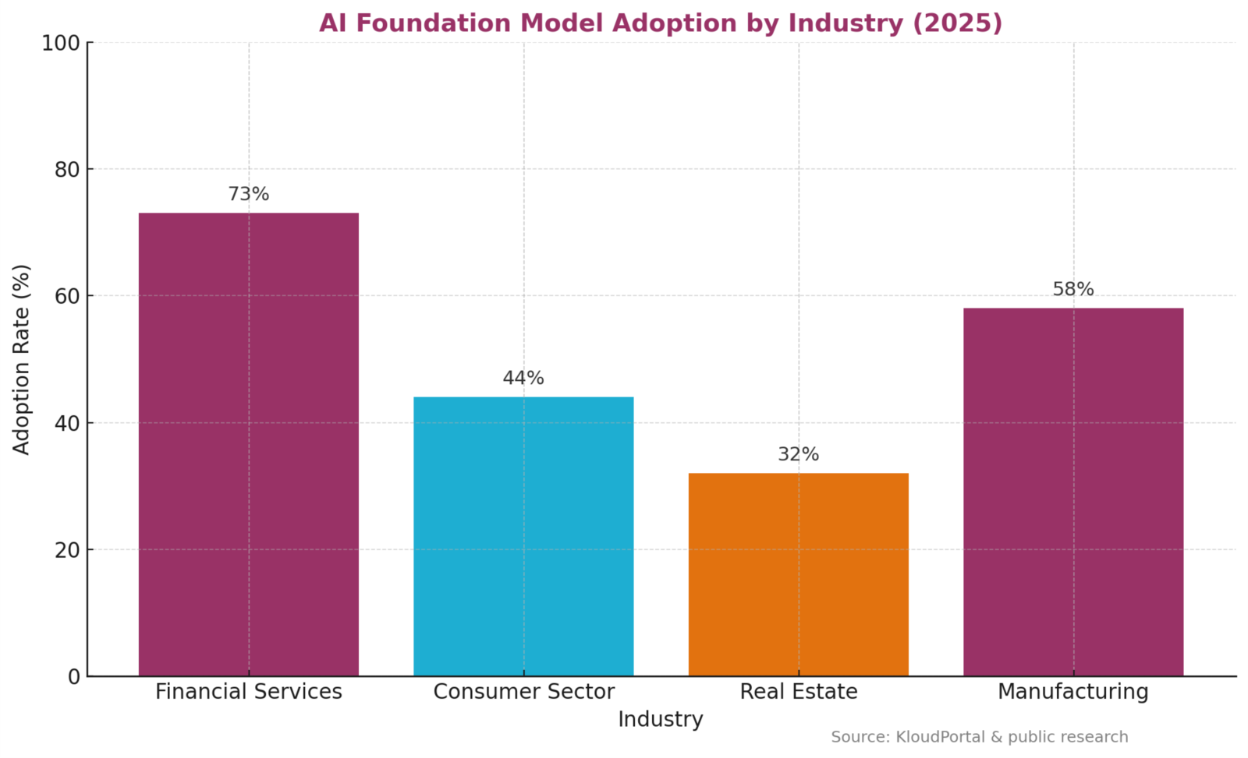
In 2025, the adoption of enterprise AI increased rapidly. Financial services lead the way with a 73% adoption rate, utilizing AI for risk modeling, fraud detection, and automation. The consumer sector is next in line, with 44%, largely focusing on streamlining logistics and distribution. In real estate, 32% of firms now deploy AI for lease automation and predictive valuation, while 58% of manufacturing companies have integrated AI models for quality control and document processing.
The advantage? Faster go-to-market, lower costs, and a product that feels custom-built for the end user.
For example, legal tech startups- by tailoring open models to understand legal language and contract patterns, they help law firms reduce hours of document review to minutes. In retail, smaller players are utilizing tailored models to manage inventory analysis, customer interactions, and demand forecasting with impressive accuracy—all without requiring a massive engineering team.
At the other end of the spectrum, digital-first enterprises and cloud-native companies are going big. They’re embedding foundation models into the core of their platforms, not as a feature—but as the fabric. These companies aren’t just automating tasks—they’re rethinking workflows, from how customer queries are resolved to how reports are generated and how product decisions are made.
What’s striking is that they’re doing this without bloated infrastructure teams. By relying on managed platforms from major cloud providers, they gain computation power, security compliance, and scalability—without running data centers or managing model training cycles. It enables teams to focus on what matters, such as building better experiences and delivering faster outcomes.
From precision healthcare to real-time customer support, foundation models are becoming invisible workhorses—handling repetitive logic, adapting to context, and bridging siloed data into something actionable.
Beyond Integration: Where It’s Going
Forget just using AI. The real frontier is adaptability — how quickly large language models can align with your workflows, data, and users.
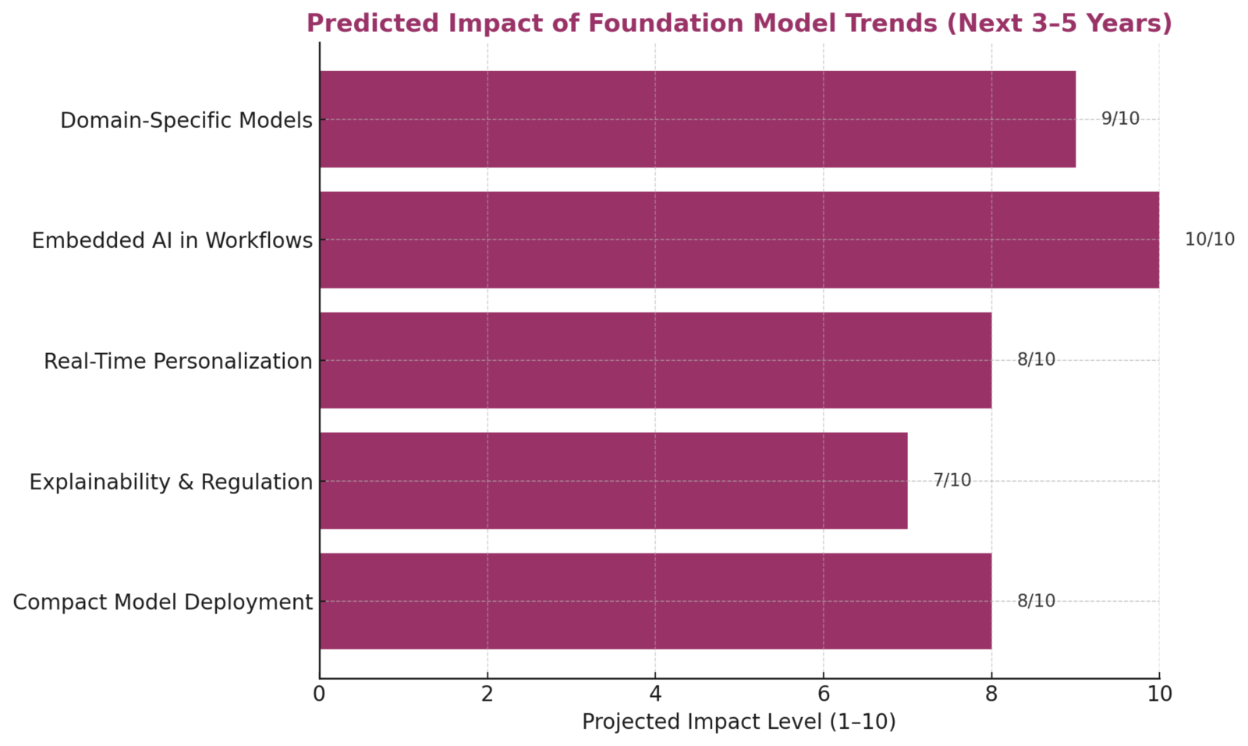
Five Trends Shaping the Future of Enterprise AI:
- Domain-specific foundation models are likely to hold a strong position in pivotal markets such as law and healthcare.
- AI will become invisible infrastructure inside CRMs and ERPs — a quiet revolution in enterprise technology.
- Real-time personalization using generative AI will shift from a trend to an expectation.
- Accountability will become mandatory for compliance, not just a luxury.
- Quantized models will thrive at the edge — unlocking cost-effective AI at scale deployment for on-premises systems.
These shifts signal a future where scalable AI solutions for enterprise applications are no longer optional — they’re embedded into the tech stack.
Why This Isn’t Just Hype — It’s a Tech Stack Shift
Analysts from a16z and Bain agree foundation models are now treated like infrastructure. But let’s dig deeper:
- Enterprises aren’t building software and adding AI later. They’re rebuilding processes around AI.
- The ROI? Fewer tools. Cleaner handoffs. Faster execution.
- Startups customizing models in-house now own a smarter version of their data — and a sharper competitive edge.
The Foundation model isn’t just software evolution; it is the enterprise adoption of AI and foundation models as the foundation of next-generation digital infrastructure.
The Bottom Line
Generative AI isn’t futuristic — it’s foundational. Enterprises that are rapidly adopting AI models — across various business functions — are setting the pace. And those who aren’t adapting quickly? They’re not lagging. They’re already outpaced. Use cases of AI foundation models in enterprises are multiplying fast — and becoming critical differentiators.