

Modern enterprises need platforms that can scale instantly, support advanced analytics, and power AI-driven decisions. A well-designed Snowflake data platform does exactly that, transforming raw data into a strategic asset.
What Makes a Data Platform “Future-Ready”?
A future-ready data platform is designed to manage increasing data volumes, adapt to evolving business needs, and leverage emerging technologies such as real-time data processing, AI/ML inference, and cross-organizational data sharing. It surpasses traditional data warehouses by providing:
01
Seamless Scalability
Scale compute and storage independently, without the need for re-architecting as data volumes grow.
Built-in Governance
Row-level security, column masking, and data lineage out of the box, rather than added on later.
Multi-Cloud Portability
Avoid vendor lock-in by effortlessly running workloads across AWS, Azure, and Google Cloud Platform (GCP).
AI/ML Readiness
Native support for Python, Snowpark, and ML model deployment directly within the warehouse.
Secure Data Sharing
Share live data across teams and partners without moving or copying any files.
Real-Time Capability
Ingest and query streaming data alongside historical data within the same unified platform.
Why Snowflake Is the Ideal Foundation for a Scalable Data Platform
Several credible cloud data platforms are available today, but Snowflake has emerged as the preferred architecture for data-driven enterprises, and the statistics support this.
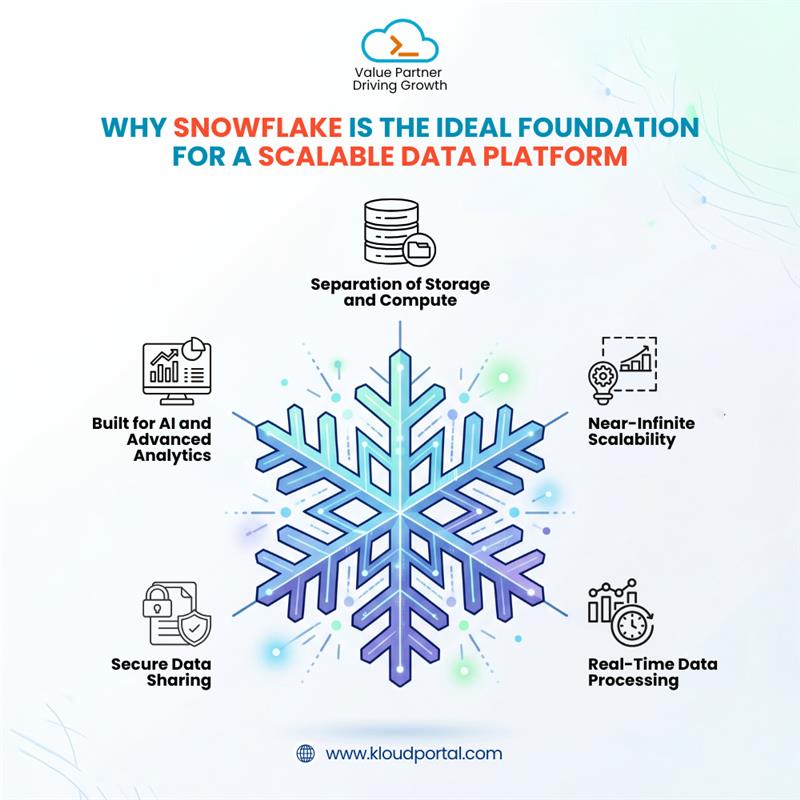
1. Separation of Storage and Compute
Snowflake’s architecture allows independent scaling of storage and compute, ensuring high performance without unnecessary costs.
2. Near-Infinite Scalability
Whether you’re handling gigabytes or petabytes, Snowflake scales effortlessly to meet demand.
3. Real-Time Data Processing
Supports real-time and batch workloads, enabling faster insights and decision-making.
4. Secure Data Sharing
Enables seamless and secure data sharing across teams, partners, and ecosystems.
5. Built for AI and Advanced Analytics
Snowflake integrates easily with AI/ML tools, making it a strong foundation for future-ready enterprises.
KloudPortal Insight: Organizations that consolidate their analytics, data sharing, and ML workloads on a single platform like Snowflake typically reduce integration maintenance time by over 35% in the first year alone.
Key Components of a Modern Snowflake Data Architecture
To build a future-ready platform, you need more than just a tool; you need a well-defined architecture.
1. Data Ingestion Layer
- Tools like Snowpipe, APIs, or ETL pipelines
- Supports structured and unstructured data
2. Data Storage Layer
- Centralized data lake or warehouse within Snowflake
- Handles massive volumes efficiently
3. Data Processing Layer
- Transform data using SQL, ELT pipelines
- Enable real-time and batch processing
4. Analytics & BI Layer
- Integrate with tools like Power BI, Tableau
- Enable dashboards and reporting
5. Governance & Security
- Role-based access control
- Data encryption and compliance
Step-by-Step: Building Your Future-Ready Snowflake Data Platform
Architecture decisions made early define your ceiling for years to come. Follow this sequence to avoid the most expensive mistakes.
01
Define Business Objectives
Start with clarity. Identify key use cases such as
- Customer analytics
- Operational insights
- Predictive analytics
02
Design Scalable Architecture
Build a flexible architecture that supports
- Multi-cloud environments
- Data lakes + warehousing
- Real-time analytics
03
Implement Data Pipelines
Set up automated pipelines for
- Data ingestion
- Transformation
- Validation
04
Optimize Performance
Leverage Snowflake features like
- Auto-scaling warehouses
- Query optimization
- Caching
05
Enable Data Governance
Ensure
- Data quality
- Compliance (GDPR, etc.)
- Secure access controls
06
Integrate AI & Advanced Analytics
Prepare your platform for
- Machine learning models
- Predictive analytics
- AI-driven insights
Business Benefits of a Snowflake-Powered Data Platform
Beyond the headline numbers, the tangible business outcomes from a mature Snowflake data platform include:
- Faster time-to-insight — queries that took hours run in seconds; reports that needed IT tickets become self-service
- Lower infrastructure costs — pay only for the compute you use, with automatic suspension when idle
- AI and ML acceleration — clean, governed data feeds ML models directly, cutting data preparation time by 40–60%
- Reduced data debt — a documented, tested dbt layer eliminates the “only Dave knows what this table means” problem
- Regulatory confidence — built-in governance means audit requests become a query, not a scramble
- Cross-functional alignment — finance, marketing, operations, and product all work from the same numbers
Common Pitfalls to Avoid
- Migrating before architecting
- Skipping governance
- Under-investing in data quality
- Treating it as a one-time project
- Ignoring change management
Why KloudPortal for Your Data Transformation Journey
Building a future-ready data platform isn’t just about technology; it’s about execution. At KloudPortal, we help enterprises:
- Design scalable Snowflake architectures
- Build robust data pipelines
- Enable AI-driven analytics
- Ensure governance and performance optimization
Our approach focuses on aligning data strategy with business outcomes, so your platform delivers measurable impact, not just infrastructure.
Conclusion
A future-ready data platform using Snowflake empowers organizations to move faster, scale smarter, and innovate continuously. The question is execution, and that’s right partner makes all the difference.
Ready to turn your data into a competitive advantage?
KloudPortal partners with enterprises to design, build, and optimize Snowflake data platforms that deliver real business impact. Connect with us and take the first step.