
The urgency of this shift is evident. According to Gartner, by 2026, organizations will discard 60% of AI projects that do not have AI-ready data. Achieving that readiness begins with having clean, governed, and traceable metadata integrated into data pipelines from the start, rather than attempting to add it later.
The teams winning with data aren’t the ones with the most pipelines — they’re the ones whose pipelines know how to run themselves.
What Makes a Pipeline “Metadata-Driven”?
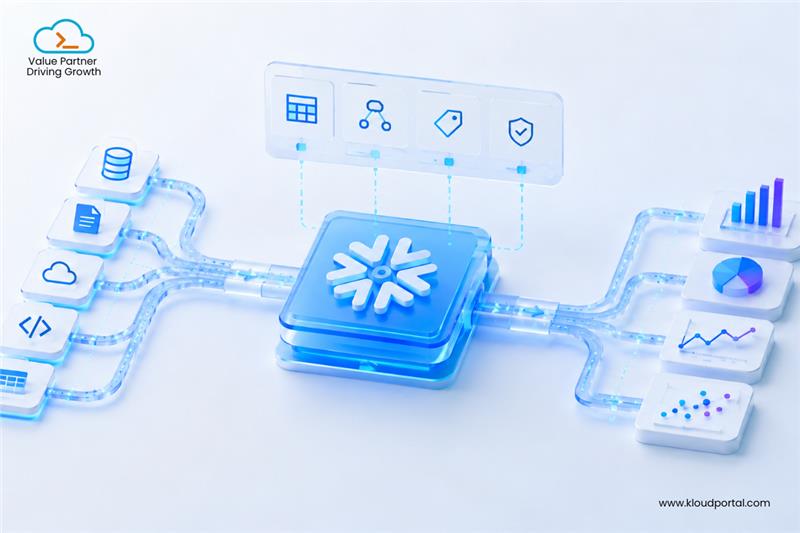
Metadata-native engineering refers to architectures in which pipeline behavior, governance, lineage, and orchestration are driven by centralized metadata rather than hardcoded procedural logic.
In a metadata-driven pipeline, operational behavior is externalized into configuration instead of embedded directly in code. Source mappings, transformation rules, load strategies, validation checks, and SLA parameters are maintained in control tables or metadata repositories. Generic pipeline frameworks interpret this metadata at runtime and execute accordingly.
The result is a highly scalable architecture where a single codebase can support dozens of pipeline variations. Adding a new data source often requires only a metadata configuration update rather than developing, testing, and deploying new pipeline code.
64%
YoY growth in daily jobs run on Snowflake’s Data Cloud, outpacing customer growth.
— Snowflake Data Trends Report
What’s New in Snowflake: The Metadata-Native Stack
Snowflake has taken significant steps to make metadata-native engineering the default option rather than just an advanced feature.
| Snowflake Capability | Role in Metadata Pipelines | Business Benefit |
|---|---|---|
| Horizon Catalog | Federated lineage & governance | Single source of data truth |
| OpenFlow | Visual metadata-controlled ingestion | 200+ connectors, rapid onboarding |
| DCM Projects | Declarative pipeline-as-code management | Git-style deploys, full auditability |
| Dynamic Tables | Continuous, declarative data freshness | Replace complex task orchestration |
| Snowflake Trail | Pipeline telemetry & observability | Proactive issue detection, audit trail |
| Cortex Code (AI) | AI-assisted pipeline code generation | Faster builds, fewer manual errors |
How KloudPortal Accelerates Metadata-Driven Snowflake Adoption
Understanding Snowflake’s capabilities is one thing. Operationalizing them across complex enterprise environments with legacy systems, governance needs, and skill gaps is another. That’s where KloudPortal comes in.
As a premier data engineering consulting partner KloudPortal helps enterprises transition from brittle, hand-coded ETL pipelines to scalable, metadata-driven architectures on Snowflake faster and with lower risk.
Data Engineering & Architecture
Designing scalable metadata-driven Snowflake architectures using control tables, Snowpark-based loaders, and automated multi-environment deployment frameworks.
AI/ML & MLOps Enablement
Integrating Snowflake Horizon Catalog and Cortex AI into governed MLOps workflows for secure, lineage-aware feature management.
Data Quality & Governance
Embedding validation, lineage, and governance directly into Snowflake pipelines to deliver trusted, AI-ready enterprise data.
Enterprise AI Acceleration
Enabling faster analytics and AI adoption with clean, traceable, metadata-driven data foundations built on Snowflake.
Key Benefits at a Glance
- Scalability without code sprawl — One reusable framework supports multiple pipeline variations without repetitive coding
- Faster source onboarding — Add or modify metadata to launch new data sources in days instead of weeks
- Self-documenting pipelines — Business logic and configurations remain centralized, auditable, and always up to date
- Built-in lineage and governance — Traceability, auditability, and compliance are embedded directly into pipeline execution
- AI-readiness by design — Metadata-driven architectures deliver the governed, high-quality data modern AI initiatives require.
- Lower operational risk & MTTR — Real-time telemetry and monitoring help identify and resolve issues before downstream impact occurs
5 Steps to Your First Metadata-Driven Pipeline
You don’t need to rebuild everything at once. Start small, prove value, then expand:
- Define your metadata schema — create control tables capturing source systems, targets, load strategies, primary keys, and transformation rules.
- Write one generic loader — use Snowpark to query the control table, build SQL dynamically, and execute. One procedure, many pipelines.
- Orchestrate with Dynamic Tables & Tasks — use Dynamic Tables for continuous freshness and Tasks for scheduled metadata-controlled triggers.
- Version and deploy with DCM Projects — declare your pipeline objects as code, preview changes with PLAN, promote across dev/staging/prod reliably.
- Connect Horizon Catalog — assign ownership, enable lineage, and give every team member a trusted and searchable enterprise data catalog.
Conclusion
The data leaders will be defined not by larger engineering teams, but by smarter, metadata-driven infrastructure. With capabilities like Dynamic Tables, OpenFlow, Horizon Catalog, Cortex AI, and Snowpark, Snowflake provides a strong foundation for scalable, governed, and AI-ready data operations.
The real opportunity lies in transforming those capabilities into measurable enterprise outcomes.
KloudPortal helps organizations accelerate Snowflake adoption through metadata-driven architectures, governance, and AI-ready data engineering at scale.