
8 reasons why customer support is your most valuable business factor

8 reasons why customer support is your most valuable business factor

Customer Service is not as simple as it sounds, but it is a vital component of your business operations that affect your business development and your company’s online worldwide presence. Knowing the rock-solid importance of your customer service is crucial because it will bring more value to your company.

Your knowledge of customer service shows you who you are, and why you do this business. The way consumers are handled is the principal sign that shows us how we need to look at issues. So, let ‘s look at the reasons why good customer service to an organization is critical and most valuable.

Customer support

1. Retaining customers is far less expensive than acquiring customers:

Attracting a new customer to your company on average, costs about five times more than maintaining a current customer. This logic alone would force you to reinforce the value of providing outstanding customer service. Should you risk losing a client? In the first place, it’s expensive enough to find new clients, and every company will do whatever it takes to make sure they stay satisfied and keep doing company with them.

2. Best customer service helps you build confidence:

Loyalty is both your rarest asset in e-commerce and the main determinant of the sustainability of your e-commerce. If you can produce loyal customers consistently, then you have a competitive advantage for yourself. The market is full of rivals and if your customer service fails by some parameters, online shoppers don’t need to travel far to visit one of the thousands of other rival stores in your area. To keep your customers and create confidence, e-commerce brands need to work harder than any other company. Online shoppers are just too quick to abandon without having to have any clarification, so provide the best customer service to build confidence among them.

3. customer support can make or break the reputation of your brand:

Your customer support can make or break the reputation of your brand. Since the advent of social media, dissatisfied online shoppers will quickly publish their frustration for their followers to see. Stakes are higher than ever-and one wrong move from your part can turn the brand into a tragedy in public relations. If your customer service does not meet standards, your company will cop some negative feedback on any number of social media platforms online.

4. Utilize your customer service as the basis for your marketing scheme:

Customer service for your e-commerce shop can be a competitive advantage. You need to trust in the ability of your team to back up your claims-build your marketing messages around the customer friendliness of your brand. You can make your customer service stand out through your promotional content to help persuade potential customers to go shopping with you. Make sure you ask customers for testimonials and product reviews after they purchase from your online store. Use these prompts in your automation email series after purchase and add it as an opportunity to help you produce more responses.

5. It increases the turnover of employees in your company:

Employees pay particular attention to how your company handles its customers and it resonates strongly with them. When you see an employer treating your customers like gold, it gives them a sense of endowment, making them proud to be part of the team and making them more willing to stick around. On the other hand, when your workers are motivated to cheat and deceive consumers for some reason, they do just the opposite.

6. Good customer support opens doors to new alliances and possibilities:

It’s effective to treat your clients like money as it opens the doors to new collaborations, particularly when other organizations see how much you care about your current clients. This says a lot about your organization and what you value when your customers are profoundly concerned. This is something you rarely see these days in the industry, but it definitely paves the way for successful alliances, collaborations, and other opportunities.

7. Customer service enables you to fulfill the ultimate aim of e-commerce – customer satisfaction:

Customer satisfaction is now the stakes of the e-commerce table. You need to exceed expectations to convert customers into sales growth. When a personal link with your mark is created, loyal e-commerce customers are formed. This is why your e-commerce companies now have to fulfill the reasonable and emotional needs of their consumers. Through an efficient customer service desk can you consistently create truly memorable experiences. When consumers are worried about price tags, most of the online shoppers are willing to pay a premium for the products they care about. Therefore, customer service enables you to fulfill the ultimate aim of e-commerce – customer satisfaction.

8. IT conveys clear moral principles and values for the objectives of the organization:

Caring about your clients conveys a clear collection of moral principles and beliefs in the mission of the organization. It means that by concentrating on building their group it transcends the need for money. It also means greater powers are at work here than pure income. It is symbolic of a deeper desire to create something of worth, to support others, and by doing so to somehow or other, change the world a little bit.

Conclusion:

The market today is highly competitive, and your organization needs to do everything in its power to remain on the top. It’s literally about survival, and your company has to adapt to the industry’s changes and continuously do better to survive and succeed. Consumers may not always be correct, but for you to survive in this industry, profits are needed and it can only be earned if the customer service value is understood. To know more about the importance of customer service, drop an e-mail to contactus@kloudportal.com

66,576 Customer Service Enquiries handled in last 11 months.
 

How to Perfect the Customer Service of Your Ecommerce Business

How to Perfect the Customer Service of Your Ecommerce Business

Customer support in e-commerce refers to the services you offer to online shoppers. If visitors have questions or need help with making a purchase, these features will help them navigate your site and attain their objectives. Customer Service in e-commerce allows representatives to meet customers whenever and wherever they want to make the support process go smoothly and efficiently.

The customer service business strategy in e-commerce is significantly different from brick-and-mortar environments. Since reps can only call or talk, you need to predict roadblocks that users will face during the buying process. It requires you to consistently get feedback from the customer and analyze it for common user pain points.

If you’re trying to boost the service in your online store, take a look at the next segment for some of the best e-commerce customer service practices we have gathered.

Best practices in e-commerce customer service:

It can be difficult for many businesses to provide outstanding customer service in an e-commerce environment. That’s because when you’re not interacting face-to-face, it can be hard to engage with them. The tips in this section can help you overcome those obstacles for the customer service of your e-commerce business and delight your online store visitors.

E-Commerce Customer Service

1. Use social media for customer service:

When providing Customer service, use social media with pace and effectiveness as it is the customer’s primary priority and also since social media is a valuable tool and acts as a platform for customer support in e-commerce and business. Customers may use social media to report issues or pose questions that will alert the support team immediately.

Your representatives can then address the issue and reach out to all of your customers and update them at once. This omnichannel experience makes it easier for online shoppers to get in contact with your customer service team rather than funneling inquiries through one communication channel.

2. Providing proactive assistance for customers:

It is necessary to provide proactive assistance in customer service for e-commerce. When customers surf through your e-commerce website, they may not be aware of your support and service features. They might have questions but have no idea where to ask. And, they can conclude that contacting help is too much work and go on to a competitor. Even if your site offers service features, the proactive sharing of them with your customer base is vital.

By creating CTA’s on your website, you can implement proactive customer service. Make it clear where users can file inquiries about help and include FAQs on what they should expect from your service team. If you have a live chatbot, create a pop-up message that draws the attention of your visitor to the chat widget. It will allow visitors to take advantage of your service features that build opportunities to connect and delight clients.

3. Focus on your average response time:

Consumers prefer shopping online, as it is efficient and convenient. They can conveniently compare product prices and order products right at their front doorstep. When customers have questions, though, they expect that inquiries will be acknowledged effortlessly. When they come to your site for a quick purchase, they don’t want to wait for the answers. Therefore, when working with e-commerce customers, it is crucial to focus on average response times.

When visitors reach out, representatives should answer in seconds. Tools such as live chat and chatbots will boost your average response time and streamline the user’s support process. Customers are less likely to get distracted and navigate away from your site by reducing the time it takes for them to get an answer. Therefore, in e-commerce, it is very crucial to focus on your average response time for better customer service business.

4. Include self-service solutions for the customers:

In customer service for e-commerce, another efficient way of delivering answers to customers is by using self-service apps of the customers. They are resources that consumers use to find solutions to their issues without a service rep. In this way, it will save them time from having to open a formal enquiry when consumers have simple or easy questions.

Self-service is one example of a knowledge base. A knowledgebase is a portion of the website containing documents relating to service and support. These resources discuss common roadblocks for customers that users experience every day. Before reaching your service team, customers can review those references.

5. Provide a phone support line to customers:

Most customers don’t have the patience to take advantage of online support services. Speed and efficiency are crucial in e-commerce settings, and consumers who aren’t tech-savvy aren’t interested in looking for answers to your web. When necessary, offer phone help, and give specific users a direct line to the service team.

Even if you don’t have a call center software or a designated phone team, it can dramatically improve the customer experience by having a direct channel to create a live interaction. For efficiency, it is necessary to provide a phone support line in the customer service business.

 Customer Service

Conclusion:

In customer service for e-commerce, your customer service quality has a tremendous impact on the performance of your business. Therefore, developing a plan to ensure customers have a smooth experience with you is vital. Customer care has a firm connection with the overall experience of the customer. It has a mouth impact phrase, which is vastly essential for e-commerce business. To learn more about how to perfect the Customer Service of your e-commerce business, drop an e-mail to contactus@kloudportal.com

The State of E-Commerce Customer Service in 2020

The State of E-Commerce Customer Service in 2020

The potential is enormous:

In customer service, customer service for e-commerce, and customer service for business the potential is enormous. As more customers become comfortable online shopping and more retailers expand their online stores, the opportunities for sales will only continue to grow. But challenges surface with all that growth. The market is not restricted to your local population anymore.

Customers can buy from any business they want – even if they’re halfway around the world. That means e-commerce enterprises have to compete in a much larger market. The primary way to do this is to offer an amazing experience in customer service that drives referrals and keeps customers coming back for more.

You need to stay on top of coming trends to do that. The difference between beating your competitors and falling behind the times can be knowing how to put innovation to work for you. In customer service, customer service for e-commerce, and customer service for business, here are three major trends for 2020 to consider.

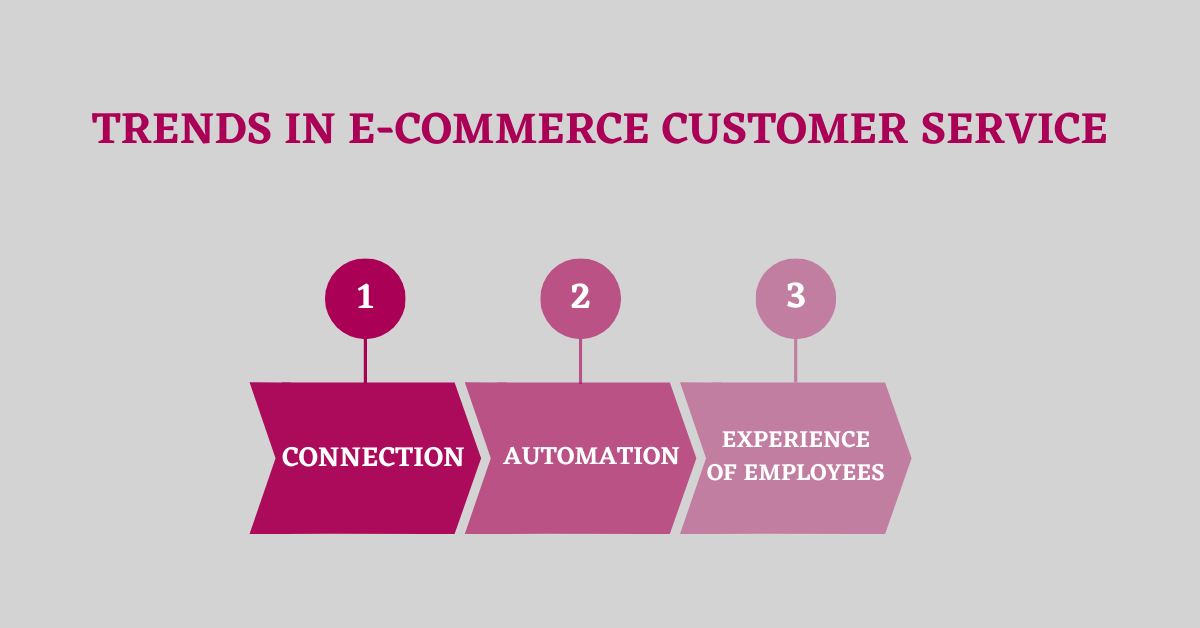
Trends in e-commerce customer service

Trends in E-Commerce customer service

1. Connection:

In customer service, customer service for e-commerce, and customer service for business connection plays a vital role. Customer service in e-commerce must rise to the occasion by 2020. If marketing should offer an omnichannel experience that attracts consumers, then customer service also needs to be able to serve customers through all channels and, with more touchpoints, it becomes harder to link all of those data sources and have a consistently great experience.

2. Automation:

Automation also plays a major role in customer service, customer service for e-commerce, and customer service for business. Online retailers are under tremendous pressure to offer customer service of world-class. Great service means prompt service for most customers. A team of human agents would be almost impossible to consistently deliver an accurate response to every question in less than 10 minutes. Fortunately, automation offers the ability of customer support teams to manage vast amounts of requests in a very short time. By automating the workflow two of the most repetitive types of retail questions (order updates and returns) can be addressed both. While speed is important, a good overall experience also needs to result in automation.

The combination of artificial intelligence and automation can help to make the experience more personalized and efficient. The majority of retailers plan to implement AI in their daily retail operations within the next three years, so you can rest assured that automation and AI will be a big player in 2020 of customer service, customer service for e-commerce, and customer service for business.

3. Experience of employees:

The final and most important aspect of customer service, customer service for e-commerce, and customer service for business is the experience of employees. Your customer service agents are the face of your business when your clients need help. So, you treat them better. A shocking 90% of customers state their experience is influenced by the mood of the agent. When you avoid thinking about your customer service agents as entry-level robots and inspire them to do excellent work, your customers will experience more.

It’s really fantastic news in several respects. If you can recruit anywhere, that means you have a bigger pool of talent to draw from. This gives businesses more access to unique competencies (including language skills) and time zone coverage. But it brings new challenges, too. A team of remote agents can be difficult to manage, empower, and develop.

Agents will have much more freedom in 2020 both in the workplace and also in their abilities but they will be held to a consistently high standard. As businesses continue to compete to give the best customer experience, the agent experience will improve as well.

Conclusion:

In customer service, customer service for e-commerce, and customer service for business the state of e-commerce customer service is constantly evolving. As companies learn to adapt to the expectations of their customers, implement innovative new technology, and cater to a new kind of workforce, the quality of service will continue to improve. In 2020, it’s critical for customer service retail e-commerce teams to seriously reassess their workflows and see if they can make it simpler for themselves and their customers. To learn more about the state of E-commerce in 2020, drop an e-mail to contactus@kloudportal.com


Nobody counts the number of ads you run; they just remember the impression you make.
 

5 ways to deliver excellent customer service

5 ways to deliver excellent customer service

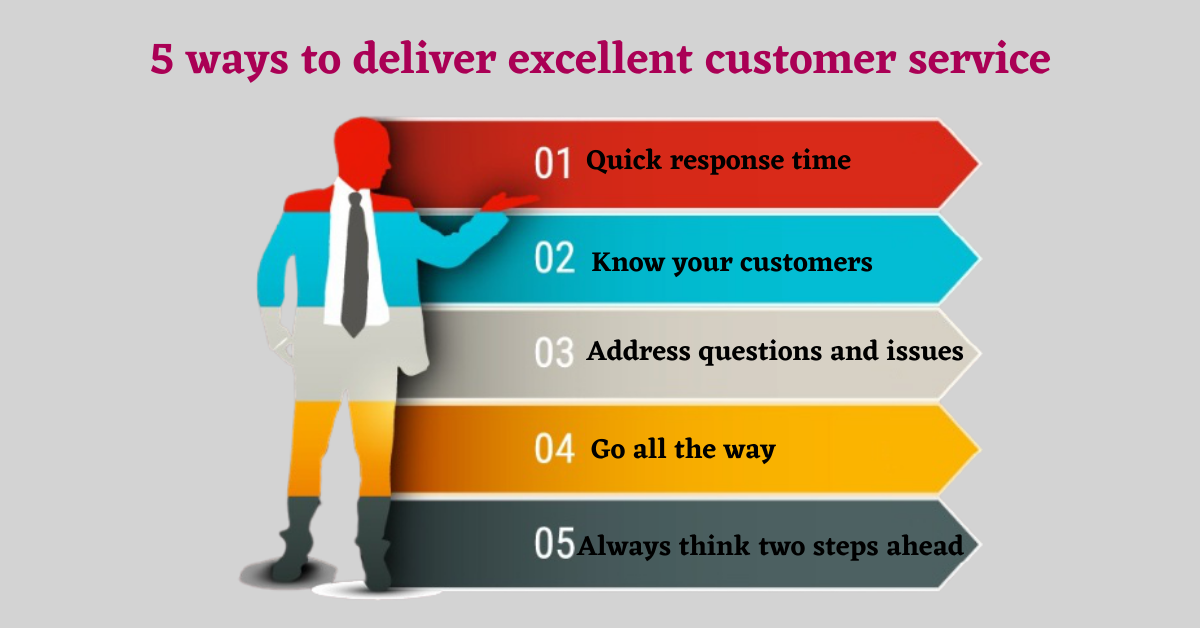
In customer service, customer service for e-commerce, and customer service for business delivering excellent customer service is a necessity. As people’s expectations for the quality of customer service continue to grow, some organizations find it somewhat difficult to keep up and ensure that they stay on top of their customers ‘ demands. There are a few things that can usually be done to fix most problems that seem to occur in this field, and if you are having difficulties, it’s a good idea to familiarize yourself with them. Here are 5 ways to deliver excellent customer service.

5 ways to deliver

1. Quick response time:

Quick response time is one of the basic aspects of customer service, customer service for e-commerce, and customer service for business. Customers appreciate service providers who value their time and treat them properly, and when you want to leave a good impression, it is imperative to address every issue that comes up with your clients as quickly as you can. However, you do want to make sure you don’t sacrifice the actual quality of your service because this is a common mistake found in such cases.

2. Know your customers:

One of the important attributes of customer service, customer service for e-commerce, and customer service for business is knowing your consumer. Understand exactly what your audience is looking for, and try to make that happen. Far too often, corporations end up spending massive quantities of money on information about which no one cares. If you don’t want to waste the resources of your company, one of the best ways to do that is to just figure out exactly what your customers expect and focus on at every step of the way.

3. Address questions and issues:

Addressing questions and issues is vital in customer service, customer service for e-commerce, and customer service for business. Problems tend to pile up in any organization if left unaddressed, and this is even more true when it comes to customer service. You would want to make sure that you are still on top of any problem that happens earlier rather than later and, if possible, take some proactive steps in the first place to reduce the risk of recurrence of such problems.

4. Go all the way:

You need to go all the way in customer service, customer service for e-commerce, and customer service for business. It’s not enough to do well – you have to make sure you give your customers all you can and that’s not as easy as it sounds if you’re not prepared to work through some really difficult circumstances. You’ll have to understand each situation in an intricate way, and know when it’s appropriate to push even more forward rather than being satisfied with a state of mediocrity.

5. Always think two steps ahead:

In customer service, customer service for e-commerce, and customer service for business you need to always think two steps ahead. There are different ways to prevent long-term issues from occurring as long as you think ahead and consider all this as one big game of chess. Remember, customers are your most valuable long-term asset, and you have to make sure you pay attention to their needs and properly nurture them. Sometimes this may mean going out of your way to do something you were not planning to do until much later, but if it ultimately results in a satisfied customer, that’s all that matters.

Conclusion:

All these components combine to create excellent customer service. It’s a service that keeps your customers loyal to you and your company, and you’ll gain a reputation for assistance and even a pleasure for them to work with. Customers deserve to be handled as humans, not a number in a queue for tickets. Humanize them, and humanize yourself for a future driven by customer service. To know more ways to deliver excellent customer service, drop an e-mail to contactus@kloudportal.com

quote-5 ways to deliver excellent customer service
6 key elements of using social media for customer service

6 key elements of using social media for customer service

People use social media to connect with businesses in today’s digital world. And they expect companies to be on the social side to provide help when they need it. Using social media to help your consumers is different from using the same social marketing tools. Customer service, customer service for e-commerce, and customer service for business. in social media can help strengthen relationships and maintain the credibility of your brand.

People want the brands they interact with to offer social customer support and the whole point of providing customer service is to keep customers happy. The following are 6 key elements of using social media for customer service, customer service for e-commerce, and customer service for business.

6 key elements of using social media for customer service

1. Respond quickly on social media:

Most customer service forms are not usually supposed to be available 24/7 via phone and email. But customer service from social media has generated an “always-on” assumption. That means the best social media customer service approach is to respond to inquiries, feedback, and complaints as quickly as possible. Timely answers are compensated on social media customer service enquiries.

Social media response times are definitely an important factor for a customer service campaign to concentrate on and participate in. It can not only strengthen a customer relationship but can also boost sales in the right context! Replying as quickly as possible is an important aspect of customer service, customer service for e-commerce, and customer service for business.

2. Know which public or private socia media posts to solve:

Develop a strategy to provide clear direction for your business on how to handle customer service via social media. Guidelines are important to monitor and follow since consistency can only reinforce your overall brand construction. Identify which conversations should become private — whether moving to direct mail, email, or telephone.

In every company, this method looks different but follows a general structure. In the case of direct messages involving analysis, respond immediately to let the sender know the message was received and a response is coming soon. In customer service, customer service for e-commerce, and customer service for business knowing which public or private social media posts to sole plays a vital role.

3. Reply to all feedback, questions and comments on social media:

Every question on social media requires updates, analysis, and check-in. It is one of the main best practices in social media customer care. A consumer just needs to be heard! Since there are so many comments that the public can view, businesses have an incentive to be attentive to everyone via social media. Just like no business in its store will neglect a customer, no business would leave a message unattended online! Reply to all feedback, questions, and comments on social media for effective communication in customer service, customer service for e-commerce, and customer service for business.

4. Include a greeting with names or initials, and be transparent:

In customer service, customer service for e-commerce, and customer service for business always Include a greeting with names or initials and be transparent. If a name is obvious from the social profile of your customer, please do not hesitate to use it with a greeting. It helps the customer feel noticed by an actual person and also allows the business to see who replied if a disagreement occurs.

This creates reckoning on both sides of the coin. These are easy things to include which considerably soften a response. Giving your name to a customer immediately humanizes the brand. It gives them someone to talk to directly if they are interested in continuing the discussion.

5. Fight negativity with social media positivity:

When you post a negative message, companies can be inclined to defend themselves. In customer service, customer service for e-commerce, and customer service for business positivity always meets negativity. When a customer complains in the store, maybe three additional customers could overhear. When a customer complains on social media, it could potentially be seen by every single customer in their news feed! Remaining positive also helps your loyal customers get support.

Brainstorming positive responses can be a crucial piece of your social media customer service strategy, depending on how likely your business is to be on the receiving end of social media negativity. The most important thing is to show you the customer’s opinion, care, and gratitude, no matter if it started negative. It goes a long way to show empathy in your comments by using social media for customer service.

6. Use social media to monitor customer service with a tool:

In customer service, customer service for e-commerce, and customer service for business use social media to monitor customer service with a tool. The incoming customer service moderator through social media should be given the same training traditional representatives receive, and a tool to assist their process. This holds true, no matter if you are a company with a new presence in social media or, a company that has long owned social media accounts and is using social media for customer service purposes only now.

Customer service social media training is often included as part of the price of an online tool or software. Use that to your advantage! Because social media is never “closing,” tools can notify you with a text or an app — even if your business is off hours.

Conclusion:

Social media plays a big part in the success of brand loyalty and activism in customer service, customer service for e-commerce, and customer service for business. Using social media for customer support will take the digital group to the next stage, with the right planning and listening tool. Be prepared to use your social media platforms to support clients by incorporating the six key elements provided here. To avail more info, drop an e-mail to contactus@kloudportal.com

We use cookies to ensure that we give you the best experience on our website. If you continue to use this site we will assume that you are happy with it.

Cookies settings
Accept
Privacy & Cookie policy
Privacy & Cookies policy
Cookie name Active

Privacy Policy

What information do we collect?

We collect information from you when you register on our site or place an order. When ordering or registering on our site, as appropriate, you may be asked to enter your: name, e-mail address or mailing address.

What do we use your information for?

Any of the information we collect from you may be used in one of the following ways: To personalize your experience (your information helps us to better respond to your individual needs) To improve our website (we continually strive to improve our website offerings based on the information and feedback we receive from you) To improve customer service (your information helps us to more effectively respond to your customer service requests and support needs) To process transactions Your information, whether public or private, will not be sold, exchanged, transferred, or given to any other company for any reason whatsoever, without your consent, other than for the express purpose of delivering the purchased product or service requested. To administer a contest, promotion, survey or other site feature To send periodic emails The email address you provide for order processing, will only be used to send you information and updates pertaining to your order.

How do we protect your information?

We implement a variety of security measures to maintain the safety of your personal information when you place an order or enter, submit, or access your personal information. We offer the use of a secure server. All supplied sensitive/credit information is transmitted via Secure Socket Layer (SSL) technology and then encrypted into our Payment gateway providers database only to be accessible by those authorized with special access rights to such systems, and are required to?keep the information confidential. After a transaction, your private information (credit cards, social security numbers, financials, etc.) will not be kept on file for more than 60 days.

Do we use cookies?

Yes (Cookies are small files that a site or its service provider transfers to your computers hard drive through your Web browser (if you allow) that enables the sites or service providers systems to recognize your browser and capture and remember certain information We use cookies to help us remember and process the items in your shopping cart, understand and save your preferences for future visits, keep track of advertisements and compile aggregate data about site traffic and site interaction so that we can offer better site experiences and tools in the future. We may contract with third-party service providers to assist us in better understanding our site visitors. These service providers are not permitted to use the information collected on our behalf except to help us conduct and improve our business. If you prefer, you can choose to have your computer warn you each time a cookie is being sent, or you can choose to turn off all cookies via your browser settings. Like most websites, if you turn your cookies off, some of our services may not function properly. However, you can still place orders by contacting customer service. Google Analytics We use Google Analytics on our sites for anonymous reporting of site usage and for advertising on the site. If you would like to opt-out of Google Analytics monitoring your behaviour on our sites please use this link (https://tools.google.com/dlpage/gaoptout/)

Do we disclose any information to outside parties?

We do not sell, trade, or otherwise transfer to outside parties your personally identifiable information. This does not include trusted third parties who assist us in operating our website, conducting our business, or servicing you, so long as those parties agree to keep this information confidential. We may also release your information when we believe release is appropriate to comply with the law, enforce our site policies, or protect ours or others rights, property, or safety. However, non-personally identifiable visitor information may be provided to other parties for marketing, advertising, or other uses.

Registration

The minimum information we need to register you is your name, email address and a password. We will ask you more questions for different services, including sales promotions. Unless we say otherwise, you have to answer all the registration questions. We may also ask some other, voluntary questions during registration for certain services (for example, professional networks) so we can gain a clearer understanding of who you are. This also allows us to personalise services for you. To assist us in our marketing, in addition to the data that you provide to us if you register, we may also obtain data from trusted third parties to help us understand what you might be interested in. This ‘profiling’ information is produced from a variety of sources, including publicly available data (such as the electoral roll) or from sources such as surveys and polls where you have given your permission for your data to be shared. You can choose not to have such data shared with the Guardian from these sources by logging into your account and changing the settings in the privacy section. After you have registered, and with your permission, we may send you emails we think may interest you. Newsletters may be personalised based on what you have been reading on theguardian.com. At any time you can decide not to receive these emails and will be able to ‘unsubscribe’. Logging in using social networking credentials If you log-in to our sites using a Facebook log-in, you are granting permission to Facebook to share your user details with us. This will include your name, email address, date of birth and location which will then be used to form a Guardian identity. You can also use your picture from Facebook as part of your profile. This will also allow us and Facebook to share your, networks, user ID and any other information you choose to share according to your Facebook account settings. If you remove the Guardian app from your Facebook settings, we will no longer have access to this information. If you log-in to our sites using a Google log-in, you grant permission to Google to share your user details with us. This will include your name, email address, date of birth, sex and location which we will then use to form a Guardian identity. You may use your picture from Google as part of your profile. This also allows us to share your networks, user ID and any other information you choose to share according to your Google account settings. If you remove the Guardian from your Google settings, we will no longer have access to this information. If you log-in to our sites using a twitter log-in, we receive your avatar (the small picture that appears next to your tweets) and twitter username.

Children’s Online Privacy Protection Act Compliance

We are in compliance with the requirements of COPPA (Childrens Online Privacy Protection Act), we do not collect any information from anyone under 13 years of age. Our website, products and services are all directed to people who are at least 13 years old or older.

Updating your personal information

We offer a ‘My details’ page (also known as Dashboard), where you can update your personal information at any time, and change your marketing preferences. You can get to this page from most pages on the site – simply click on the ‘My details’ link at the top of the screen when you are signed in.

Online Privacy Policy Only

This online privacy policy applies only to information collected through our website and not to information collected offline.

Your Consent

By using our site, you consent to our privacy policy.

Changes to our Privacy Policy

If we decide to change our privacy policy, we will post those changes on this page.
Save settings
Cookies settings