
“Is 99.9% uptime good enough? And who is actually responsible for it?”
The answer to both is uncomfortable, but critical. Because uptime isn’t owned by IT anymore, it’s now a business imperative. Companies that recognize this shift are the ones scaling faster, retaining customers longer, and avoiding costly outages.

The Hidden Math Behind 99.9% Uptime

“99.9% uptime” sounds nearly perfect, until you break it down:

~8 hours 45 minutes of downtime per year
That’s an entire business day where your platform is unavailable.
Now imagine that downtime hitting:

  • A SaaS platform during onboarding
  • An e-commerce checkout during peak sales
  • A fintech platform during trading hours

The impact becomes massive. Here are the real-world numbers (2026 insights):

  • Average downtime costs: Over $14,000 per minute
  • For large enterprises: Up to $23,750 per minute
  • For small and medium-sized businesses (SMBs): $25,000 to $100,000 per hour

The reality is 99.9% uptime on paper does not equal 99.9% uptime in practice. A system with automation, failover mechanisms, and observability operates very differently from one dependent on manual fixes at 2 AM.

Why Uptime Must Be Engineered, Not Just Monitored

Many companies still treat uptime as a metric to track, install monitoring tools, configuring alerts, and reacting only when issues occur. But this reactive approach falls short in today’s always-on environment. High-performing organizations take a different path. They treat uptime as a business strategy and design reliability into their systems from the start.

How to Achieve High Uptime in Modern Systems

  • High availability architecture
  • Automation-first DevOps practices
  • CI/CD automation with rollback mechanisms
  • SRE-driven reliability engineering

Because uptime isn’t achieved during incidents, it’s engineered long before they happen.

Real Example: When Uptime Becomes a Business Crisis

In early 2025, a major financial institution experienced a multi-day outage that prevented millions of users from accessing their accounts and completing transactions. The issue wasn’t just infrastructure failure, but a lack of resilience engineering:

  • No automated failover
  • Limited observability
  • Slow recovery processes

In contrast, companies that engineer for uptime experience:

  • Fail over instantly
  • Self-heal systems automatically
  • Minimal impact on customers

Same industry, different choices, different outcomes.

The Major Cause of Downtime: Human Error

66% to 80% of outages are caused by human error (2025 Uptime Institute). This is not due to a lack of tools or talent, but rather the reliance on manual processes under pressure.
If your uptime depends on:

  • Manual deployments
  • Late-night debugging
  • Engineers restarting services

Then downtime is not just a risk; it’s inevitable.

Why Automation-First DevOps is the Only Scalable Solution

Modern DevOps has evolved significantly:

  • 76% of teams now utilize AI in CI/CD pipelines
  • GitOps adoption is around 65%
  • 80% report improved reliability and faster recovery

Now, automation is no longer optional; it is essential for achieving high Uptime. It helps to reduce:

  • Human error
  • Recovery time
  • Operational stress

And enhances:

  • System resilience
  • Deployment speed
  • Business continuity
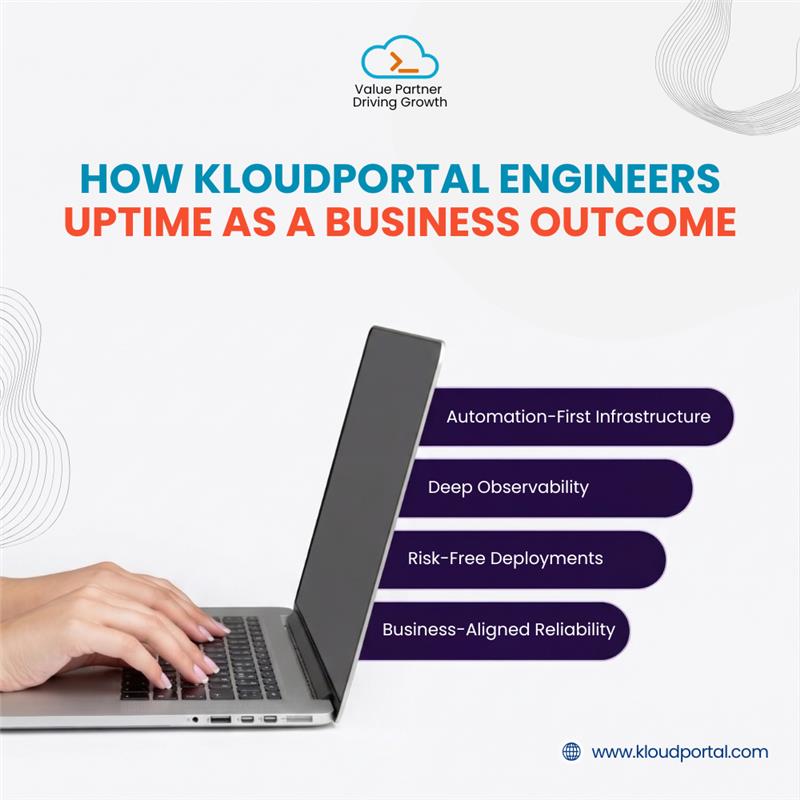
How KloudPortal Engineers Uptime as a Business Outcome

How KloudPortal Engineers Uptime as a Business Outcome

KloudPortal operates as a DevOps engineering partner. We design and manage automation-first, high-availability systems that ensure uptime is consistently delivered as a measurable business outcome.

Our approach focuses on:

1. Automation-First Infrastructure

  • Predictive auto-scaling to handle traffic spikes before they impact performance
  • Self-healing systems that detect and resolve failures automatically
  • Zero-touch recovery to restore services instantly without manual intervention

2. Deep Observability

  • Root cause visibility to quickly identify and resolve issues
  • Real-time system insights for proactive monitoring and decision-making
  • Predictive failure detection to prevent incidents before they occur

3. Risk-Free Deployments

  • Blue-green deployments to release updates without downtime
  • Canary releases to test changes with minimal risk
  • Automated rollback triggers to instantly revert failed deployments

4. Business-Aligned Reliability

  • Aligning uptime with revenue-critical systems to protect business impact
  • Mapping system performance to customer behavior patterns
  • Optimizing availability during peak usage hours

How to Choose the Right Uptime Target for Your Business

Not every system needs five nines, but every system needs clarity.

99.9% (Three Nines)

  • ~8.7 hours downtime/year
  • Suitable for non-critical systems

99.99% (Four Nines)

  • ~52 minutes/year
  • Ideal for SaaS, APIs, and checkout systems

99.999% (Five Nines)

  • ~5 minutes/year
  • For financial, healthcare, and mission-critical systems

What Are the Hidden Costs of Downtime

Beyond immediate revenue loss, downtime creates long-term business damage that’s often harder to measure but more expensive to recover from:

1. SEO & Search Rankings

Frequent downtime reduces trust signals, which impacts rankings.

2. Brand Reputation

Companies invest heavily to maintain a robust brand image; outages can undermine that trust.

3. Customer Churn

One negative experience can lead to a permanent switch to a competitor.

4. Engineering Burnout

Firefighting cultures drive top talent away from organizations.

Key Takeaways

  • Uptime is a business decision, not just an IT metric
  • Automation is the only scalable way to reduce downtime risks
  • The gap between Service Level Agreements (SLAs) and reality is addressed through DevOps engineering, not just tools.

Conclusion

The real question isn’t “Can we achieve 99.9% uptime?” It’s “What does downtime cost your business and how do you prevent it?”
Leading companies treat uptime as a business strategy, powered by automation-first DevOps and engineered reliability. If you’re still reacting to outages or relying on manual processes, it’s time to evolve. Partner with KloudPortal to build resilient, scalable systems that ensure uptime and drive growth.

Frequently Asked Questions

Is 99.9% uptime good enough for SaaS?

Not always. Most SaaS businesses require 99.99% uptime (~52 minutes), depending on business needs.

What causes most downtime incidents?

Human error is responsible for 66–80% of outages. Implementing automation significantly reduces this risk.

What’s the difference between DevOps tool installers and automation operators?

Tool installers configure systems while DevOps automation operators engineer self-healing, scalable, and resilient systems to ensure consistent uptime.

We use cookies to ensure that we give you the best experience on our website. If you continue to use this site we will assume that you are happy with it.

Cookies settings
Accept
Privacy & Cookie policy
Privacy & Cookies policy
Cookie name Active

Privacy Policy

What information do we collect?

We collect information from you when you register on our site or place an order. When ordering or registering on our site, as appropriate, you may be asked to enter your: name, e-mail address or mailing address.

What do we use your information for?

Any of the information we collect from you may be used in one of the following ways: To personalize your experience (your information helps us to better respond to your individual needs) To improve our website (we continually strive to improve our website offerings based on the information and feedback we receive from you) To improve customer service (your information helps us to more effectively respond to your customer service requests and support needs) To process transactions Your information, whether public or private, will not be sold, exchanged, transferred, or given to any other company for any reason whatsoever, without your consent, other than for the express purpose of delivering the purchased product or service requested. To administer a contest, promotion, survey or other site feature To send periodic emails The email address you provide for order processing, will only be used to send you information and updates pertaining to your order.

How do we protect your information?

We implement a variety of security measures to maintain the safety of your personal information when you place an order or enter, submit, or access your personal information. We offer the use of a secure server. All supplied sensitive/credit information is transmitted via Secure Socket Layer (SSL) technology and then encrypted into our Payment gateway providers database only to be accessible by those authorized with special access rights to such systems, and are required to?keep the information confidential. After a transaction, your private information (credit cards, social security numbers, financials, etc.) will not be kept on file for more than 60 days.

Do we use cookies?

Yes (Cookies are small files that a site or its service provider transfers to your computers hard drive through your Web browser (if you allow) that enables the sites or service providers systems to recognize your browser and capture and remember certain information We use cookies to help us remember and process the items in your shopping cart, understand and save your preferences for future visits, keep track of advertisements and compile aggregate data about site traffic and site interaction so that we can offer better site experiences and tools in the future. We may contract with third-party service providers to assist us in better understanding our site visitors. These service providers are not permitted to use the information collected on our behalf except to help us conduct and improve our business. If you prefer, you can choose to have your computer warn you each time a cookie is being sent, or you can choose to turn off all cookies via your browser settings. Like most websites, if you turn your cookies off, some of our services may not function properly. However, you can still place orders by contacting customer service. Google Analytics We use Google Analytics on our sites for anonymous reporting of site usage and for advertising on the site. If you would like to opt-out of Google Analytics monitoring your behaviour on our sites please use this link (https://tools.google.com/dlpage/gaoptout/)

Do we disclose any information to outside parties?

We do not sell, trade, or otherwise transfer to outside parties your personally identifiable information. This does not include trusted third parties who assist us in operating our website, conducting our business, or servicing you, so long as those parties agree to keep this information confidential. We may also release your information when we believe release is appropriate to comply with the law, enforce our site policies, or protect ours or others rights, property, or safety. However, non-personally identifiable visitor information may be provided to other parties for marketing, advertising, or other uses.

Registration

The minimum information we need to register you is your name, email address and a password. We will ask you more questions for different services, including sales promotions. Unless we say otherwise, you have to answer all the registration questions. We may also ask some other, voluntary questions during registration for certain services (for example, professional networks) so we can gain a clearer understanding of who you are. This also allows us to personalise services for you. To assist us in our marketing, in addition to the data that you provide to us if you register, we may also obtain data from trusted third parties to help us understand what you might be interested in. This ‘profiling’ information is produced from a variety of sources, including publicly available data (such as the electoral roll) or from sources such as surveys and polls where you have given your permission for your data to be shared. You can choose not to have such data shared with the Guardian from these sources by logging into your account and changing the settings in the privacy section. After you have registered, and with your permission, we may send you emails we think may interest you. Newsletters may be personalised based on what you have been reading on theguardian.com. At any time you can decide not to receive these emails and will be able to ‘unsubscribe’. Logging in using social networking credentials If you log-in to our sites using a Facebook log-in, you are granting permission to Facebook to share your user details with us. This will include your name, email address, date of birth and location which will then be used to form a Guardian identity. You can also use your picture from Facebook as part of your profile. This will also allow us and Facebook to share your, networks, user ID and any other information you choose to share according to your Facebook account settings. If you remove the Guardian app from your Facebook settings, we will no longer have access to this information. If you log-in to our sites using a Google log-in, you grant permission to Google to share your user details with us. This will include your name, email address, date of birth, sex and location which we will then use to form a Guardian identity. You may use your picture from Google as part of your profile. This also allows us to share your networks, user ID and any other information you choose to share according to your Google account settings. If you remove the Guardian from your Google settings, we will no longer have access to this information. If you log-in to our sites using a twitter log-in, we receive your avatar (the small picture that appears next to your tweets) and twitter username.

Children’s Online Privacy Protection Act Compliance

We are in compliance with the requirements of COPPA (Childrens Online Privacy Protection Act), we do not collect any information from anyone under 13 years of age. Our website, products and services are all directed to people who are at least 13 years old or older.

Updating your personal information

We offer a ‘My details’ page (also known as Dashboard), where you can update your personal information at any time, and change your marketing preferences. You can get to this page from most pages on the site – simply click on the ‘My details’ link at the top of the screen when you are signed in.

Online Privacy Policy Only

This online privacy policy applies only to information collected through our website and not to information collected offline.

Your Consent

By using our site, you consent to our privacy policy.

Changes to our Privacy Policy

If we decide to change our privacy policy, we will post those changes on this page.
Save settings
Cookies settings