The Future Of Web Development: Trends And Innovations

The Future Of Web Development: Trends And Innovations

By Almaas Saleem

Websites may seem like a static collection of text and images; still, in reality web development is a constantly evolving field that is driven by innovation and the changing needs of users. New trends emerge all the time, influencing everything from user experience to security and shaping how we interact with the web.

Staying informed about web development trends is essential.

Today, we will explore the future of the web development domain in 2024, including the key advancements, technologies, and approaches that are shaping the digital world.

From emerging technologies to enhancing user engagement, we will cover everything to ensure you have a complete picture of what’s on the horizon.

Key Takeaways

  • Web development is evolving rapidly, responding to innovation and user demands.
  • AI and ML transform user experiences, predict behaviors, and automate tasks for efficient development.
  • Low-code/no-code tools empower non-coders, enhancing engagement and accessibility.
  • VR, AR, and the “metaverse” pose exciting possibilities but also challenges for future development.

The Evolution of Web Development

Imagine a world without instant access to information, where sharing ideas took weeks or months.

That was the reality before the invention of web browsers!

In the 1980s, Tim Berners-Lee saw a need for a better way for researchers to share information.

His revolutionary idea: ‘The World Wide Web.’

The early web was a simple place, mostly text and basic images. But it was the start of the revolution! People could finally access information quickly and easily from anywhere in the world.

This was a monumental shift, helping students to research without a library and businesses to connect with customers across borders.

Of course, it wasn’t all smooth sailing. People were unsure of this new technology. Was it safe? Could they trust the information they found online?

Learning to navigate web browsers felt like deciphering a new language. But slowly, people embraced the web. Businesses saw the potential to reach new markets, and individuals discovered a world of knowledge and connection at their fingertips. This journey of acceptance and adaptation is a testament to the web’s enduring impact.

The web continued to evolve, becoming more interactive and user-friendly. New tools like CSS and JavaScript started the era of responsive web design.

Remember those fancy blinking text greetings from the early 2000s?

Today, the web is an essential part of our lives. We use it for everything from shopping and banking to staying connected with loved ones and learning new skills.

But the story doesn’t end there! The web application is constantly changing, with predictive analytics and trends emerging all the time. The future of web development looks more exciting and promising!

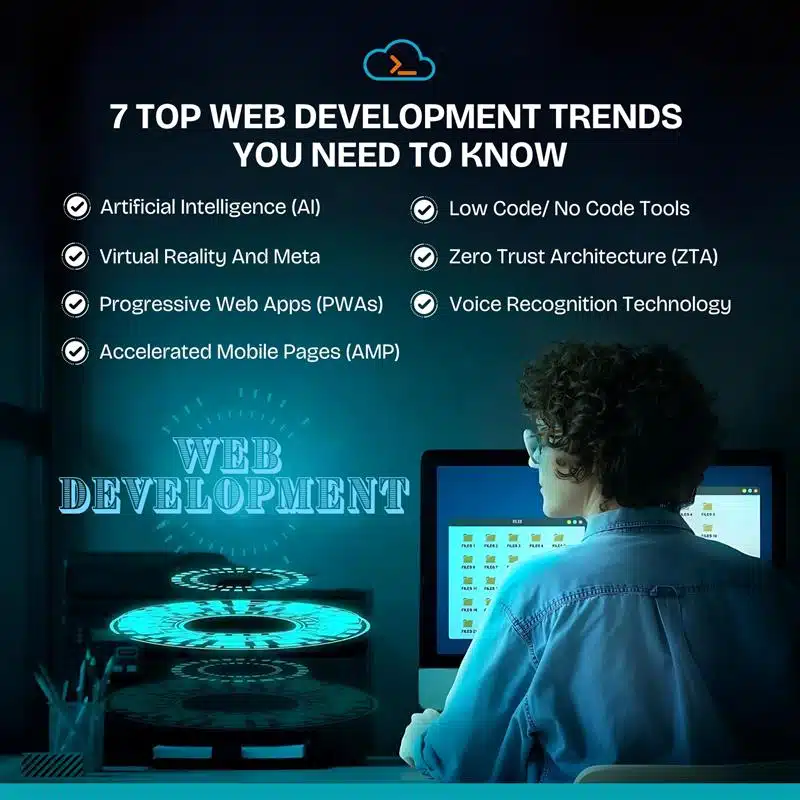
7 Top Web Development Trends You Need To Know

Artificial Intelligence (AI)

AI holds the power to transform web development by personalizing user experiences. But how did AI get so popular, and what does it really mean to create web applications?

The rise of AI is fueled by advancements in machine learning (ML), a subset of AI that allows computers to learn from data with minimal intervention. Imagine a website that learns your browsing habits and recommends products you’ll actually love or a bot program that can answer your questions in a natural, conversational way. That’s the power of machine learning in action.

We can expect to see even more sophisticated web and mobile applications that can personalize content, automate tasks, and create truly immersive web experiences.

Low code/ no code tools

Traditionally, building web applications requires complex coding knowledge. But what if there was a way to create powerful web app(s) and mobile apps without writing a single line of code? That’s the promise of low-code/no-code tools.

These web platforms use drag-and-drop interfaces and pre-built components, allowing anyone with a basic understanding of design and logic to build functional web development domains with great user interface(s).

Low-code/no-code tools have proven their versatility, being used not just for simple landing pages but also for server management. Their user-friendly nature makes them a boon for entrepreneurs, small businesses, and even citizen developers within larger corporations. This flexibility empowers businesses to have better web experiences.

Reach, engage, and convert your potential leads with our effective digital marketing services.

Virtual reality and meta

Virtual reality (VR) has long captured our imaginations, promising immersive experiences that transport us to fantastical worlds or recreate real-world scenarios.

Recent advancements in VR are changing the narrative. Meta (formerly Facebook) has stepped into the picture.

Meta has made VR and Augmented Reality (AR) a central focus, pouring resources into developing powerful VR headsets and software. Their vision is for VR to play a major role in the “metaverse,” a proposed future iteration of the internet helping to enhance user interaction and web accessibility.

Is VR an example of future web development? It’s too early to say for certain. VR offers exciting possibilities, but it’s important to remain aware of the challenges.
7 Top Web Development Trends You Need To Know

Zero trust architecture (ZTA)

Picture a website where security isn’t based on blind trust but on constant verification. That’s the core principle behind Zero Trust Architecture (ZTA), a rapidly growing trend in web development. Let’s break down what ZTA is and why it’s becoming increasingly important.

Traditionally, web security has relied on a perimeter-based approach. Think of it like a castle – once inside the walls (the network), users were generally trusted. However, this approach has vulnerabilities. If an attacker breaches the perimeter, they have free rein to access sensitive data.

ZTA flips this concept on its head. It assumes no user or device is inherently trustworthy, regardless of location. Every access attempt from any device is continuously verified before granting access to resources. This “never trust, always verify” approach significantly reduces the attack surface and provides enhanced security.

Progressive web apps (PWAs)

In today’s mobile-driven world, users expect a seamless and app-like experience when browsing websites on their phones. This is where Progressive Web Apps (PWAs) become superheroes.

PWAs are websites built with web technologies that offer easy controls and user experience of native apps without the need to download from app stores.

If a website loads instantly, even with a slow internet connection, a shopping site lets you add items to your cart even when offline. These are just some of the benefits PWAs offer users.

But why are they so important for web developers in 2024?

  • Limited reach: Not everyone downloads apps, especially for niche businesses or one-time use cases. Relying solely on a native app might restrict your potential user base.
  • Engagement hurdles: App download processes can be clunky, discouraging users from trying out your offering.
  • Installation friction: Updates for native apps require users to go through the app store, introducing a delay and potential user frustration.

Therefore, PWAs bridge the gap between websites and native apps, offering several advantages such as better user experience, high engagement”, “low development costs.

Voice recognition technology

As smart speakers and voice assistants like Google Home and Amazon Echo become more popular, users are increasingly comfortable using voice commands to interact with technology. This shift in user behavior presents a tremendous opportunity for web developers.

By incorporating VUI and voice search capabilities into websites, developers can create a more natural and intuitive user experience, especially for hands-free situations like cooking or driving.

Additionally, voice search optimization allows websites to be more discoverable through spoken queries, reaching a wider audience and boosting user engagement.

Craft compelling stories that drive results and grow your brand’s presence with our powerful content marketing services.

Accelerated mobile pages (AMP)

Forget waiting! Today, users have an attention span of just 3 seconds, and a slow mobile website is the kiss of death for engagement. This is where Accelerated Mobile Pages (AMP) come in as a knight in shining armor for web developers.

AMP optimizes website code and utilizes cached content to ensure blazing-fast loading times, even on unreliable connections. Consider your website on a mobile fitness program – it sheds unnecessary code and gets lean for peak performance. This translates to a happy user experience, keeping visitors engaged and exploring your content. With mobile browsing dominating the web landscape, AMP is a crucial trend for developers in 2024, ensuring your website remains optimized and keeps users happily clicking.

Looking Ahead With KloudPortal

With AI integration accelerating and innovative tools emerging, the future of web development promises a web experience unlike ever before. Get ready for a brighter digital landscape in 2024 with KloudPortal.

We build the future of your web presence. We craft websites using cutting-edge UI design and integrate the latest search engine optimization (SEO) strategies to ensure you shine online.

Frequently Asked Questions (FAQs)

What is innovation in web development?

Marketers need to be data-driven, creative storytellers, social media savvy, and adaptable to constant change.

What is the changing landscape in marketing?

Innovation includes things like using artificial intelligence to personalize user experiences or virtual reality to create immersive web applications.

Which web technology will be best for the future?

There’s no single “best” technology, as it depends on your project’s needs. However, some promising areas include:

  • AI & Machine Learning: Tailoring web browser content and enhancing user experiences using natural language processing.
  • Progressive Web Apps (PWAs): Web applications that feel like native apps, even without downloading.
  • Voice User Interfaces (VUIs): Controlling websites and searching with your voice.

What is the future of web development?

The future of web development will likely be:

  • More Intelligent: AI enables developers to automate tasks and build interactive websites.
  • More Immersive: VR and AR could create new ways to interact with web applications.
  • More Secure: New security protocols will help with cyber threats on social media platforms.

What is the trend of web development?

The latest web development trends include:

  • Low-code/No-code Tools: Making user-friendly websites and single-page websites, improving the mobile user experience.
  • Serverless Architecture: Ditch server headaches! Focus on your application’s logic while the cloud handles server setup, scaling, and content delivery networks. Think pay-per-use for website development.
  • Interactive Design: Move beyond static site generators! Engage users with animations, push notifications, and real-time data. Think quizzes, polls, and dynamic content management system(s) according to the evolving user expectations.

The Changing Marketing Landscape: The Top 4 Skills Marketers Need to Stay Ahead

The Changing Marketing Landscape: The Top 4 Skills Marketers Need to Stay Ahead

By Almaas Saleem

Many marketers, including those in the B2B sector, often believe that a foundational skillset is enough to ensure success. However, the reality is that the marketing career is in a constant state of flux, with trends evolving at a rapid pace. Just as one platform is mastered, a new one emerges. To stay timeless in the digital marketing game, companies need to possess a specific set of marketing skills. The blog post gives you a deep understanding of four essential interpersonal skills that enable modern marketers to adapt and think of innovative solutions, thereby giving a competitive edge and helping achieve business objectives.

Key Takeaways

  • Upskilling is crucial in today’s digital marketing landscape to stay relevant and competitive.
  • Marketers need technical expertise to execute campaigns with emerging technologies effectively.
  • Evolve SEO and content strategies to meet changing customer expectations.
  • Agile marketing strategies are crucial to keep up with industry trends and give a competitive edge.

Why Upskilling Is Important?

Imagine the thrill of crafting a meticulously targeted content strategy, only to discover your audience has migrated to a new platform you haven’t even heard of.

Is it fair enough to blame the online audiences?

Do you see the drop in consumer engagement and reflect on your content strategy?

Not really?

In the current digital world, staying relevant is not just a challenge but an opportunity for growth. It’s a chance to take control of your career and steer it towards unparalleled success in the marketing world. These require a commitment to constantly upgrading our marketing skills.

Here are the three strong reasons why updating marketing skills is not just an option but a necessity for modern marketing jobs:

  • The tech tide is rising: Emerging Technologies underpin every aspect of modern marketing. From programmatic advertising and predictive analytics to influencer marketing, new tools and platforms emerge at a dizzying pace. Marketers who fail to possess technical expertise risk not just getting left behind but also missing out on the potential of these powerful tools to understand consumer behaviors effectively.
  • Consider the rise of short-form video marketing platforms like Instagram/TikTok. A marketer who hasn’t learned to utilize these key performance indicators by continuous learning not only misses out on a massive potential customer base but also risks becoming obsolete in the digital marketing landscape.
  • Customer expectations keep shifting: Consumer trends are constantly evolving. What resonated yesterday might sound generic today. Upskilling and curating updated SEO strategies equips marketers with an understanding of these changing preferences.
  • To understand these better, suppose you have a content strategy that hasn’t embraced the growing importance of social responsibility in marketing. The campaigns might fall flat with a generation increasingly concerned with a brand’s ethical and environmental impact.
  • Competition is fierce and agile: Your competitors are constantly innovating and adapting. To stay ahead, you need to do the same. Having the right marketing skills allows you to understand the customer data and work on Search engine optimization accordingly.
  • For example, marketing professionals who fail to upgrade their technical skills might see their website buried in search engines, while a competitor using the latest techniques thrives.

The consequences of not updating your marketing skills are clear: stagnant content strategy, dwindling engagement, and missed revenue opportunities.

Four Essential Skills Marketers Need

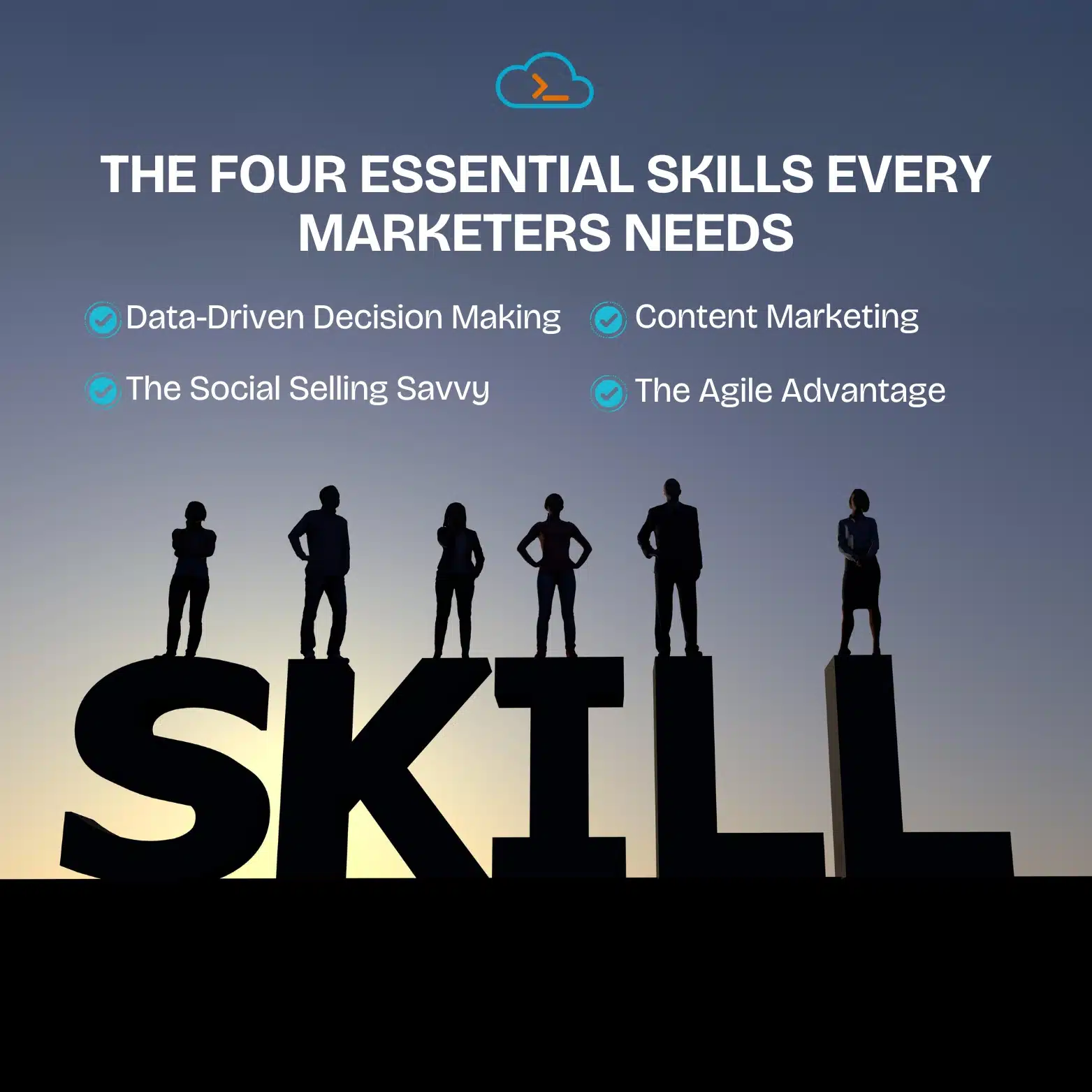
 The Four Essential Skills Every Marketers Needs

The B2B marketing landscape is a competitive and dynamic field characterized by a rapid pace of change and a need for continuous innovation.

But it’s not impossible! Equipped with the right skill set, you can survive and even conquer this dynamic terrain. Mastering the four essential skills we’re about to unveil can open doors to new opportunities, propel your career forward, and lead to unprecedented success in the B2B marketing landscape.

Here are the four essential skills that will propel you ahead of the competition:

1. Data-driven decision making

Gone are the days of relying on intuition alone. Today’s B2B marketing thrives on data. Imagine a software company making product development decisions based on gut feelings instead of analyzing user data to identify key features desired by their target market.

Disastrous, right?

Data empowers you to make informed decisions about everything from campaign strategy to content creation. By leveraging marketing analytics tools like Google Analytics or Salesforce Marketing Cloud, you can gain valuable insights into buyer behavior, campaign performance, and competitor strategies. It allows you to optimize campaigns for maximum ROI and deliver content that people connect with.

Example: A B2B software company utilizes marketing automation software to track website visitor behavior. They discover that decision-makers from the healthcare industry spend a significant amount of time on a specific page outlining their product’s HIPAA compliance features. This data allows them to tailor future content marketing efforts to highlight these features and attract qualified leads from the healthcare sector.

2. Content marketing 

Content is king in the B2B world. Position your brand as a thought leader and build trust with educational content, but simply creating content isn’t enough. It would help if you were a master storyteller who can weave engaging narratives that resonate with your target audience.

Think of a B2B financial services company that bombards potential clients with dry, technical jargon-filled white papers. Snooze-fest, right? However, by crafting engaging case studies that showcase real-world client success stories, they can demonstrate their expertise and value proposition in a way that’s both informative and captivating.

Example: A B2B marketing automation company creates a series of informative blog posts that address common pain points from the customer experience in the manufacturing industry. These blog posts not only attract qualified leads but also position the company as a valuable resource and trusted advisor.

With our digital marketing services, you skyrocket your online presence, establish a powerful brand reputation, and foster meaningful connections with customers. Don’t let your competitors get ahead. Let us help you dominate your market and achieve your goals.

3. The social selling savvy 

Social media is no longer just a place to share cat videos (although those are pretty great, too). It’s a powerful content strategy platform for B2B marketers to do market research and connect with potential clients, build relationships, and establish brand authority.

Example: In the digital Marketing terrain, a company can implement social media marketing practices on LinkedIn to showcase its marketing talent and skills. They encourage employees to share industry articles on social media platforms, participate in relevant discussions, do cross-functional projects, and connect with potential customers. This approach not only positions the agency as a thought leader but also helps in innovative solutions and actionable insights.

4. The agile advantage

The B2B marketing landscape is anything but predictable. Technological advancements, unique customer demands, and shifting market trends are constants. Marketers who can adapt quickly and remain agile are the ones who will succeed.

Think of a B2B marketing team rigidly clinging to outdated content strategy as the world embraces new technologies. This social strategy, which gives high-performance metrics, will take the business to the next level. By staying up-to-date on industry trends, embracing new tools and platforms, and encouraging a culture of experimentation, B2B marketers can successfully navigate the ever-changing marketing landscape.

Example: A B2B marketing team for a cloud computing company recognizes the growing influence of industry podcasts and webinars. They experiment with creating their podcast series featuring industry experts discussing relevant cloud computing trends. This agile approach allows them to reach a wider audience, establish them as thought leaders, and attract potential clients actively seeking such information.

Equip Yourself With Digital Marketing Success

By mastering the four key skills we’ve explored – data-driven decisions, compelling content, social savvy, and agile thinking – any marketeer is well-equipped to navigate change, build customer loyalty, and drive business growth.

Looking to take your B2B marketing to the next level?

You are at the right place!

We are experts in leveraging cutting-edge technology and developing data-driven strategies to reach and engage your target markets effectively. Our confidence in our expertise is backed by years of experience delivering unparalleled results to our clients. Partner with us today and unlock the full potential of your marketing efforts!

Frequently Asked Questions (FAQs)

What are the four things marketers need to be successful?

Marketers need to be data-driven, creative storytellers, social media savvy, and adaptable to constant change.

What is the changing landscape in marketing?

Technology, customer behavior, and competitor strategies are all constantly evolving in the marketing landscape.

What are the 4 P’s of a good marketing strategy?

  • Product: Understanding your product’s features, benefits, and how it solves customer problems.
  • Price: Determining the right price point that considers value, competition, and profitability.
  • Place: Choosing the best channels to reach your target audience, whether it’s online, in-store, or a combination.
  • Promotion: Developing effective communication strategies to raise awareness, generate interest, and drive sales.

What is a market landscape?

The market landscape is a big-picture view of the current trends, competition, and opportunities within a specific industry.

Inclusive Marketing: How Diversity Is Reshaping Digital Advertising

Inclusive Marketing: How Diversity Is Reshaping Digital Advertising

By Almaas saleem

We all have grown up seeing images of “Santoor Moms” in magazines, perpetuating an idealized version of motherhood where women effortlessly manage spotless homes and perfectly cooked meals.

Wearing the “Mother Cape” now, we realize the stark contrast between the advertisement and reality. It leads to an essential question: Is it ethical for advertising to uphold unrealistic standards and expectations?

These portrayals not only create a sense of inadequacy but also fail to reflect the beautiful diversity of real people. Outdated stereotypes like the “perfect housewife” and inauthentic minority representations can cause more emotional harm than good.

Fortunately, the landscape is shifting. Inclusive marketing is emerging as a powerful force in consumer expectations, celebrating diversity and resonating with a wider, more authentic audience.

Key Takeaways

  • Celebrate diversity and ensure everyone feels valued and included.
  • Show representation for all, be authentic, and make content accessible.
  • Benefits include building loyalty, reaching new audiences, and creating a positive brand image.
  • Consumers gain meaningful connections and enhanced user experiences.
  • Continuous improvement and embracing diversity are keys to long-term success.

Understanding Diversity and Inclusion

Picture a perfect family reunion. It’s not just one type of person, right? There’s your vegetarian cousin next to your little hard-of-hearing grandma, your aunt with a disability laughing with your extroverted friend. Diversity is like that family reunion – a beautiful mix of backgrounds, experiences, and perspectives. It’s about recognizing everyone’s unique story.

Inclusion, however, is making sure everyone feels welcome at the reunion. It’s not just inviting everyone and expecting to blend in. It’s about having vegetarian options for your cousin, ensuring there’s accessible seating for your aunt and your grandma doesn’t feel left out, and encouraging everyone to share their stories.

Inclusive marketing strives for the same thing – celebrating the diversity in our communities and creating advertising that resonates with all cultures, not a one-size-fits-all stereotype.

Inclusive Marketing

Inclusive marketing is a strategic approach to advertising that recognizes and celebrates the diversity of people in the real world. It goes beyond traditional marketing tactics that often rely on stereotypes or limited portrayals.

Here are the three key aspects to consider:

  • Representation: Show everyone, not just a few.
  • Authenticity: Be real and resonate deeply.
  • Accessibility: Don’t exclude, make it all-inclusive.

Benefits of Inclusive Marketing

Inclusive marketing isn’t just a feel-good practice; it benefits both brands and consumers. Let’s delve into the advantages of each:

Benefits for brands:

  • Increased brand loyalty: When consumers see themselves reflected in advertising, they feel a sense of connection and value. It builds trust and loyalty for your business brands.
  • Diverse range of audience: By moving beyond stereotypes and embracing diversity, brands tap into a wider pool of potential customers. It allows them to reach new markets and explore previously ignored demographics.
  • Positive brand image: It demonstrates a brand’s commitment to social responsibility and inclusivity. It resonates with consumers who value diversity and aligns the brand with positive social movements.

Example:  Dove’s “Real Beauty” campaign celebrated women of all shapes, sizes, ethnicities, and ages. These inclusivity efforts challenged beauty standards and resonated with a broad spectrum, leading to a significant trust in brand loyalty and sales.

Looking for the best digital marketing partner agency in India for your business? Think beyond tigers – Get Results!

Benefits for consumers:

  • Feeling seen and valued: Diversity and Inclusion helps consumers see themselves and their experiences reflected in advertising. It cultivates a sense of belonging and makes meaningful connections.
  • Stronger brand connection: When consumers feel seen and understood, they’re more likely to connect with brands on a deeper level. It leads to building a loyal customer base.
  • Improved user experience: It plays a pivotal role in improving user experience for less privileged people, too.
Inclusive Marketing Strategies

Inclusive Marketing Strategies

Understanding the diverse world is crucial, but the real power lies in translating that knowledge into action. Here are some key strategies for speaking the inclusive language:

Representation matters

  • Diverse casting: Ensure your business practices reflect the diverse representation of the consumers. Consider race, ethnicity, gender identity, age, ability, body type, and socioeconomic background in your casting choices.
  • Storylines that reflect real lives: Ditch the one-size-fits-all narratives. Showcase real-life stories and situations that resonate with diverse audience(s). Let your marketing strategies reflect the messiness, joy, and complexity of varied experiences.

Authenticity is key

  • Avoid stereotypes: Move away from tired tropes and clichés. Challenge stereotypes and create characters that feel genuine and relatable.
  • Relatable language and situations: Use clear and concise language that avoids jargon or cultural references that might exclude certain audiences. Situate your marketing strategies in scenarios that feel relatable to your diverse target audience.

Accessibility for all

  • Cultural backgrounds: It’s important to consider cultural differences when developing marketing strategies. Consider language translations, avoiding offensive imagery, and adapting your message to resonate with a diverse audience.
  • Clear and concise language: Use clear, concise language that is easy to understand for everyone. Avoid complicated sentence structures or technical jargon.
  • Features for people with disabilities: Make your marketing materials accessible to individuals with disabilities. It includes incorporating closed captions on videos, providing alternative text descriptions for images, and ensuring a user-friendly design for websites and apps.

Continuous improvement and evaluation

Regularly evaluate the effectiveness of your campaigns. Improve your business by having a deeper understanding of cultural competency. It is important to gather feedback from a diverse audience and be open to refining your approach based on the results.

Embrace Diversity With KloudPortal

In this digital age, embracing diversity is no longer a choice – it’s a necessity. So, take that step towards a more inclusive approach – it can lead to a more meaningful connection with your audience and pave the way for long-term success even for future generations. Let KloudPortal’s Digital Marketing Services be your guide on the journey to inclusive marketing success!

Frequently Asked Questions (FAQs)

What are the six principles of inclusive marketing?

  • Representation: Showcasing diversity in race, ethnicity, gender, ability, etc.
  • Authenticity: Avoiding stereotypes and portraying real-life experiences.
  • Accessibility: Making marketing materials understandable for everyone (clear language, disability features).
  • Unconscious bias awareness: Recognizing and mitigating personal biases in marketing decisions.
  • Cultural sensitivity: Understanding and respecting cultural nuances when creating campaigns.
  • Long-term commitment: Continuously striving for improvement and inclusivity in marketing efforts.

Why is inclusive marketing so important?

  • Resonates with a wider audience: Reaches beyond limited demographics.
  • Builds brand loyalty: Consumers connect with brands that value them.
  • Positive brand image: Shows commitment to social responsibility and diversity

What are the seven principles of marketing?

7 Principles of Marketing (Traditional):

  1. Product: Understanding your offering and its value proposition.
  2. Price: Determining the right price point for your target audience.
  3. Place: Choosing the best channels to reach your customers.
  4. Promotion: Communicating your product’s benefits through marketing campaigns.
  5. People: Understanding your consumers and their needs.
  6. Process: Creating a smooth customer experience from awareness to purchase.
  7. Physical Evidence: Tangible aspects of your brand (packaging, website).

What are the types of inclusive marketing?

  • Representation in advertising: Diverse casting, storylines reflecting real lives.
  • Accessible content: Clear language, closed captions, alt text descriptions.
  • Multicultural marketing: Campaigns tailored to specific cultures and languages.
  • Micro-influencer marketing: Partnering with diverse influencers with smaller, engaged followings.
Quantum Marketing: Revolutionizing Marketing Strategies

Quantum Marketing: Revolutionizing Marketing Strategies

By Almaas saleem

In today’s world, everyone has heard of super-fast computers tackling impossible problems – that’s quantum computing. But have you heard of a new marketing mindset called Quantum Marketing? This exciting new approach uses revolutionary marketing strategies from science to understand customers better than ever before. Imagine ads that feel like they can read your mind, reaching you with exactly what you want right when you need it. That’s the potential of Quantum Marketing, and it’s about to take the entire marketing landscape to a whole new level.

Key Takeaways

  • It uses quantum computing-inspired concepts for hyper-personalized marketing.
  • Analyzes extensive data for customized strategies.
  • Benefits: hyper-personalization, insights, future-proofing, ROI optimization.
  • Steps: agile marketing, data utilization, innovative tactics, tech integration, learning culture.
  • Empower marketers for impactful customer-centric strategies and business growth.

What Is Quantum Marketing?

Quantum Marketing is inspired by concepts from quantum computing, particularly the idea of superposition, to analyze vast amounts of customer data. Superposition refers to the ability of a system to exist in multiple states simultaneously. In marketing terms, this translates to understanding that today’s consumers’ needs and interests might be multifaceted and not limited to a single category. For example, a sporting goods store might send a generic ad for athletic shoes to everyone who has purchased shoes in the past. However, with Quantum Marketing, the store can leverage a supercomputer to analyze a wider range of data points, including social media activity, search history, and even weather patterns. This forward-thinking way allows the store to target a specific customer who recently searched for “hiking trails” and “waterproof gear” with an ad for high-performance running shoes, even if they haven’t bought running shoes before.

Traditional Marketing v/s Quantum Marketing

  • Data depth: Traditional marketing relies on a narrower range of data points, such as purchase history, demographics, and self-reported preferences through surveys and focus groups. Quantum Marketing enables organizations to delve deeper, utilizing extensive datasets encompassing social media activity, browsing behavior, and external factors such as weather patterns.
  • Understanding the customer: Traditional marketing paints a broad picture of the customer. In contrast, Quantum Marketing aspires to a more holistic understanding. It utilizes the “superposition” concept to acknowledge that customers have diverse needs and interests, going beyond simple demographics.
  • Sensory experience: Traditional marketing primarily focuses on appealing to sight and sound through visuals and audio messages. Quantum Marketing, however, recognizes the power of multisensory branding. It seeks to engage all five senses (think interactive experiences, immersive content, or scent marketing) for a deeper customer connection.
  • Influence vs. understanding: Traditional marketing often aims to influence or persuade customers toward a specific purchase. Quantum Marketing, however, prioritizes understanding the “why” behind customer behavior.
On the contrary, you could grow your local business with powerful digital marketing in Hyderabad.

Benefits of Quantum Marketing Strategies

While the traditional vs. quantum marketing contrast highlights the differences in approach, let’s explore the potential benefits Quantum Marketing brings to the table:

Hyper-personalization

Imagine receiving product recommendations that feel like they were curated just for you. Quantum Marketing unlocks the potential for ultra-personalized experiences. By analyzing vast datasets, it can predict your needs and wants with incredible accuracy, leading to marketing messages that resonate deeply and drive higher engagement.

Uncovering hidden insights

Traditional marketing methods can miss hidden customer segments or niche preferences. Quantum Marketing’s data-driven approach acts like a powerful magnifying glass, uncovering hidden patterns and customer segments with specific needs. These allow businesses to tailor their offerings and marketing strategies to previously overlooked demographics, expanding their reach and market share.

Future-proofing marketing strategies

The marketing landscape is always changing. Quantum Marketing, which focuses on data analysis and real-time insights, enables businesses to stay ahead of the curve. By continuously learning and adapting to customer behavior, businesses can develop innovative marketing strategies that remain relevant and effective.

Boosting customer lifetime value

Quantum Marketing isn’t just about a single sale; it’s about building long-term relationships with customers. By understanding individual preferences and anticipating needs, businesses can create targeted loyalty programs and personalized recommendations that keep customers engaged and coming back for more, ultimately increasing their lifetime value.

Optimizing marketing roi

Quantum Marketing’s data-driven approach allows for highly targeted campaigns. By focusing on the right audience with the right message at the right time, businesses can optimize their marketing spend and see a significant return on investment. Gone are the days of scattershot marketing tactics; Quantum Marketing allows for laser-focused precision that maximizes efficiency and effectiveness. Attract & convert leads effortlessly with our digital marketing services.
Benefits Of Quantum Marketing Strategies

How To Get Started With Quantum Marketing

Quantum Marketing might sound futuristic, but several practical steps can be taken to integrate its principles into your existing marketing strategy. Here’s a roadmap to get you started:

Embrace agile marketing

Ditch the lengthy, rigid marketing campaigns of the past. Quantum Marketing thrives on agility. Develop shorter, focused campaigns that can be quickly adapted based on real-time customer data and market trends. Think of it as a continuous feedback loop – test, analyze, refine, repeat. Tools like pay-per-click advertising with real-time data analysis are perfect examples.

Harness the power of data

Data is the fuel that propels Quantum Marketing. Start by collecting a wider range of customer data points beyond demographics and purchase history. Explore social media activity, browsing behavior, and even external factors like weather patterns (think seasonal clothing recommendations). Utilize CRM software and marketing automation tools to gather and analyze customer data effectively.

Think beyond the click

Quantum Marketing goes beyond traditional sight and sound tactics. Explore multisensory marketing strategies to create a deeper connection with your customers. Consider interactive experiences on your website, immersive content like 360-degree product views, or even incorporating elements of scent marketing in your physical stores.

Embrace technological advancements

Stay ahead of the curve by integrating emerging technologies into your marketing mix. Augmented reality (AR) can create interactive product experiences on e-commerce platforms, while AI-powered chatbots can enhance customer service interactions. Encourage your team to explore tools like ChatGPT for content creation and AI-powered sales tools to streamline outreach.

Build a culture of continuous learning

Quantum Marketing is a journey, not a destination. Encourage continuous learning within your organization. Train your marketing team on data analysis and interpretation and keep them updated on the latest marketing technologies and trends. Remember, the key is to be adaptable and embrace change.

Take a quantum leap today with KloudPortal

Quantum Marketing isn’t about replacing humans with machines but rather empowering your team with the tools and insights to create truly impactful and personalized marketing strategies. By embracing these steps, you can take your business on a Quantum Leap toward a future-proof and customer-centric marketing approach.

Our digital marketing agency offers comprehensive solutions. Contact us for a quote today.

Frequently asked questions (FAQs)

Can you provide an example of quantum marketing in action?

In 2007, Ford noticed increased interest in fuel-efficient vehicles and used data-driven tactics to target eco-conscious buyers, leading to a significant sales increase.

How does quantum computing play a role in marketing?

Quantum Marketing uses quantum mechanics concepts for detailed data analysis, enabling hyper-personalized advertising and product recommendations.

What are the primary technologies and tools used in quantum marketing?

Quantum Marketing uses advanced technologies such as machine learning, big data analytics, AI, CRM software, and marketing automation to analyze vast data and personalize strategies.

How does quantum marketing ensure data privacy and security when dealing with extensive customer data?

Quantum Marketing prioritizes data privacy and security, following strict regulations, using secure storage and encryption, and implementing advanced authentication and access controls.

Top 10 Generative AI Tools for Marketers

Top 10 Generative AI Tools for Marketers

By Almaas Saleem

Struggling to create fresh, engaging content that resonates with your audience? You’re not alone. Writer’s block, time constraints, and the ever-present pressure to produce high-quality content can leave even the most creative minds feeling stuck.

But what if there was a way to overcome these challenges? Generative AI offers a powerful solution. This article reveals ten generative AI marketing tools designed to tackle your marketing content woes. From curating perfect ad copy to generating personalized email sequences, these tools can help you produce effective campaigns that convert, freeing you up to focus on the bigger picture.

Key Takeaways

  • Generative AI transforms marketing through streamlined content and campaign optimization.
  • HubSpot’s CRM and Jasper offer personalized outreach and AI content creation.
  • Grammarly ensures error-free marketing copy with advanced checks.
  • Surfer SEO uses AI for data-driven SEO insights and optimization recommendations.
  • Notion AI, Gemini AI, Flick AI, Revue, Crayon, and Adext AI offer AI-powered marketing tools.

Top Ten Generative AI Marketing Tools

1. HubSpot (CRM)

HubSpot’s CRM is one of the powerful AI marketing tools that uses artificial intelligence to provide personalized outreach and predict customer behavior. It goes beyond basic customer data to provide a treasure trove of predictive analytics that resonate on a deeper level. HubSpot isn’t just a fancy CRM; it’s a complete customer data platform that integrates marketing, conversion rates, content creation, and customer interactions. By focusing on your customers, you can watch your business thrive.

2. Jasper

Jasper is an AI writing tool that creates compelling marketing content. With Jasper by your side, you can overcome writer’s block and produce high-quality content across various formats. Jasper has several features that make it a valuable addition to the marketing landscape.

It maintains consistency across all your marketing materials by adapting your brand’s voice and tone.

Additionally, Jasper can generate a variety of content formats, from blog post outlines and catchy social media captions to SEO-optimized title tags and meta descriptions. Jasper’s multilingual capabilities allow you to translate your content into over 30 languages, expanding your reach to a target audience at the global level.

3. Grammarly

You can easily craft flawless marketing copy with Grammarly’s AI magic! Ensure error-free content with advanced grammar, spelling, and punctuation checks. Write with clarity and precision for maximum engagement and customer satisfaction. Plus, Grammarly adapts to your brand voice and writing style for a truly polished touch. The free version tackles basics, and the premium unlocks advanced features like tone and vocabulary suggestions.

4. Surfer SEO

Search engine algorithms change frequently, making it challenging to maintain your content’s high ranking in search results. However, Surfer SEO’s natural language processing capabilities can assist with search engine optimization (SEO). This AI marketing tool empowers the marketing teams to optimize content creation, driving organic traffic and boosting your social media platforms.

Here’s how Surfer SEO uses AI to propel competitive intelligence to the next level:

  • Cracking the SEO code: Surfer SEO goes beyond simple keyword research. This marketing automation tool analyzes top-ranking pages for your target keywords, providing data-driven insights into what search engines favor. With this knowledge, you can optimize the landing pages, ad creatives, and web pages.
  • Data-driven optimization: Surfer SEO provides clear, actionable recommendations for optimizing your content.
  • Organic search rankings: Optimize search engines’ optimization power play with these marketing tools and watch your website climb the search engine rankings for your target keywords.

Dominate your market by collaborating with the best digital marketing agency in India.

5. Notion AI

Notion AI is one of the perfect AI marketing tools. It is similar to having a personal AI assistant within your favorite project management tool. Ask questions in plain English about your Notion projects, notes, or wikis, and Notion AI instantly delivers the answers. Brainstorm ideas, generate content, and automate tedious tasks – all within the familiar Notion interface.

6. Gemini AI

Gemini AI is a cutting-edge tool that can help you break the text barrier. Unlike other text-only tools like ChatGPT (Free version), Gemini AI leverages the power of multimodality. With Gemini, you can easily generate captivating marketing materials in various formats, including text, images, and even video content, all powered by AI.

7. Flick AI

Flick streamlines your social media workflow with AI-powered features. Generate targeted hashtags for wider reach, repurpose long-form content into bite-sized social media posts, and schedule effortlessly. This AI assistant frees you up to focus on high-level marketing strategies while maintaining an active social media presence.

8. Revue

Revue leverages AI to streamline your email marketing campaigns. This tool helps the marketing teams to analyze the historical data and recommends relevant articles to personalize your newsletters using sentiment analysis, saving you time and enhancing your readers’ experience.

Rule the marketing industry by leveraging top enterprise SEO services in India.

9. Crayon

Gain a competitive edge with Crayon’s generative AI-powered market intelligence. This tool helps the marketing teams to track your competitors’ online activities, uncovering their strategies, promotions, and messaging. Armed with this invaluable data, you can tailor your marketing campaigns to outshine the competition.

10. Adext AI

Managing digital ad campaigns can be complex. Adext AI simplifies the process by automating bid adjustments and budget allocation across platforms. This intelligent solution maximizes your campaign conversions and ensures you get the most out of your ad spend.

Top 10 Generative AI Marketing Tools

AI Marketing Is The Future!

So far, we understand how these powerful AI marketing tools empower you to analyze data, personalize content, and optimize campaigns for the best results.

One pro tip: Level up your social media marketing, scale your Search Engine Optimization (SEO), and achieve breakout growth – all with the help of AI.

Feeling overwhelmed?

The leading digital marketing agency guides you every step of the way. Contact us today!

Frequently Asked Questions (FAQs)

How do marketers use AI?

AI empowers you to analyze large amounts of customer data in seconds using machine learning algorithms. These translate into actionable insights such as predicting future customer behavior, personalizing content with laser focus, and uncovering hidden patterns within your data.

How can marketers use ChatGPT?

By feeding prompts or questions, marketers can leverage ChatGPT to its fullest. It sparks engaging conversations, resolves users’ questions quickly and accurately, and personalizes product recommendations based on customer data, boosting conversions and making your marketing efforts easy.

How to use AI in digital marketing?

AI-powered marketing simplifies your life. It analyzes customer data, predicts behavior, personalizes content for higher engagement, and automates tasks to save you time.

Is AI replacing digital marketing?

AI isn’t here to steal your marketing job; it’s here to be your partner! While AI excels at crunching data and automating tasks, it can’t replicate the human touch. Your ability to connect with customers emotionally makes you irreplaceable, along with your strategic thinking and creativity.

We use cookies to ensure that we give you the best experience on our website. If you continue to use this site we will assume that you are happy with it.

Cookies settings
Accept
Privacy & Cookie policy
Privacy & Cookies policy
Cookie name Active

Privacy Policy

What information do we collect?

We collect information from you when you register on our site or place an order. When ordering or registering on our site, as appropriate, you may be asked to enter your: name, e-mail address or mailing address.

What do we use your information for?

Any of the information we collect from you may be used in one of the following ways: To personalize your experience (your information helps us to better respond to your individual needs) To improve our website (we continually strive to improve our website offerings based on the information and feedback we receive from you) To improve customer service (your information helps us to more effectively respond to your customer service requests and support needs) To process transactions Your information, whether public or private, will not be sold, exchanged, transferred, or given to any other company for any reason whatsoever, without your consent, other than for the express purpose of delivering the purchased product or service requested. To administer a contest, promotion, survey or other site feature To send periodic emails The email address you provide for order processing, will only be used to send you information and updates pertaining to your order.

How do we protect your information?

We implement a variety of security measures to maintain the safety of your personal information when you place an order or enter, submit, or access your personal information. We offer the use of a secure server. All supplied sensitive/credit information is transmitted via Secure Socket Layer (SSL) technology and then encrypted into our Payment gateway providers database only to be accessible by those authorized with special access rights to such systems, and are required to?keep the information confidential. After a transaction, your private information (credit cards, social security numbers, financials, etc.) will not be kept on file for more than 60 days.

Do we use cookies?

Yes (Cookies are small files that a site or its service provider transfers to your computers hard drive through your Web browser (if you allow) that enables the sites or service providers systems to recognize your browser and capture and remember certain information We use cookies to help us remember and process the items in your shopping cart, understand and save your preferences for future visits, keep track of advertisements and compile aggregate data about site traffic and site interaction so that we can offer better site experiences and tools in the future. We may contract with third-party service providers to assist us in better understanding our site visitors. These service providers are not permitted to use the information collected on our behalf except to help us conduct and improve our business. If you prefer, you can choose to have your computer warn you each time a cookie is being sent, or you can choose to turn off all cookies via your browser settings. Like most websites, if you turn your cookies off, some of our services may not function properly. However, you can still place orders by contacting customer service. Google Analytics We use Google Analytics on our sites for anonymous reporting of site usage and for advertising on the site. If you would like to opt-out of Google Analytics monitoring your behaviour on our sites please use this link (https://tools.google.com/dlpage/gaoptout/)

Do we disclose any information to outside parties?

We do not sell, trade, or otherwise transfer to outside parties your personally identifiable information. This does not include trusted third parties who assist us in operating our website, conducting our business, or servicing you, so long as those parties agree to keep this information confidential. We may also release your information when we believe release is appropriate to comply with the law, enforce our site policies, or protect ours or others rights, property, or safety. However, non-personally identifiable visitor information may be provided to other parties for marketing, advertising, or other uses.

Registration

The minimum information we need to register you is your name, email address and a password. We will ask you more questions for different services, including sales promotions. Unless we say otherwise, you have to answer all the registration questions. We may also ask some other, voluntary questions during registration for certain services (for example, professional networks) so we can gain a clearer understanding of who you are. This also allows us to personalise services for you. To assist us in our marketing, in addition to the data that you provide to us if you register, we may also obtain data from trusted third parties to help us understand what you might be interested in. This ‘profiling’ information is produced from a variety of sources, including publicly available data (such as the electoral roll) or from sources such as surveys and polls where you have given your permission for your data to be shared. You can choose not to have such data shared with the Guardian from these sources by logging into your account and changing the settings in the privacy section. After you have registered, and with your permission, we may send you emails we think may interest you. Newsletters may be personalised based on what you have been reading on theguardian.com. At any time you can decide not to receive these emails and will be able to ‘unsubscribe’. Logging in using social networking credentials If you log-in to our sites using a Facebook log-in, you are granting permission to Facebook to share your user details with us. This will include your name, email address, date of birth and location which will then be used to form a Guardian identity. You can also use your picture from Facebook as part of your profile. This will also allow us and Facebook to share your, networks, user ID and any other information you choose to share according to your Facebook account settings. If you remove the Guardian app from your Facebook settings, we will no longer have access to this information. If you log-in to our sites using a Google log-in, you grant permission to Google to share your user details with us. This will include your name, email address, date of birth, sex and location which we will then use to form a Guardian identity. You may use your picture from Google as part of your profile. This also allows us to share your networks, user ID and any other information you choose to share according to your Google account settings. If you remove the Guardian from your Google settings, we will no longer have access to this information. If you log-in to our sites using a twitter log-in, we receive your avatar (the small picture that appears next to your tweets) and twitter username.

Children’s Online Privacy Protection Act Compliance

We are in compliance with the requirements of COPPA (Childrens Online Privacy Protection Act), we do not collect any information from anyone under 13 years of age. Our website, products and services are all directed to people who are at least 13 years old or older.

Updating your personal information

We offer a ‘My details’ page (also known as Dashboard), where you can update your personal information at any time, and change your marketing preferences. You can get to this page from most pages on the site – simply click on the ‘My details’ link at the top of the screen when you are signed in.

Online Privacy Policy Only

This online privacy policy applies only to information collected through our website and not to information collected offline.

Your Consent

By using our site, you consent to our privacy policy.

Changes to our Privacy Policy

If we decide to change our privacy policy, we will post those changes on this page.
Save settings
Cookies settings