Ideal Remote Customer Support Rep

Ideal Remote Customer Support Rep

By Aparna Sushumna

In the ever-evolving world of modern business, remote support has emerged as a key factor for companies seeking to enhance their home customer service jobs and support strategies. Whether you’re a small startup or a multinational corporation, understanding the impact of remote customer service jobs is important to stay ahead and meet the evolving needs of your clients. Embracing a remote customer service strategy revolutionizes your approach to supporting customers.

Remote and home customer service jobs efficiently address customer needs in modern customer service. Organizations adapt by employing remote agents who utilize excellent communication tools to provide support. This approach offers cost-efficiency and scalability and taps into a global talent pool. Agents can now provide round-the-clock customer support from remote or home-based settings, reflecting the evolving nature of customer service in our highly interconnected digital world, where responsiveness and accessibility are paramount, integrating with the application process.

Key Takeaways

  • Remote customer service jobs are great in the new digital transformation era.
  • With technology innovation, home customer service jobs have become an evolving part of remote customer service job openings.
  • Customer service or remote work requires immense training in customer handling, retention, and customer satisfaction./li>

Types of Remote Job Customer Interactions

Several types of customer services are designed to fulfill a wide range of needs and preferences in digital marketing services.

a. Co-browsing

Co-browsing empowers an agent to access and control a user’s screen securely. It gives them a clear view of the remote customer service agent’s activities and the ability to act on their behalf, such as guiding navigation or completing forms. This powerful feature optimizes issue resolution, minimizes misunderstandings, and saves valuable troubleshooting time, making the process more efficient.

b. Live chat

Live chat, a tool that empowers businesses to a live chat agent to deliver immediate and personalized customer support, is a critical addition to support tools.

c. Phone support

Phone support is a remote customer service job and support that allows customers to talk directly to support agents, who provide immediate responses.

d. Email support

Agents address customer inquiries and issues through email, preserving a written record and enabling detailed explanations.

e. Online resource centers

Online resources and call centers provide efficient remote customer support, empowering customers to find information without contacting the support team.

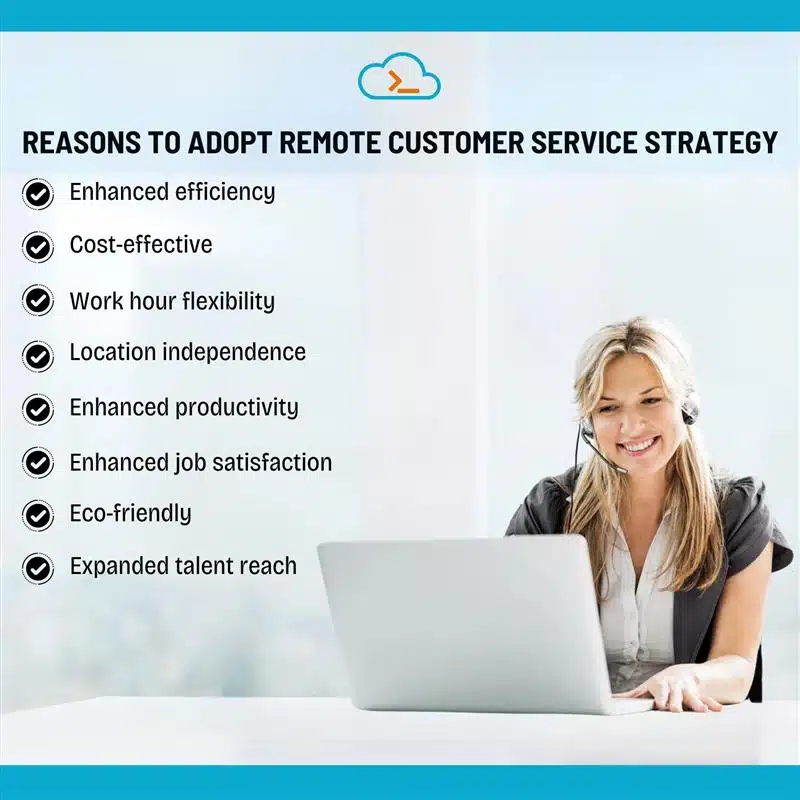
Reasons To Adopt Remote Customer Service Strategy

Here are a few compelling reasons why adopting a remote customer service strategy can benefit your business:

1. Enhanced efficiency

Remote work optimizes time and boosts productivity. Eliminating daily commutes and office distractions allows remote customer service agents to focus on their work, enhancing efficiency and performance in remote jobs.

2. Cost-effective

Embracing remote customer service agents can significantly decrease your company’s operational expenses and offer financial benefits to your employees. This approach allows your staff to save on commuting, fuel, work-related expenses, and wardrobe costs, ultimately leading to substantial overall savings.

3. Work hour flexibility

Remote customer service agents can select their preferred work hours, enabling a range of schedules. Employers can create 24/7 customer support coverage by hiring agents for remote jobs with diverse time zone availability, ensuring high demand and comprehensive service for early risers and night owls.

4. Location independence

Remote work is highly valued by employees, especially millennials and those with job and family responsibilities. It promotes a healthier work-life balance and increases long-term commitment to your company.

5. Enhanced productivity

The advantages of remote work are clear: it boosts productivity by minimizing distractions compared to an office environment. A study by the Harvard Business Review even found that remote employees can be so productive that they effectively gain an extra workday every week.

6. Enhanced job satisfaction

Remote customer service jobs allow employees to pursue an improved work-life balance, increased job satisfaction, vacation management, and reduced stress levels. This workflow can positively impact remote customer service agents’ motivation and employee retention rates.

7. Eco-friendly

Incorporating remote and customer service roles into your company’s corporate social responsibility efforts can positively impact the environment. Remote work diminishes commuting, energy consumption in office buildings, and paper usage, consciously supporting sustainability goals and fostering a greener workspace.

8. Expanded talent reach

Embracing remote customer service opens up the opportunity to source top talent globally, allowing access to a diverse pool of highly skilled customer experience professionals.

By adopting a remote customer service strategy with the assistance of a SaaS product marketing agency, your organization can enjoy multiple advantages, such as cost savings, increased productivity, remote customer service openings, and the ability to tap into a larger talent pool.
Reasons To Adopt Remote Customer Service Strategy

Role of Ideal Remote Customer Center Agent

Customer support roles and responsibilities are critical in any business, directly influencing customer satisfaction, retention, and overall success. Listed below are prerequisites that customer service job seekers should practice.

1. Responding to customer inquiries

To address customer inquiries effectively, respond promptly and courteously to questions about products, services, policies, and processes. Maintain clear communication and professionalism. Use automated systems for inquiry confirmation, guide common questions, and employ a multi-channel approach to home customer service through email, telephone, and live chat support.

2. Resolving customer complaints

Effective complaint management is essential for maintaining high customer satisfaction. Representatives should demonstrate empathy, answer questions, employ problem-solving skills, and ensure follow-up. It’s best to establish a clear protocol for handling grievances, empower agents to provide timely resolutions and leverage customer feedback to enhance products and services.

3. Providing product and service information

Ensuring that customer service agents thoroughly understand the company’s offerings, including product knowledge, service understanding, and recommendation skills, is essential for effective assistance.

4. Following up with customers

Following up with clients to express gratitude and ensure satisfaction is important. Use phone calls, emails, and surveys. Key aspects include proactivity, feedback collection, and relationship building. Best practices involve scheduling future appointments, using automated systems, and personalizing follow-up messages.

5. Processing orders and transactions

Customer service representatives assist with orders, transactions, accuracy, efficiency, and security by using safe software, providing comprehensive training, and regularly reviewing procedures.

6. Collecting and analyzing customer feedback

Customer feedback is essential for refining products, services, and customer satisfaction. Customer service representatives should systematically gather and analyze feedback to identify areas for improvement. Always maintain accurate and current customer data. Use secure CRM software, provide employee data privacy and security training, and regularly update customer records.

Conclusion

Strong communication and problem-solving skills are important when seeking remote customer service jobs. Additionally, having a dedicated workspace and reliable high-speed internet connection is crucial for success in customer support jobs. Numerous job search platforms and specialized websites cater to remote customer service positions, and reputable companies like Amazon and Apple frequently offer such opportunities.

Frequently Asked Questions

What is the ideal customer service representative?

The most effective customer support team is adept at identifying and addressing the needs of frustrated individuals. Instead of taking things personally, they prioritize the situation and communicate empathy swiftly.

How can one be a good remote customer service representative?

A remote customer service agent is the first point of contact for a customer approaching with an issue. This position requires effective communication and problem-solving ability while being patient during outbound calls. Efficient time management and active listening.

What does a customer support representative do?

Support representatives are readily available to assist with customer inquiries or address questions. They offer their services through email or text, catering to customers’ needs in different industries.

Web Development In 2024: Futuristic Transformative Trends

Web Development In 2024: Futuristic Transformative Trends

By Rasmita Patro

Web development in 2024 is set for transformative changes propelled by rapid technological advancements and evolving user expectations. The emphasis is on crafting more interactive, responsive, and secure web experiences. New-generation technologies such as machine learning, artificial intelligence, and augmented reality are redefining the landscape while the integration of voice user interfaces and optimization for smart devices continues to expand.

Next-generation AI technologies reshape the web development process, user interactions, and web experiences. This brief explores key trends and future directions, highlighting how these advancements revolutionize web programming and drive digital transformation. With the widespread adoption of cloud service providers, social media platforms now leverage content delivery networks and interactive user interfaces to enhance site functionality, efficiently handle user queries, and collect data through advanced capture tools. Businesses can use custom web development and content management systems to enhance web browsers and achieve improved site functionality while ensuring secure access to sensitive data.

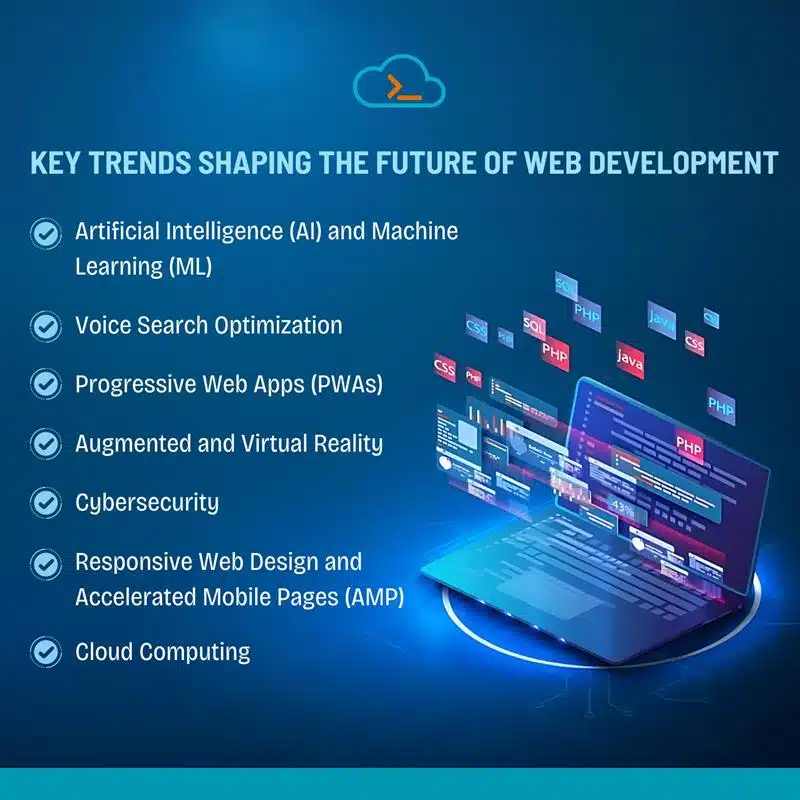
Key Trends Shaping the Future of Web Development

Web programming has evolved significantly from static web pages to dynamic, interactive platforms. Incorporating emerging technologies is transforming the development process, user satisfaction, and the overall impact of web applications. Following are the key web development trends that will shape our future:

  • Artificial Intelligence (AI) and Machine Learning (ML) – AI-powered algorithms analyze user behavior to deliver tailored content and recommendations, enhancing user impressions. AI can assist in code generation, testing, debugging, and streamlining the development lifecycle. By analyzing vast datasets, AI helps businesses make data-driven decisions and anticipate user needs.
  • Voice search optimization – As voice assistants become increasingly common, optimizing websites for voice search is essential. Developers are creating voice-driven interactions, making web experiences more intuitive using NLP. Providing clear and concise information in search results is essential for voice search visibility.
  • Progressive web apps (PWAs) – PWAs offer app-like experiences, including offline access, push notifications, and fast loading times. These apps work seamlessly across different devices, providing consistent user satisfaction. PWAs reduce bounce rates and increase user retention.
  • Augmented and virtual reality – AR and VR transform how users interact with digital content. Augmented reality can enhance product visualization, while VR offers virtual try-ons. Immersive learning experiences are becoming more accessible through AR and VR.
  • Cybersecurity – With increasing cyber threats, safeguarding user data is paramount. Strong encryption protocols are essential to protect sensitive information. Keeping software and systems up-to-date is crucial for preventing vulnerabilities.
  • Responsive web design and accelerated mobile pages (AMP) – Responsive design allows websites to adjust seamlessly to various screen sizes. AMP accelerates page load times on mobile devices, improving user impressions.
  • Cloud computing – Cloud-based development offers scalability and cost-effectiveness. Cloud platforms facilitate teamwork and remote development.
Key Trends Shaping the Future of Web Development

Future of Development In the Next 5 Years

The future of web development is characterized by:

  • Human-centric design: Creating intuitive and accessible experiences for users of all abilities.
  • Ethical considerations: Developing websites and applications that respect user privacy and data security.
  • Continuous learning: It is essential to stay competitive and keep up to date with the latest technologies and trends.
  • Collaboration: Working closely with designers, UX experts, and other stakeholders to create exceptional products.

AI will revolutionize web development by automating tasks, personalizing user experiences, and enabling predictive modeling. Developers will need to acquire AI skills to stay competitive. Businesses should invest in research and development, collaborate with skilled web developers, and prioritize user engagement.

Here are a few futuristic transformative web development trends that will shape the future of web development:

  • AI-driven development tools: AI automates coding, bug detection, and optimization, speeding up development and enhancing code quality. Examples include AI-driven editors, IDEs, and debugging tools. Predictive analytics will further optimize web applications.
  • Intelligent CMS: AI-enhanced CMS platforms automate content generation, personalization, and SEO, improving user experience and satisfaction by delivering tailored content.
  • Personalized user experiences: AI processes user data to deliver personalized content, products, and services, boosting engagement and conversion rates.
  • Chatbots and virtual assistants: AI-powered chatbots provide real-time support, handling queries and transactions to enhance user interaction and reduce human support workload.
  • AI in predictive analytics: AI predictive modeling helps developers anticipate user needs and make data-driven decisions, improving web application performance and engagement.
  • Adoption of emerging tech: Blockchain, IoT, and 5G will drive innovation in web development, offering new opportunities and capabilities.

For businesses looking to excel in web technologies, collaborating with a leading digital marketing agency in India can offer innovative strategies and insights to effectively integrate futuristic and transformative trends into your online presence.

AI-Powered Innovations

  • AI-enhanced security measures – AI tools are increasingly being used to enhance cybersecurity. They can identify and address threats in real-time, identify vulnerabilities, and provide predictive analysis to prevent potential attacks. AI-based security systems continuously learn and adapt to new threats, ensuring robust protection in web apps.
  • Autonomous web development – The concept of autonomous web development, where AI systems can build and maintain websites with minimal human intervention, is becoming a reality. These systems can create design layouts, write code, and optimize performance based on predefined parameters and ongoing learning from user engagements.
  • AI-powered web design – AI tools are transforming web design by automating the creation of aesthetically pleasing and functional layouts. These tools analyze design trends, user preferences, and usability principles to generate designs that enhance the user experience.
  • Enhanced voice user interface (VUI) – AI advancements in natural language processing (NLP) are improving VUI capabilities. These interfaces are becoming more intuitive and capable of understanding complex commands, providing a seamless and efficient way for users to interact with web applications.

To effectively navigate the futuristic web development trends, investing in top-notch content marketing services can help you create engaging and innovative content that aligns with the latest advancements and enhances your website’s impact.

Key Takeaways

  • AI and ML transform web development: AI and ML drive personalized experiences, automate coding, and improve predictive modeling.
  • Voice search optimization grows: Voice-driven interactions and NLP are becoming crucial for intuitive and accessible web experiences.
  • PWAs and AR/VR integration: Progressive Web Apps enhance user satisfaction, while AR/VR transforms digital content interaction for immersive experiences.

Conclusion

Web development is on the cusp of a transformative era. In 2024, web development will be defined by the inclusion of advanced technologies and a focus on creating more engaging, responsive, and secure web experiences. As the web development domain evolves, staying updated with these transformative trends will be crucial for developers and businesses.

Frequently Asked Questions

1. What are Progressive Web Applications (PWAs)?

PWAs are the applications that provide a native app-like experience by combining the best features of web and mobile apps. They offer offline functionality, faster load times, and enhanced performance.

2. How is voice search optimization important for web development?

Voice search optimization is important as it caters to the growing number of users relying on voice assistants and smart devices. Optimizing content for voice queries ensures better discoverability and user experience.

3. What role do AI and ML play in web development?

AI and ML enhance web development trends by enabling predictive modeling, personalized user engagements, and efficient data capture. They also power chatbots and virtual assistants, improving user interactions.

4. How can cybersecurity be ensured in web development?

Cybersecurity in web development involves implementing robust security measures such as encryption, secure authentication, and regular security audits to protect confidential data and prevent unauthorized access.
6 Essential Considerations for SEOs Building a Headless Website

6 Essential Considerations for SEOs Building a Headless Website

By Aparna Sushumna

Building a headless website has become a popular choice for modern SEOs seeking to enhance site performance, flexibility, and user experience. Unlike traditional websites, a headless setup separates the front-end and back-end, allowing developers to use different technologies for each. This separation offers numerous advantages, such as faster loading times and a more dynamic user experience. However, to fully leverage the benefits of a headless architecture, SEOs must consider several essential factors.

The global demand for headless content management systems has surged due to the increasing need for flexibility and control in distributing content across multiple channels. Headless CMSes are also viewed as more developer-friendly than traditional, monolithic CMSes.

In this blog, we will explore six crucial considerations for SEOs when building a headless website.

Understanding Headless Websites

A headless content management system involves implementing specific processes for optimizing SEO on headless websites. These processes include content modeling, intentional technical setup, and omnichannel search. It’s important to note that many popular SEO tools may not integrate seamlessly with headless CMSs. Despite this, SEO remains a fundamental aspect, aiming to deliver the best content most effectively. Ultimately, a successful headless SEO campaign hinges on three key elements.

Content Management Systems (CMS) utilize content models to separate content from its presentation effectively. Instead of just a collection of web pages, a content model is meticulously designed to represent the content’s structure accurately. This strategy allows for different types of content to be stored centrally and made available across various platforms. This approach empowers any front end to leverage the data format that best aligns with its specific requirements. agnostic to specific devices such as mobile phones or tablets. The primary objective of the content model is to precisely define the content needs based on attributes and their interrelations.

Traditional CMS vs. Headless CMS

Traditional CMSs consolidate all content within a single location and offer customization capabilities for specific devices, like combining various ingredients in a pizza. In contrast, a headless CMS separates content, codes, and designs, facilitating the seamless creation of content across diverse media platforms. For instance, in headless eCommerce, pricing data can be obtained from separate systems and seamlessly integrated into the website, operating independently from other content.

A headless CMS is a modern content management system that separates front-end and back-end functions that effectively separates front-end and back-end services for content creation, maintenance, and distribution. This architectural approach provides enhanced flexibility and scalability compared to traditional CMS systems. A key feature of a headless CMS is its utilization of a data layer instead of a traditional database, simplifying integration with third-party solutions. SEO best practices for headless website can be well executed with the best enterprise SEO agency in India.

Benefits And Disadvantages Of Using A Headless CMS For Search Engines

Benefits: easier integration with third-party technologies, content reuse across channels, and improved SEO performance.

Disadvantages: There is a prevalence of customizable integrations, which can be challenging to set up, and transitioning from a traditional CMS to a headless setup can be challenging due to the need for technical setup.

Headless SEO Fundamentals

a. Headless SEO and how it is different from traditional SEO

Headless SEO refers to the unique strategies SEOs use to optimize content with a headless CMS. It differs from traditional SEO approaches in terms of content creation and content distribution.

b. Importance of omnichannel SEO in headless architecture

Omnichannel SEO is a growing trend, requiring SEOs to optimize for search engines, social media, email, and other channels. Headless SEO goes beyond website optimization, considering user experience across all channels.

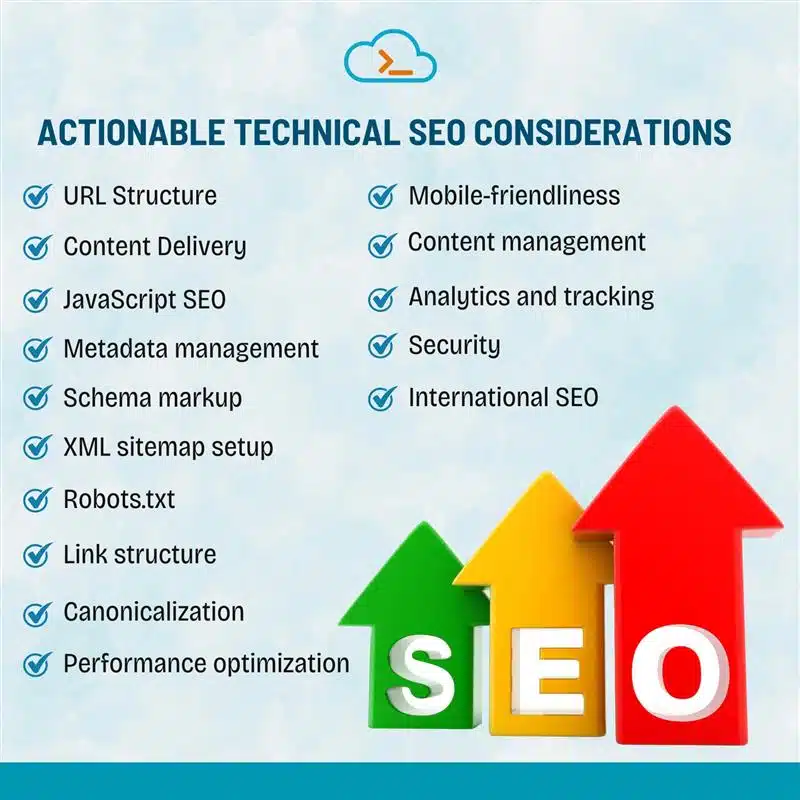
Actionable Technical SEO Considerations

Building a headless website involves separating the technical aspects of the presentation layer (front-end) from the back-end content management system (CMS). Here are key considerations the SEO team should consider:

1. URL Structure:

Ensure the URL structure on the static page is SEO-friendly, clear, and consistent. Avoid dynamic parameters and maintain clean, absolute URLs.

2. Content Delivery:

A content delivery network (CDN) can ensure fast and reliable content delivery, improving page load times and user experience.

3. JavaScript SEO:

Since headless websites often render JavaScript, search engines should properly crawl and index the content. Use SSR (server-side rendering) or SSG (static site generation).

4. Metadata management:

Implement proper meta tags, including title tags, to ensure search engines understand your pages’ content, structure, and internal linking.

5. Schema markup:

Improving your chances of appearing in rich search results.

6. XML sitemap setup:

Creating and maintaining XML sitemaps in the root directory helps search engines discover and reuse content, create valuable content, and index your pages more efficiently.

7. Robots.txt:

Ensuring your robots.txt or X-Robots-Tag directives is correctly configured allows search engines to crawl the necessary parts of your site while blocking sensitive areas.

8. Link structure:

Maintain a logical and hierarchical link structure to ensure easy navigation, fix broken links, and ensure proper internal linking, which will benefit users and search engines.

9. Canonicalization:

Canonical tags prevent duplicate content issues and ensure that search engines know the preferred version of a page. The top best enterprise agency in Hyderabad assists in preventing errors in canonical URLs.

10. Performance optimization:

Optimize for speed and performance, as users and search engines favor fast-loading pages. Compress images, leverage browser caching, and minimize cascading style sheets and JavaScript.

11. Mobile-friendliness:

Ensure the site is fully responsive and mobile-friendly, as mobile usability on-page content is a critical ranking factor.

12. Content management:

Have a clear strategy for managing and updating content to keep it fresh and relevant, which is important for SEO.

13. Analytics and tracking:

It is properly implementing analytics and tracking to monitor user behavior, traffic, and the effectiveness of SEO efforts.

14. Security:

Ensure the website is secure (HTTPS). Search engines present secure sites, and users trust them more.

15. International SEO:

Implement lang tags for multilingual or multi-regional sites to indicate language and regional targeting if applicable.

Top enterprise SEO agency in India assists firms and businesses in attaining the above SEO requirements.

Actionable Technical SEO Considerations For Headless Website

Benefits And Drawbacks Of Using A Headless CMS

Ahrefs primarily utilizes the headless framework to present content using the Google algorithm. This approach enables agile updates and ensures that our content remains consistently current. Nonetheless, we have found that the advantages of avoiding headless approaches outweigh those of embracing them.

It is important to understand the potential drawbacks of a headless CMS. Despite the advantages of headless systems, it’s important to consider some potential drawbacks. While they can be more complex than traditional CMS systems, they offer exciting opportunities for innovative web development. Non-technical development teams may initially find navigating the integration and specialized APIs challenging. Still, headless systems can lead to successful and efficient web development with the right support and expertise. Although there are challenges, smaller firms can thrive in headless situations with the right strategies and support.

Key Takeaways

  • To excel at Headless SEO setup, it’s essential to grasp the intricacies of working with a system that separates content from presentation.
  • To enhance their performance, SEOs should proactively request essential fields in the CMS, such as titles, editable URL slugs, and an indexing management system.
  • Conducting a JavaScript parity audit is vital when establishing a JavaScript-heavy headless SEO strategy to guarantee that ensuring search engines can correctly interpret and index the content uncovered during keyword research.

Conclusion

The rise of headless CMSes demands an evolution in SEO practices. SEO professionals must sharpen their technical skillset and rethink content strategies. Building a strong technical SEO foundation on the front-end is essential. Headless architecture, however, empowers optimizations within the CMS itself, streamlining workflows for content editors.

Frequently Asked Questions

1. What is headless SEO?

Headless SEO involves optimizing a headless website for organic search engines. This process includes using headless content management systems and implementing methods that assist search engine spiders in efficiently crawling, searching, and ranking headless web pages.

2. How does headless CMS affect SEO?

Enhance your Search Engine Optimization efforts with a modern headless CMS that fully supports emojis. The headless CMS platform continuously evolves as technology progresses, empowering businesses to keep pace with the latest SEO trends and elevate content delivery across multiple channels.

3. What are the advantages of headless SEOs?

The biggest perks of adopting headless websites are Facilitating seamless content publishing across multiple channels, expanding reach to a wider audience, Streamlining the website for increased agility and versatility, and enhancing collaboration between development and content teams by eliminating bottlenecks.
The Role Of AI In E-commerce Customer Support: Opportunities And Challenges

The Role Of AI In E-commerce Customer Support: Opportunities And Challenges

By Rasmita Patro

Artificial Intelligence (AI) is revolutionizing e-commerce companies and the customer support landscape, offering significant opportunities and posing unique challenges. This article explores how AI is transforming customer service in e-commerce, increasing customer satisfaction, and its implications for e-commerce businesses.

In recent years, AI technologies have been increasingly integrated into various aspects of e-commerce operations, particularly in customer support. This integration has been driven by the need for efficiency, personalization, and responsiveness in handling accurate customer interactions. AI tools and algorithms can now analyze customer data, predict behaviors, and automate responses, thereby improving the customer service paradigm.

How AI Is Revolutionizing E-commerce Customer Care

AI encompasses various technologies like machine learning models, natural language processing (NLP), and deep learning. When applied to customer support, artificial intelligence takes on several roles and provides:

  • 24/7 Availability: AI-powered chatbots and virtual customer service representatives can provide instant customer support, regardless of the time zone. This eliminates long wait times and frustrations associated with traditional customer service channels.
  • Efficient Handling of Inquiries: AI can manage customer questions, allowing human service representatives to concentrate on more complex issues that need empathy and a personal touch.
  • Proactive Problem Solving: By analyzing consumer data and identifying patterns, machine learning can anticipate potential problems and proactively offer AI solutions. This can include suggesting alternative products, reminding customers about abandoned carts, or offering troubleshooting steps.

A Digital Marketing Company can create targeted social media campaigns for your online businesses and help your e-commerce business reach new customers.

Boosting E-commerce Success With AI

AI significantly impacts customer services, offering many advantages. Here’s an overview:

  • Enhanced Customer Satisfaction: Faster response times, personalized service, and proactive problem-solving lead to a more positive customer experience, ultimately boosting satisfaction and loyalty.
  • Improved Operational Efficiency: AI automates repetitive tasks, freeing up human resources for higher-value activities. It translates to cost savings and a more efficient customer service operation.
  • Data-Driven Insights: AI can process extensive customer data to uncover valuable insights into their preferences, behaviors, and challenges. This enables businesses to personalize their offerings, improve customer satisfaction, and enhance overall decision-making processes.
  • Increased Sales and Conversions: AI can help e-commerce businesses convert more visitors into paying customers by providing personalized recommendations and proactively addressing customer concerns.

Navigating AI Implementation Challenges In E-commerce

Implementing AI in customer services offers numerous benefits but comes with several challenges. Here are some of the key challenges:

  • High Implementation Costs: Developing and implementing AI technology can be expensive, particularly for smaller e-commerce businesses.
  • Data Protection Concerns: Utilizing consumer data for AI requires strict adherence to data protection regulations. This ensures that customer privacy is maintained, data is securely stored and processed, and consent is obtained for historical data usage, thereby building trust and compliance with legal standards. E-commerce businesses must ensure transparency and build trust with customers regarding how their data is collected, used, and stored.
  • Limited Emotional Intelligence: Machine learning currently lacks the emotional intelligence to handle complex or sensitive customer interactions. Human consumer service representatives remain vital for situations requiring empathy, understanding, and de-escalation.
  • Bias in AI Algorithms: AI systems can inherit and amplify biases from the information they are trained on. E-commerce businesses need to be proactive in recognizing and addressing potential biases to guarantee fair and inclusive customer experiences.

Transforming Customer Interaction And Support With AI

In customer interaction and support, Artificial Intelligence (AI) assumes several roles. Some of them are illustrated below:

  • Virtual Assistant: Providing instant support, answering common customer queries, and directing customers to relevant resources.
  • Data Analyst: Analyzing customer information to identify trends, understand behavior, and improve service quality.
  • Proactive Problem Solver: Anticipating customer issues and offering solutions before they escalate.
  • Feedback Collector: Gathering customer feedback through chatbots and sentiment analysis to continuously improve customer service.
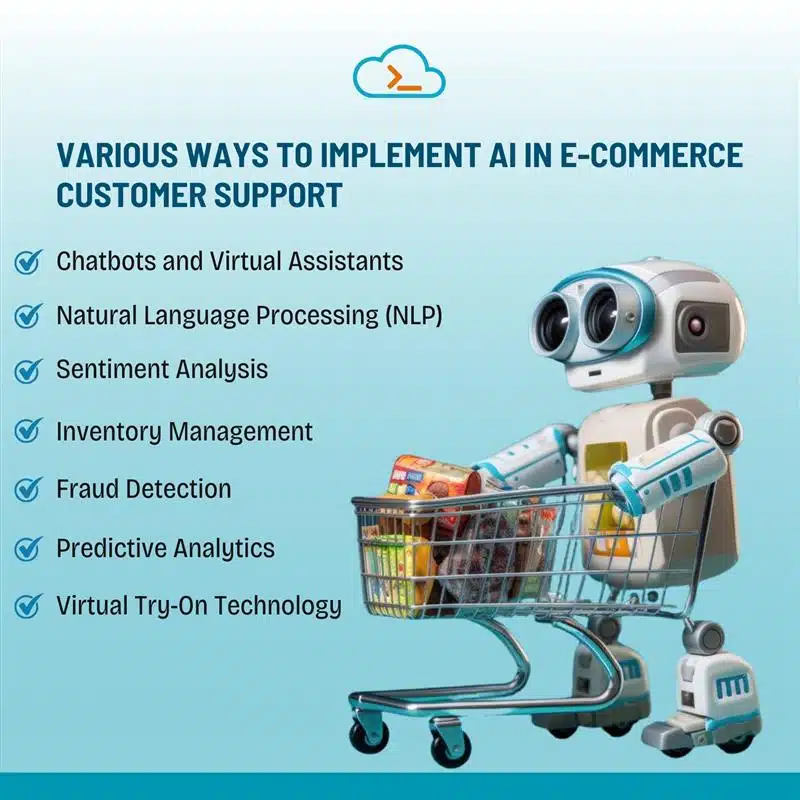
Various Ways to Implement AI in E-commerce Customer Support

AI Applications in E-commerce: Boosting Customer Support

The E-commerce industry can implement AI in various ways to enhance customer support and gain a competitive edge. Here are some practical applications:

  • Chatbots and Virtual Assistants: These Artificial Intelligence (AI) tools can answer frequently asked questions (FAQs), guide customers through self-service options, and collect basic information to route them to the appropriate human representative for complex issues.
  • Natural Language Processing (NLP): NLP allows AI to understand natural language and respond to customer inquiries in a natural and conversational way. It makes interacting with the system smoother and less aggravating.
  • Sentiment Analysis: AI can analyze client interactions, including chat transcripts, emails, and social media posts, to understand customer sentiment. This enables businesses to pinpoint areas for enhancement and address customer concerns proactively.
  • Inventory Management: AI can analyze sales data to predict future demand, enabling businesses to optimize inventory levels and prevent stockouts. This translates to a smoother customer experience and fewer order fulfillment issues.
  • Fraud Detection: AI algorithms can examine purchasing patterns and detect anomalies that may signal fraudulent activity. This helps protect e-commerce businesses from financial losses.
  • Predictive Analytics: AI analyzes customer data to predict client behavior and preferences. This allows businesses to personalize the customer journey by offering targeted recommendations, proactive support, and dynamic pricing strategies.
  • Virtual Try-On Technology: AI-powered virtual try-on tools allow customers to see how clothes or other products would look on them before they purchase. This lowers the risk of returns and boosts customer gratification.

Building Trust And Transparency In AI-Driven E-commerce Support

Ethical considerations become paramount as AI plays a more prominent role in e-commerce customer support. Here’s how businesses can build trust and transparency:

  • Be transparent about AI usage: Inform customers when they are interacting with an AI and clearly define the limitations of AI technology.
  • Provide clear opt-out mechanisms: Allow customers to choose not to interact with AI and opt for human interaction if they prefer.
  • Respect data privacy: Adhere to regulations, ensure confidentiality, and clearly communicate how user data is managed, and be transparent about how user data is collected, used, and stored.
  • Focus on human-AI collaboration: Embrace a hybrid approach where AI complements human interaction, allowing human representatives to handle complex situations that require empathy and emotional intelligence.

The Future

The future of AI in e-commerce customer service is bright. Here’s what we can expect:

  • More Sophisticated AI Assistants: AI assistants will continue to evolve, becoming more adept at understanding complex customer inquiries and responding with empathy and personalization.
  • Multimodal Client Interactions: Customers will interact with AI through various channels, including text, voice, and video chat, creating a more seamless and natural experience.
  • Integration with Existing E-commerce Platforms: Artificial Intelligence (AI) Solution will become increasingly integrated with existing online platforms, allowing for a smooth and unified customer experience across all touchpoints.
  • Enhanced Personalization: AI will leverage customer information to personalize consumer interactions even more, offering highly targeted recommendations and proactive assistance.

By effectively leveraging AI and prioritizing ethical considerations, digital businesses can create exceptional consumer experiences that foster brand loyalty and drive business growth.

Key Takeaways

  • AI boosts customer satisfaction and sales in e-commerce by offering faster support, personalizing experiences, and anticipating needs, leading to happier, loyal customers.
  • Implementing AI involves challenges such as cost, potential biases, data privacy concerns, and ensuring customer trust and understanding of the technology.
  • AI is transforming customer service, with future advancements promising more sophisticated assistants, seamless multi-channel interactions, and enhanced personalization.
  • Strategic and ethical AI use will keep e-commerce businesses competitive.

Conclusion

AI represents a powerful tool for enhancing e-commerce customer support, offering opportunities for improved efficiency, personalized experiences, and strategic insights. However, businesses must navigate challenges such as integration complexity, data privacy concerns, and ensuring customer acceptance. By leveraging AI to analyze customer behavior more effectively and ethically, businesses can differentiate themselves in a competitive market, driving customer happiness and loyalty through innovative customer service solutions.

Frequently Asked Questions

1. How does AI improve customer retention in e-commerce?

AI enhances customer retention by personalizing online shopping experiences, anticipating needs, and providing proactive support, thereby fostering loyalty and satisfaction.

2. What are the ethical considerations for using AI in customer support?

Ethical considerations include ensuring fairness in AI algorithms that understand customer behavior, maintaining transparency in automated interactions, and safeguarding customer privacy and data.

3. Can AI completely replace human customer service representatives?

While AI can effectively handle routine tasks and inquiries about AI systems, human representatives are indispensable for empathy, complex problem-solving, and building emotional customer connections.

Voice Assistance Technology In Customer Support: A New Era Of Personalized Experience

Voice Assistance Technology In Customer Support: A New Era Of Personalized Experience

By Rasmita Patro

In today’s dynamic business landscape, Voice Assistant Technology (VAT) is revolutionizing customer support operations, ushering in a new era of personalized customer experiences. This advanced technology leverages artificial intelligence (AI), machine learning (ML), and natural language understanding (NLU) to enhance customer interactions, streamline support processes, and ultimately drive customer satisfaction to new heights.

Advanced voice-responsive technology has emerged as a pivotal tool in modern customer support systems, promising significant enhancements in efficiency,“Customer trafficking”, and operational cost savings. By integrating VAT into existing customer support systems and frameworks, businesses can elevate their service capabilities, foresee customer needs, and deliver contextually relevant solutions swiftly and effectively.

Revolutionizing Customer Interactions

Imagine a world where customers can give voice commands to get the help they need. Voice bots, fueled by natural language processing (NLP) and machine learning (ML), are making this a reality. These intelligent helpers can understand natural language just like humans, eliminating the need for customers to decipher complex menus or cryptic error messages. With simple voice commands and voice bots, customers can ask questions, make requests, and receive solutions – all through a natural, conversational interface. This intuitive approach removes the friction from traditional customer support systems, making it easier and faster for customers to get the assistance they deserve.

Unlocking The Power Of Customer Data

Voice assistants go beyond mere interaction. They leverage the power of customer data to personalize the support experience. By seamlessly integrating with existing CRM systems, voice AI gains access to a customer’s past interactions, preferences, and purchase history. This treasure trove of relevant data empowers voice bots to tailor responses, provide contextually relevant solutions, and even anticipate customer needs before they arise. Imagine a customer contacting support about a technical issue. The voice bots, armed with the customer’s device history, can access past troubleshooting attempts, address concerns, and suggest solutions specific to the problem at hand. This personalized approach fosters deeper customer relationships and builds trust, leaving customers feeling valued and understood.

Traditionally, customer support relied heavily on human intervention, often resulting in limitations in scalability and consistency. With the advent of VAT, powered by advanced voice recognition tech and AI-driven voice bots, businesses can now automate routine tasks, provide instant responses to customer queries, and achieve substantial improvements in operational efficiency.

Elevating Customer Engagement

Voice Assistance Technology injects a dose of natural engagement into customer experiences. Conversational interactions with a voice AI feel less like talking to a machine and more like interacting with a helpful representative. This personalized and engaging approach can significantly enhance customer satisfaction and loyalty. Moreover, voice bots are always available 24/7, eliminating the frustration of wait times and limited operating hours. Customers can get the help they need whenever it’s convenient for them, fostering a sense of empowerment and control over their customer experience.

Voice recognition technology lies at the core of VAT, enabling businesses to interact seamlessly with customers through voice interactions and understand customer queries in natural language. ML algorithms enhance VAT’s capabilities over time by learning from customer interactions, thereby improving accuracy and responsiveness. Together, these technologies empower businesses to offer personalized consumer experiences tailored to individual preferences and histories.

Benefits of Voice AI Technology

Benefits Of Voice AI Technology

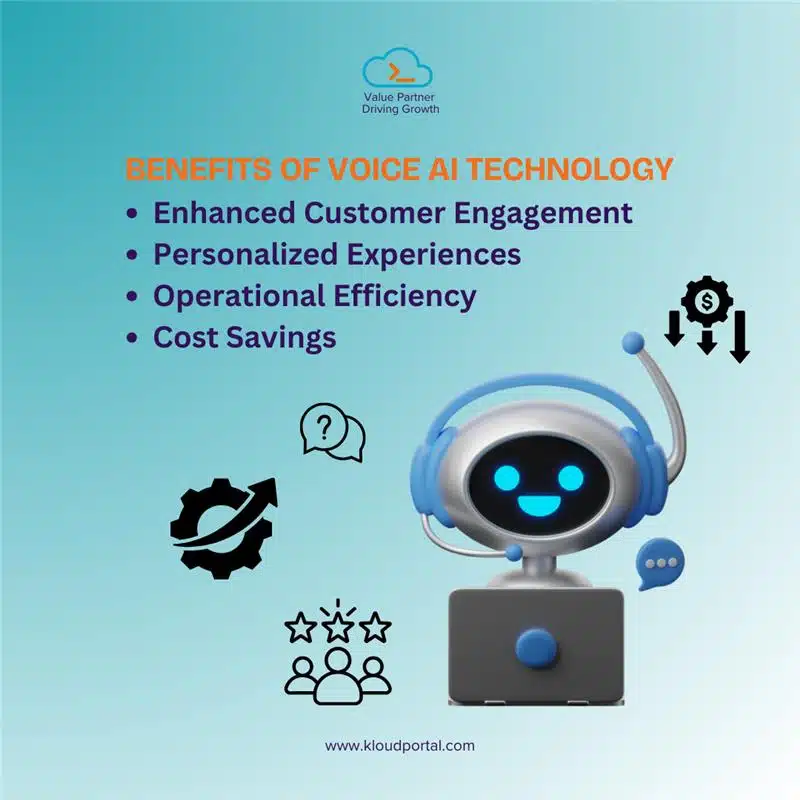
Implementing Voice Assistance Technologies offers numerous benefits to businesses aiming to get customer feedback and elevate their customer support capabilities:

  • Enhanced Customer Engagement: VAT enables natural and conversational interactions, fostering deeper connections and understanding between businesses and customers.
  • Operational Efficiency: Automation of repetitive tasks reduces response times and operational costs, allowing support teams to focus on complex issues and strategic initiatives.
  • Cost Savings: Through efficient resource allocation and error reduction, VAT results in significant cost savings within customer support operations.
  • Personalized Experiences: AI-driven insights enable businesses to personalize interactions based on customer preferences, histories, and real-time context.

Challenges And Considerations

While VAT offers transformative benefits, its implementation requires careful consideration of several factors:

  • Technical Integration: Guaranteeing seamless integration with existing systems and infrastructure.
  • Data Privacy: Safeguarding consumer data and complying with data protection regulations.
  • User Acceptance: Educating customers about VAT capabilities and addressing concerns about privacy and security.
  • Continuous Improvement: Consistent updates and maintenance to align with changing customer expectations and technological advances.

The Role Of AI In Personalization

The voice AI system is not mere parrots repeating pre-programmed responses. They are powered by advanced voice technology, including voice recognition and natural language understanding (NLU). These AI capabilities empower voice AI to comprehend the context and intent of a customer’s query. This allows them to go beyond keyword matching and provide more accurate and helpful responses. As AI continues to evolve, voice bots will become even more sophisticated, offering customers a truly personalized experience that feels as natural as talking to a friend.

AI is crucial in shaping personalized customer experiences through voice automation technology (VAT). By analyzing extensive consumer data, AI algorithms can predict customer behavior, anticipate needs, and recommend relevant products or services. This proactive strategy not only improves customer satisfaction but also fortifies customer relations by providing timely and valuable insights derived from pertinent data.

For businesses in Hyderabad, choosing a Digital Marketing Agency ensures localized technical expertise and an understanding of the regional market dynamics. These agencies leverage their knowledge to craft effective digital strategies tailored to meet local business needs and objectives.

Future Challenges And Strategic Planning

The successful integration of voice AI systems is not just an upgrade; it’s a strategic leap. By leveraging voice technology, businesses can gain valuable insights into customer behavior and preferences. This data can be utilized to predict customer needs, enhance support services, and devise faster and more effective solutions and marketing strategies. Additionally, voice AI has the potential to redefine communication channels. Searches through voice bots can become the primary mode of customer interaction, allowing customers to access support seamlessly through their smartphones, smart home devices, and other voice-enabled platforms.

However, navigating this voice-powered future requires careful planning and integration of voice bots with existing systems. Businesses must ensure a smooth transition and avoid customer frustration. Striking a balance between voice control systems and human intervention is crucial. Complex issues and situations requiring empathy and emotional intelligence will still benefit from the human touch.

Key Takeaways

  • Voice Assistant Technology (VAT) enables natural, conversational interactions, improving customer engagement and satisfaction by making support more accessible and personalized.
  • Automating repetitive tasks with VAT reduces response times and operational costs, allowing support teams to focus on more complex issues and strategic initiatives.
  • Voice Assistant Technology leverages customer data to provide contextually relevant solutions and anticipates customer needs, fostering deeper relationships and trust.

Conclusion

Voice AI technology is revolutionizing customer support, transforming it from a reactive process into a proactive one. By offering a natural, personalized, and efficient experience, voice AI is empowering businesses to build stronger customer relations, increase satisfaction, and gain a competitive edge. As voice technology advances, the potential to create a seamless and delightful customer experience knows no bounds. The future of customer support lies in a voice-powered oasis where customers can get the help they need, whenever they need it, through a natural and engaging conversation. Embrace the power of voice and create a customer support experience that sets your brand apart.

Frequently Asked Questions

1. What technologies enable effective voice recognition in customer service?

Advanced voice assistant recognition technologies, supported by AI and NLU capabilities, facilitate accurate understanding and response to customer queries.

2. What are the benefits of integrating AI with VAT for customer interactions?

AI enhances VAT by analyzing consumer data to predict needs, personalize interactions, and deliver proactive solutions, thereby enhancing the overall customer experience.

3. How can businesses leverage VAT to gain a competitive edge in customer support?

By leveraging VAT, businesses can differentiate themselves through superior customer service, increased operational efficiency, and deeper customer insights, ultimately driving growth and loyalty.

We use cookies to ensure that we give you the best experience on our website. If you continue to use this site we will assume that you are happy with it.

Cookies settings
Accept
Privacy & Cookie policy
Privacy & Cookies policy
Cookie name Active

Privacy Policy

What information do we collect?

We collect information from you when you register on our site or place an order. When ordering or registering on our site, as appropriate, you may be asked to enter your: name, e-mail address or mailing address.

What do we use your information for?

Any of the information we collect from you may be used in one of the following ways: To personalize your experience (your information helps us to better respond to your individual needs) To improve our website (we continually strive to improve our website offerings based on the information and feedback we receive from you) To improve customer service (your information helps us to more effectively respond to your customer service requests and support needs) To process transactions Your information, whether public or private, will not be sold, exchanged, transferred, or given to any other company for any reason whatsoever, without your consent, other than for the express purpose of delivering the purchased product or service requested. To administer a contest, promotion, survey or other site feature To send periodic emails The email address you provide for order processing, will only be used to send you information and updates pertaining to your order.

How do we protect your information?

We implement a variety of security measures to maintain the safety of your personal information when you place an order or enter, submit, or access your personal information. We offer the use of a secure server. All supplied sensitive/credit information is transmitted via Secure Socket Layer (SSL) technology and then encrypted into our Payment gateway providers database only to be accessible by those authorized with special access rights to such systems, and are required to?keep the information confidential. After a transaction, your private information (credit cards, social security numbers, financials, etc.) will not be kept on file for more than 60 days.

Do we use cookies?

Yes (Cookies are small files that a site or its service provider transfers to your computers hard drive through your Web browser (if you allow) that enables the sites or service providers systems to recognize your browser and capture and remember certain information We use cookies to help us remember and process the items in your shopping cart, understand and save your preferences for future visits, keep track of advertisements and compile aggregate data about site traffic and site interaction so that we can offer better site experiences and tools in the future. We may contract with third-party service providers to assist us in better understanding our site visitors. These service providers are not permitted to use the information collected on our behalf except to help us conduct and improve our business. If you prefer, you can choose to have your computer warn you each time a cookie is being sent, or you can choose to turn off all cookies via your browser settings. Like most websites, if you turn your cookies off, some of our services may not function properly. However, you can still place orders by contacting customer service. Google Analytics We use Google Analytics on our sites for anonymous reporting of site usage and for advertising on the site. If you would like to opt-out of Google Analytics monitoring your behaviour on our sites please use this link (https://tools.google.com/dlpage/gaoptout/)

Do we disclose any information to outside parties?

We do not sell, trade, or otherwise transfer to outside parties your personally identifiable information. This does not include trusted third parties who assist us in operating our website, conducting our business, or servicing you, so long as those parties agree to keep this information confidential. We may also release your information when we believe release is appropriate to comply with the law, enforce our site policies, or protect ours or others rights, property, or safety. However, non-personally identifiable visitor information may be provided to other parties for marketing, advertising, or other uses.

Registration

The minimum information we need to register you is your name, email address and a password. We will ask you more questions for different services, including sales promotions. Unless we say otherwise, you have to answer all the registration questions. We may also ask some other, voluntary questions during registration for certain services (for example, professional networks) so we can gain a clearer understanding of who you are. This also allows us to personalise services for you. To assist us in our marketing, in addition to the data that you provide to us if you register, we may also obtain data from trusted third parties to help us understand what you might be interested in. This ‘profiling’ information is produced from a variety of sources, including publicly available data (such as the electoral roll) or from sources such as surveys and polls where you have given your permission for your data to be shared. You can choose not to have such data shared with the Guardian from these sources by logging into your account and changing the settings in the privacy section. After you have registered, and with your permission, we may send you emails we think may interest you. Newsletters may be personalised based on what you have been reading on theguardian.com. At any time you can decide not to receive these emails and will be able to ‘unsubscribe’. Logging in using social networking credentials If you log-in to our sites using a Facebook log-in, you are granting permission to Facebook to share your user details with us. This will include your name, email address, date of birth and location which will then be used to form a Guardian identity. You can also use your picture from Facebook as part of your profile. This will also allow us and Facebook to share your, networks, user ID and any other information you choose to share according to your Facebook account settings. If you remove the Guardian app from your Facebook settings, we will no longer have access to this information. If you log-in to our sites using a Google log-in, you grant permission to Google to share your user details with us. This will include your name, email address, date of birth, sex and location which we will then use to form a Guardian identity. You may use your picture from Google as part of your profile. This also allows us to share your networks, user ID and any other information you choose to share according to your Google account settings. If you remove the Guardian from your Google settings, we will no longer have access to this information. If you log-in to our sites using a twitter log-in, we receive your avatar (the small picture that appears next to your tweets) and twitter username.

Children’s Online Privacy Protection Act Compliance

We are in compliance with the requirements of COPPA (Childrens Online Privacy Protection Act), we do not collect any information from anyone under 13 years of age. Our website, products and services are all directed to people who are at least 13 years old or older.

Updating your personal information

We offer a ‘My details’ page (also known as Dashboard), where you can update your personal information at any time, and change your marketing preferences. You can get to this page from most pages on the site – simply click on the ‘My details’ link at the top of the screen when you are signed in.

Online Privacy Policy Only

This online privacy policy applies only to information collected through our website and not to information collected offline.

Your Consent

By using our site, you consent to our privacy policy.

Changes to our Privacy Policy

If we decide to change our privacy policy, we will post those changes on this page.
Save settings
Cookies settings