Snowflake vs Databricks vs BigQuery: Which Data Platform Should You Choose? 

Snowflake vs Databricks vs BigQuery: Which Data Platform Should You Choose? 

Choosing a cloud data platform today feels a lot like picking the engine for a race car — the wrong one won’t just slow you down, it can cost you the race entirely. Snowflake, Databricks, and Google BigQuery dominate nearly every serious conversation about modern data infrastructure, and for good reason: all three are world-class. But they aren’t interchangeable.

If you’re a data leader, architect, or engineering head weighing Snowflake vs Databricks vs BigQuery, this guide cuts through the marketing noise and gives you a grounded, practical comparison — one that reflects how these platforms behave in production, not just on a benchmark slide.

Understanding the Core Philosophy of Each Platform

Before comparing features, it’s worth understanding what each platform was built to be. That foundational DNA shapes every trade-off you’ll encounter.

Feature Snowflake Databricks BigQuery
Architecture Data Warehouse Lakehouse Serverless Warehouse
Best For BI & Analytics AI/ML & Engineering GCP Analytics
Cloud Support AWS/Azure/GCP AWS/Azure/GCP GCP Only
Pricing Compute-based Cluster-based Query-based
SQL Support Excellent Good Excellent
ML Capabilities Limited Native Advanced Moderate
Infrastructure Mgmt Very Low Medium None

Performance & Cost: The Real-World Picture

Benchmarks tell part of the story, but real-world cost depends heavily on your workload pattern. Here’s what matters in practice:

  • Snowflake excels at concurrent, multi-team analytics. Its per-second billing and automatic suspension make costs predictable for bursty workloads.
  • Databricks can be more cost-efficient for heavy batch ETL at scale, but requires careful cluster tuning and Spark expertise to realize those savings.
  • BigQuery is often the cheapest for sporadic, ad-hoc queries — but poorly partitioned tables can result in surprisingly high scan costs.
According to Gartner, worldwide end-user spending on public cloud services reached $723.4 billion in 2025 — a 21.5% year-on-year increase — driven heavily by AI adoption and enterprise data modernization. That momentum has only accelerated into 2026.
That spending surge tells you one thing: organizations aren’t dabbling anymore. They’re committing. And the platform you commit to will shape your analytics, AI capabilities, and cloud bill for years to come.

Which Platform Wins for Your Use Case?

Snowflake

Choosse if….

Your teams are primarily SQL-driven analysts and data consumers. You need strong data governance, cross-team data sharing, and a platform that works across AWS, Azure, and GCP. Snowflake’s near-zero operational overhead means your engineers spend time on insights, not infrastructure. It’s the safest “default choice” for analytics-first organizations.

Best for analytics-first enterprise

Databricks

Choose if….

You’re running complex data engineering pipelines, training ML models, or building AI applications. If your team speaks Python and Spark fluently, Databricks’s open lakehouse architecture — with Delta Lake, MLflow, and Model Serving — gives you an end-to-end platform that no other vendor matches for advanced data science workloads.

Best for AI/ML-heavy organization

BigQuery

Choose if….

You’re already invested in Google Cloud. BigQuery’s native integrations with Looker, Vertex AI, Google Ads, and GA4 make it the natural home for GCP-native analytics. The fully serverless model means zero infrastructure management, and for marketing or product analytics teams, it’s often the fastest path to insight.

Google-native analytics teams

A Real-World Scenario: The Multi-Team Enterprise

Consider a mid-size fintech company with three distinct teams: a business intelligence team running SQL dashboards, a data engineering team building batch pipelines, and a machine learning team training risk models.

This is precisely where many organizations end up running more than one platform. Snowflake for BI consumption. Databricks for ML pipelines. BigQuery if they have Google Cloud commitments.

The platforms are increasingly complementary, not mutually exclusive — and modern data stacks often bridge two or three of them with tools like dbt, Fivetran, or Apache Airflow.

Conclusion

The Snowflake vs Databricks vs BigQuery debate doesn’t have a single correct answer — and anyone who tells you otherwise is selling something. The right platform is the one that maps to how your team actually builds, queries, and operationalizes data today and where you’re headed over the next three years.

With cloud infrastructure spending accelerating and AI workloads demanding more from data platforms, this decision is strategic, not just technical.

Still unsure which path is right for your organization? That’s where expert guidance matters.

At KloudPortal, we help organizations navigate data platform decisions with clarity — from architecture assessments to end-to-end implementation across Snowflake, Databricks, and BigQuery.
Let’s talk about your data journey →

Frequently Asked Questions

Which is better: Snowflake or Databricks?

Snowflake is better for enterprise analytics and BI workloads, while Databricks is stronger for AI, machine learning, and large-scale data engineering.

Is BigQuery cheaper than Snowflake?

BigQuery can be cost-effective for occasional analytics workloads due to its serverless pricing. However, frequent large queries may increase costs quickly compared to Snowflake’s predictable compute model.

Why are enterprises adopting Databricks?

Enterprises adopt Databricks because it combines data engineering, analytics, and AI into a unified Lakehouse platform optimized for modern machine learning workflows.

Can businesses use Snowflake and Databricks together?

Yes. Many enterprises use Snowflake for governed analytics and Databricks for AI and data science workloads, creating a hybrid modern data architecture.

End-to-End Snowflake Data Engineering Strategy for Scalable Businesses 

End-to-End Snowflake Data Engineering Strategy for Scalable Businesses 

Data is the engine of competitive advantage, but only if your infrastructure can keep up. For businesses serious about building a modern, scalable data foundation, Snowflake data engineering has become the go-to approach. With its cloud-native architecture, Snowflake lets organizations ingest, transform, govern, and activate data at scale without the friction of legacy systems.
The global cloud data warehouse market is projected to grow from $36.31 billion in 2025 to $155.66 billion by 2034 at a CAGR of 17.55% (Market Research Future, 2025). Snowflake sits at the center of this shift, posting 27% year-over-year revenue growth and a $3.8B revenue run rate in 2024.

Why Snowflake? The Architecture That Changes Everything

Snowflake’s core advantage is simple: it separates compute from storage. You scale each independently, pay only for what you use, and avoid the over-provisioning trap that makes legacy warehouses expensive. Add multi-cloud support (AWS, Azure, GCP), native data sharing, zero-copy cloning, and Time Travel for point-in-time queries, and you have a platform designed for the way modern businesses actually work.

Building an End-to-End Snowflake Data Engineering Strategy

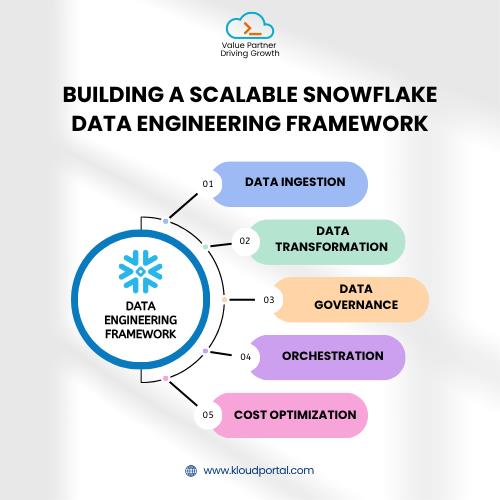
A real Snowflake strategy covers five interconnected layers:

01

Data Ingestion — Get the Right Data in

Use Snowpipe or COPY INTO for batch loads, Kafka connectors for real-time streams, and ELT tools like Fivetran or Airbyte for SaaS sources.

The principle: ingest raw first, transform later. This ELT approach preserves data fidelity and gives your team flexibility.

02

Data Transformation — DBT is the Standard

DBT (data build tool) has become the industry default for Snowflake transformations. Write modular SQL, version-control your logic, and run automated data quality tests.

A well-structured transformation layer moves data through three zones: Staging (clean raw data) → Intermediate (business logic applied) → Mart (analytics-ready datasets).

03

Data Governance — Trust at Scale

Snowflake’s native governance tools — column-level security, dynamic data masking, row access policies, and the Horizon data catalog — let you enforce access controls without bolting on external tools.

Notably, Snowflake’s Data Trends 2024 report found that enterprises doubled their use of governance features and increased their consumption of governed data by nearly 150%. Governance isn’t optional at scale; it’s what makes scale sustainable.

04

Orchestration — Keep Pipelines Reliable

Tools like Apache Airflow, Prefect, or dbt Cloud handle scheduling and sequencing. Every pipeline run should be observable, recoverable, and alerting to failure.

Build this early — retrofitting observability on a mature pipeline is painful and expensive.

05

Cost Optimization — Scale Smart

Snowflake’s consumption model rewards discipline. Right-size virtual warehouses, set auto-suspend policies, profile expensive queries, apply clustering keys to large tables, and lean on Snowflake’s 24-hour result cache wherever possible.

Real-World Use Case: Retail Analytics at Scale

A mid-size e-commerce retailer had 15+ data sources — Shopify, Salesforce, Google Analytics, custom inventory systems — stitched together with CSV exports and aging on-prem infrastructure. Reporting that required 6 hours to generate. After moving to a Snowflake-first architecture with Fivetran for ingestion, dbt for transformation, and Airflow for orchestration:

  • End-of-day reports went from 6 hours to under 4 minutes
  • Inventory optimization moved from monthly to daily cycles
  • Row-level security ensured regional managers saw only their data

That’s not a technology upgrade. That’s a business transformation.

Designing for AI from Day One

Snowflake has evolved beyond being just a data warehouse; it is now an AI Data Cloud. With Snowflake Cortex, teams can run tasks powered by large language models (LLMs) such as summarization, classification, and sentiment analysis directly on their data, without transferring it to an external provider.

Over 20,000 developers created more than 33,000 LLM-based applications in the Streamlit community within a single year (Snowflake Data Trends 2024).

If you are developing AI-powered products such as recommender systems, churn prediction models, or demand forecasts, designing your Snowflake environment to accommodate AI workloads from the very beginning will help you avoid a difficult retrofit later.

Building a Scalable Snowflake Data Engineering Framework

Where KloudPortal Fits into Your Snowflake Journey

Designing and executing a Snowflake data engineering strategy at scale is not a task that can be completed over a weekend. It requires deep expertise in various areas, including data ingestion, transformation, governance, orchestration, and cost management — often all at once.

KloudPortal brings practical Snowflake implementation experience to assist businesses in architecting solutions that are both technically sound and strategically aligned. Whether you are starting from scratch with a new Snowflake buildout or migrating from legacy data warehouses, our team understands how to transform raw data into real business value, without the trial-and-error pitfalls that usually slow down these initiatives.

If you’re considering a Snowflake-first strategy or looking to enhance your existing implementation, partner with the experts.

Conclusion

An end-to-end Snowflake data engineering strategy gives you exactly that: reliable ingestion, governed transformation, and AI-ready activation at scale.

KloudPortal brings hands-on Snowflake implementation experience — from greenfield builds to legacy migrations helping businesses move from raw data to real business value, faster and with fewer wrong turns.

If you’re ready to build a Snowflake strategy that grows with your business, let’s talk!

Frequently Asked Questions

1. What is Snowflake data engineering?

It’s the practice of designing and managing data pipelines using Snowflake as the core platform, covering ingestion, transformation, governance, and orchestration to deliver analytics-ready data at scale reliably.

2. How does Snowflake differ from traditional data warehouses?

Snowflake separates compute from storage, enabling independent scaling and consumption-based pricing. Traditional warehouses couple the two, leading to expensive overprovisioning. Snowflake also natively supports semi-structured data, cross-cloud deployment, and live data sharing.

3. What tools work best with Snowflake for data engineering?

The core stack: dbt (transformation), Fivetran or Airbyte (ingestion), Airflow or Dagster (orchestration), and Tableau or Looker (BI). For AI workloads, Snowflake Cortex and Snowpark keep everything within the platform without data egress.

4. How can businesses control Snowflake costs as they scale?

Right-size virtual warehouses per workload, enable auto-suspend on idle compute, profile and fix expensive queries, apply clustering keys to large filtered tables, and build a FinOps practice around Snowflake with usage tagging and regular cost reviews.

How to Build a Future-Ready Data Platform Using Snowflake 

How to Build a Future-Ready Data Platform Using Snowflake 

In today’s data-driven economy, businesses aren’t struggling to collect data; they’re struggling to use it effectively. Siloed systems, slow queries, and limited scalability often stand in the way of real-time insights. This is where building a future-ready data platform using Snowflake becomes a game-changer.

Modern enterprises need platforms that can scale instantly, support advanced analytics, and power AI-driven decisions. A well-designed Snowflake data platform does exactly that, transforming raw data into a strategic asset.

What Makes a Data Platform “Future-Ready”?

A future-ready data platform is designed to manage increasing data volumes, adapt to evolving business needs, and leverage emerging technologies such as real-time data processing, AI/ML inference, and cross-organizational data sharing. It surpasses traditional data warehouses by providing:

01

Seamless Scalability

Scale compute and storage independently, without the need for re-architecting as data volumes grow.

02

Built-in Governance

Row-level security, column masking, and data lineage out of the box, rather than added on later.

03

Multi-Cloud Portability

Avoid vendor lock-in by effortlessly running workloads across AWS, Azure, and Google Cloud Platform (GCP).

04

AI/ML Readiness

Native support for Python, Snowpark, and ML model deployment directly within the warehouse.

05

Secure Data Sharing

Share live data across teams and partners without moving or copying any files.

06

Real-Time Capability

Ingest and query streaming data alongside historical data within the same unified platform.

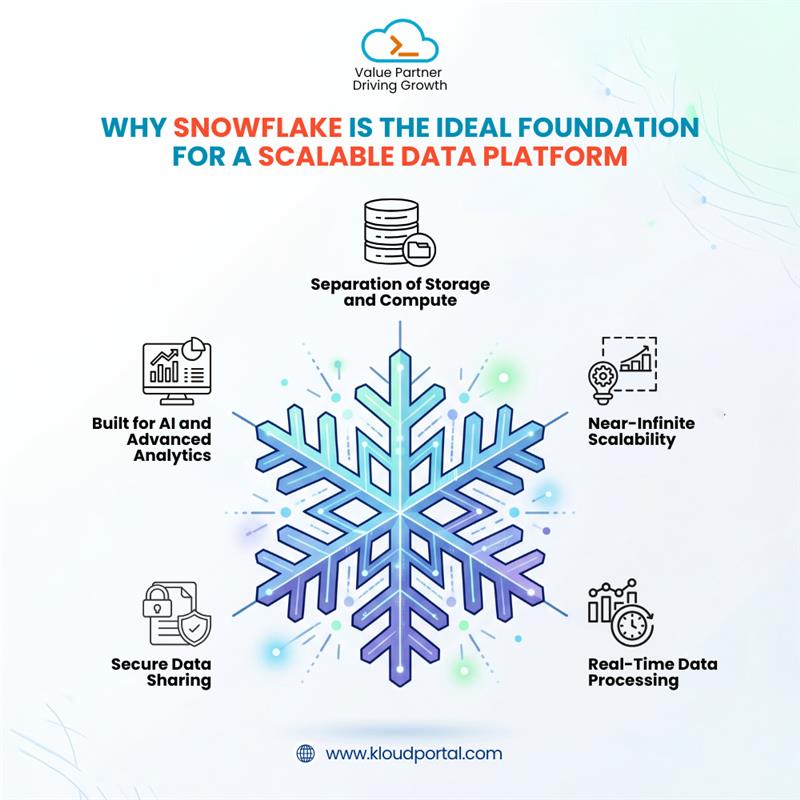
Why Snowflake Is the Ideal Foundation for a Scalable Data Platform

Several credible cloud data platforms are available today, but Snowflake has emerged as the preferred architecture for data-driven enterprises, and the statistics support this.

1. Separation of Storage and Compute

Snowflake’s architecture allows independent scaling of storage and compute, ensuring high performance without unnecessary costs.

2. Near-Infinite Scalability

Whether you’re handling gigabytes or petabytes, Snowflake scales effortlessly to meet demand.

3. Real-Time Data Processing

Supports real-time and batch workloads, enabling faster insights and decision-making.

4. Secure Data Sharing

Enables seamless and secure data sharing across teams, partners, and ecosystems.

5. Built for AI and Advanced Analytics

Snowflake integrates easily with AI/ML tools, making it a strong foundation for future-ready enterprises.

Snowflake Data Platform Strategy for Modern Enterprises

KloudPortal Insight: Organizations that consolidate their analytics, data sharing, and ML workloads on a single platform like Snowflake typically reduce integration maintenance time by over 35% in the first year alone.

Key Components of a Modern Snowflake Data Architecture

To build a future-ready platform, you need more than just a tool; you need a well-defined architecture.

1. Data Ingestion Layer

  • Tools like Snowpipe, APIs, or ETL pipelines
  • Supports structured and unstructured data

2. Data Storage Layer

  • Centralized data lake or warehouse within Snowflake
  • Handles massive volumes efficiently

3. Data Processing Layer

  • Transform data using SQL, ELT pipelines
  • Enable real-time and batch processing

4. Analytics & BI Layer

  • Integrate with tools like Power BI, Tableau
  • Enable dashboards and reporting

5. Governance & Security

  • Role-based access control
  • Data encryption and compliance

Step-by-Step: Building Your Future-Ready Snowflake Data Platform

Architecture decisions made early define your ceiling for years to come. Follow this sequence to avoid the most expensive mistakes.

01

Define Business Objectives

Start with clarity. Identify key use cases such as

  • Customer analytics
  • Operational insights
  • Predictive analytics

02

Design Scalable Architecture

Build a flexible architecture that supports

  • Multi-cloud environments
  • Data lakes + warehousing
  • Real-time analytics

03

Implement Data Pipelines

Set up automated pipelines for

  • Data ingestion
  • Transformation
  • Validation

04

Optimize Performance

Leverage Snowflake features like

  • Auto-scaling warehouses
  • Query optimization
  • Caching

05

Enable Data Governance

Ensure

  • Data quality
  • Compliance (GDPR, etc.)
  • Secure access controls

06

Integrate AI & Advanced Analytics

Prepare your platform for

  • Machine learning models
  • Predictive analytics
  • AI-driven insights

Business Benefits of a Snowflake-Powered Data Platform

Beyond the headline numbers, the tangible business outcomes from a mature Snowflake data platform include:

  • Faster time-to-insight — queries that took hours run in seconds; reports that needed IT tickets become self-service
  • Lower infrastructure costs — pay only for the compute you use, with automatic suspension when idle
  • AI and ML acceleration — clean, governed data feeds ML models directly, cutting data preparation time by 40–60%
  • Reduced data debt — a documented, tested dbt layer eliminates the “only Dave knows what this table means” problem
  • Regulatory confidence — built-in governance means audit requests become a query, not a scramble
  • Cross-functional alignment — finance, marketing, operations, and product all work from the same numbers

Common Pitfalls to Avoid

  • Migrating before architecting
  • Skipping governance
  • Under-investing in data quality
  • Treating it as a one-time project
  • Ignoring change management

Why KloudPortal for Your Data Transformation Journey

Building a future-ready data platform isn’t just about technology; it’s about execution. At KloudPortal, we help enterprises:

  • Design scalable Snowflake architectures
  • Build robust data pipelines
  • Enable AI-driven analytics
  • Ensure governance and performance optimization

Our approach focuses on aligning data strategy with business outcomes, so your platform delivers measurable impact, not just infrastructure.

Conclusion

A future-ready data platform using Snowflake empowers organizations to move faster, scale smarter, and innovate continuously. The question is execution, and that’s right partner makes all the difference.

Ready to turn your data into a competitive advantage?

KloudPortal partners with enterprises to design, build, and optimize Snowflake data platforms that deliver real business impact. Connect with us and take the first step.

Frequently Asked Questions

1. What makes Snowflake a future-ready data platform?

Snowflake offers scalability, real-time processing, and seamless integration with AI tools, making it ideal for modern data needs.

2. How does Snowflake improve data performance?

Its separation of compute and storage enables independent scaling, resulting in faster query performance and lower costs.

3. How long does it take to build a Snowflake data platform?

It depends on complexity, but with the right strategy and partner, implementation can be significantly accelerated.
Why 99.9% Uptime Is a Business Decision, Not a Technical One 

Why 99.9% Uptime Is a Business Decision, Not a Technical One 

“Is 99.9% uptime good enough? And who is actually responsible for it?”
The answer to both is uncomfortable, but critical. Because uptime isn’t owned by IT anymore, it’s now a business imperative. Companies that recognize this shift are the ones scaling faster, retaining customers longer, and avoiding costly outages.

The Hidden Math Behind 99.9% Uptime

“99.9% uptime” sounds nearly perfect, until you break it down:

~8 hours 45 minutes of downtime per year
That’s an entire business day where your platform is unavailable.
Now imagine that downtime hitting:

  • A SaaS platform during onboarding
  • An e-commerce checkout during peak sales
  • A fintech platform during trading hours

The impact becomes massive. Here are the real-world numbers (2026 insights):

  • Average downtime costs: Over $14,000 per minute
  • For large enterprises: Up to $23,750 per minute
  • For small and medium-sized businesses (SMBs): $25,000 to $100,000 per hour

The reality is 99.9% uptime on paper does not equal 99.9% uptime in practice. A system with automation, failover mechanisms, and observability operates very differently from one dependent on manual fixes at 2 AM.

Why Uptime Must Be Engineered, Not Just Monitored

Many companies still treat uptime as a metric to track, install monitoring tools, configuring alerts, and reacting only when issues occur. But this reactive approach falls short in today’s always-on environment. High-performing organizations take a different path. They treat uptime as a business strategy and design reliability into their systems from the start.

How to Achieve High Uptime in Modern Systems

  • High availability architecture
  • Automation-first DevOps practices
  • CI/CD automation with rollback mechanisms
  • SRE-driven reliability engineering

Because uptime isn’t achieved during incidents, it’s engineered long before they happen.

Real Example: When Uptime Becomes a Business Crisis

In early 2025, a major financial institution experienced a multi-day outage that prevented millions of users from accessing their accounts and completing transactions. The issue wasn’t just infrastructure failure, but a lack of resilience engineering:

  • No automated failover
  • Limited observability
  • Slow recovery processes

In contrast, companies that engineer for uptime experience:

  • Fail over instantly
  • Self-heal systems automatically
  • Minimal impact on customers

Same industry, different choices, different outcomes.

The Major Cause of Downtime: Human Error

66% to 80% of outages are caused by human error (2025 Uptime Institute). This is not due to a lack of tools or talent, but rather the reliance on manual processes under pressure.
If your uptime depends on:

  • Manual deployments
  • Late-night debugging
  • Engineers restarting services

Then downtime is not just a risk; it’s inevitable.

Why Automation-First DevOps is the Only Scalable Solution

Modern DevOps has evolved significantly:

  • 76% of teams now utilize AI in CI/CD pipelines
  • GitOps adoption is around 65%
  • 80% report improved reliability and faster recovery

Now, automation is no longer optional; it is essential for achieving high Uptime. It helps to reduce:

  • Human error
  • Recovery time
  • Operational stress

And enhances:

  • System resilience
  • Deployment speed
  • Business continuity
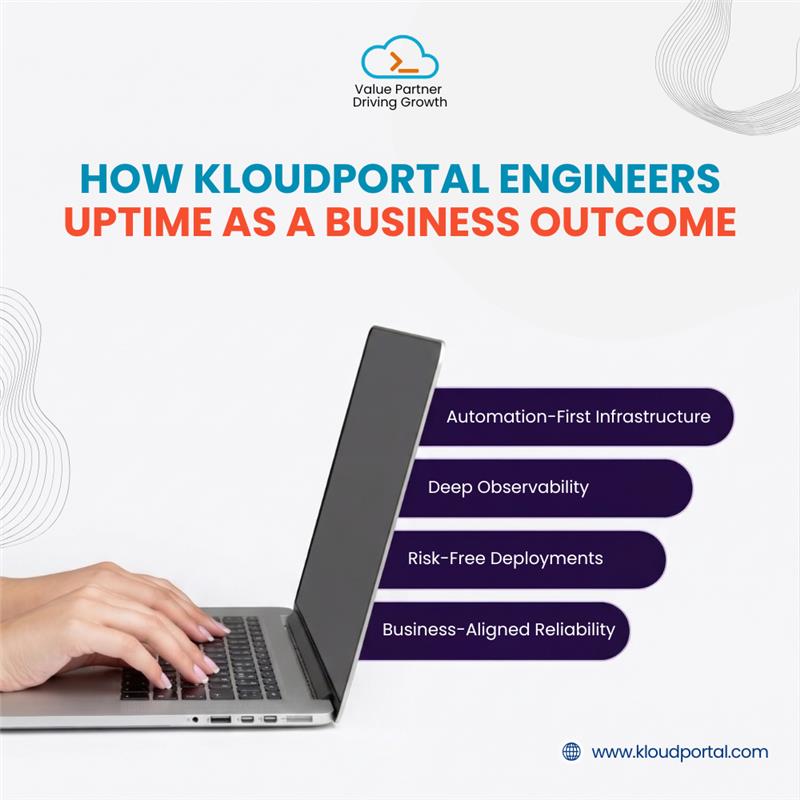
How KloudPortal Engineers Uptime as a Business Outcome

How KloudPortal Engineers Uptime as a Business Outcome

KloudPortal operates as a DevOps engineering partner. We design and manage automation-first, high-availability systems that ensure uptime is consistently delivered as a measurable business outcome.

Our approach focuses on:

1. Automation-First Infrastructure

  • Predictive auto-scaling to handle traffic spikes before they impact performance
  • Self-healing systems that detect and resolve failures automatically
  • Zero-touch recovery to restore services instantly without manual intervention

2. Deep Observability

  • Root cause visibility to quickly identify and resolve issues
  • Real-time system insights for proactive monitoring and decision-making
  • Predictive failure detection to prevent incidents before they occur

3. Risk-Free Deployments

  • Blue-green deployments to release updates without downtime
  • Canary releases to test changes with minimal risk
  • Automated rollback triggers to instantly revert failed deployments

4. Business-Aligned Reliability

  • Aligning uptime with revenue-critical systems to protect business impact
  • Mapping system performance to customer behavior patterns
  • Optimizing availability during peak usage hours

How to Choose the Right Uptime Target for Your Business

Not every system needs five nines, but every system needs clarity.

99.9% (Three Nines)

  • ~8.7 hours downtime/year
  • Suitable for non-critical systems

99.99% (Four Nines)

  • ~52 minutes/year
  • Ideal for SaaS, APIs, and checkout systems

99.999% (Five Nines)

  • ~5 minutes/year
  • For financial, healthcare, and mission-critical systems

What Are the Hidden Costs of Downtime

Beyond immediate revenue loss, downtime creates long-term business damage that’s often harder to measure but more expensive to recover from:

1. SEO & Search Rankings

Frequent downtime reduces trust signals, which impacts rankings.

2. Brand Reputation

Companies invest heavily to maintain a robust brand image; outages can undermine that trust.

3. Customer Churn

One negative experience can lead to a permanent switch to a competitor.

4. Engineering Burnout

Firefighting cultures drive top talent away from organizations.

Key Takeaways

  • Uptime is a business decision, not just an IT metric
  • Automation is the only scalable way to reduce downtime risks
  • The gap between Service Level Agreements (SLAs) and reality is addressed through DevOps engineering, not just tools.

Conclusion

The real question isn’t “Can we achieve 99.9% uptime?” It’s “What does downtime cost your business and how do you prevent it?”
Leading companies treat uptime as a business strategy, powered by automation-first DevOps and engineered reliability. If you’re still reacting to outages or relying on manual processes, it’s time to evolve. Partner with KloudPortal to build resilient, scalable systems that ensure uptime and drive growth.

Frequently Asked Questions

Is 99.9% uptime good enough for SaaS?

Not always. Most SaaS businesses require 99.99% uptime (~52 minutes), depending on business needs.

What causes most downtime incidents?

Human error is responsible for 66–80% of outages. Implementing automation significantly reduces this risk.

What’s the difference between DevOps tool installers and automation operators?

Tool installers configure systems while DevOps automation operators engineer self-healing, scalable, and resilient systems to ensure consistent uptime.
Which B2B Companies Provide the Best Data Engineers and Data Scientists in Hyderabad?

Which B2B Companies Provide the Best Data Engineers and Data Scientists in Hyderabad?

Hyderabad has emerged as a premier hub for technology and data talent in India. The city currently hosts over 300 Global Capability Centers (GCCs) and accounts for nearly 17% of India’s GCC ecosystem, making it a top destination for organizations building advanced digital and data capabilities. The demand for data engineering talent in Hyderabad continues to rise, fueled by the rapid adoption of AI platforms, cloud-native data infrastructure, and real-time analytics at scale. Despite the availability of talent, hiring the right professionals remains a strategic challenge. Industry reports suggest that the demand–supply gap for skilled data engineers and data scientists in India ranges between 60% and 73%. Because of this gap, many enterprises prefer partnering with specialized B2B technology providers that can deliver experienced professionals and scalable data solutions. This blog highlights leading B2B companies in Hyderabad that provide data engineers and data scientists, helping enterprises choose the right partner to build high-performing data teams.

Top B2B Companies That Provide Data Engineers and Data Scientists in Hyderabad

Several B2B technology companies in Hyderabad provide experienced data engineers and data scientists to help enterprises build modern data engineering teams and scalable data platforms. Some of them include: 1. Tiger Analytics: Consulting firm delivering AI-driven insights and advanced data science solutions. The company helps enterprises build scalable data platforms, machine learning models, and data-driven decision systems. 2. DataFactZ: Helps organizations modernize their data platforms and analytics ecosystems. Its services include data engineering, cloud data architecture, and predictive analytics for modern data environments. 3. Helical IT Solutions: Specializes in big data technologies, data warehousing, and business intelligence consulting. The company helps enterprises build modern data infrastructure and analytics dashboards for faster insights. 4. BizAcuity: Provides data engineering, analytics, and business intelligence solutions for enterprises. The company helps transform raw data into actionable insights through advanced reporting and analytics frameworks. 5. Kanerika Inc: Focuses on data integration, automation, and AI-powered analytics solutions for enterprises. The company supports organizations in building modern data pipelines and intelligent automation systems. 6. XenonStack: Specializes in enterprise AI platforms and cloud-native data engineering solutions, helping organizations implement scalable analytics architectures. 7. SetuServ: Combines human intelligence and artificial intelligence to deliver enterprise analytics solutions that help organizations extract deeper insights from large datasets and improve business decision-making. 8. ValueLabs: Provides data engineering, AI, and digital transformation services for enterprises across multiple industries. 9. Kellton Tech: Offers digital transformation services with expertise in data engineering, analytics platforms, and cloud-based enterprise data strategies. 10. Flutura Decision Sciences: Focuses on industrial AI and advanced analytics, helping manufacturing and energy companies implement predictive analytics and IoT-powered data platforms.

KloudPortal: Helping Enterprises Build High-Impact Data Engineering Teams

KloudPortal is a Hyderabad-based digital engineering company helping enterprises design, build, and scale modern data engineering and AI ecosystems. As an official Databricks partner, KloudPortal supports the entire data lifecycle from data architecture and master data management to machine learning deployment and advanced analytics. The company differentiates itself by combining deep technical expertise with strong alignment to business outcomes. focuses on ensuring that data initiatives drive revenue growth, operational efficiency, and improved customer experiences.

Key Capabilities

  • Data Architecture & Design for scalable cloud platforms
  • Master Data Management (MDM) for reliable enterprise data
  • Data Integration & Security across systems
  • AI & Machine Learning solutions
  • Modern data stack expertise, including Databricks and cloud analytics tools

Why Enterprises Choose KloudPortal

  • Access to skilled data engineers, data scientists, and AI specialists
  • Ability to augment teams with niche roles such as Data Science Engineers and LLM experts
  • Agile delivery models aligned with enterprise transformation goals
  • Strong reputation for responsive collaboration and outcome-driven delivery
By combining advanced data engineering capabilities with specialized talent, KloudPortal enables organizations to transform raw data into actionable insights and build future-ready data platforms.
What to Look for in a B2B Data Engineering Partner

What to Look for in a B2B Data Engineering Partner

Selecting the right partner is critical for organizations building modern data ecosystems. Here are some factors to consider.
  • Modern Stack Fluency: Leading providers typically work with modern technologies such as Python, Apache Spark, Snowflake, Databricks, and major cloud platforms like AWS, Azure, and Google Cloud to build scalable data pipelines and AI-ready platforms.
  • AI-Readiness: Data platforms today must support machine learning and AI workloads, so providers should have experience designing AI-ready data architectures.
  • Speed and Reliability: Enterprises need partners who can deploy skilled teams quickly while maintaining consistent delivery standards.
  • Engagement Flexibility: The best partners offer flexible engagement models such as staff augmentation, dedicated engineering teams, or project-based delivery.
  • Domain Coverage: Industry expertise across sectors such as fintech, healthcare, SaaS, retail, and manufacturing helps accelerate implementation and deliver better results.

Key Takeaways

  • Hyderabad offers enterprises access to some of the best B2B partners for building modern data teams and analytics platforms.
  • Companies like KloudPortal, Tiger Analytics, DataFactZ, Kanerika, and Helical IT Solutions provide strong B2B expertise for building modern data teams.
  • Choosing the right partner depends on technology expertise, AI readiness, delivery speed, and industry experience.

Conclusion

As organizations increasingly depend on data-driven strategies, the demand for skilled data engineers and data scientists continues to rise. Hyderabad’s vibrant technology ecosystem provides businesses with strong B2B partnerships for developing modern data platforms and enhancing analytics capabilities. If your organization is looking to expand its data engineering capabilities, KloudPortal can help you integrate the right talent, designing scalable data platforms, and accelerating your journey toward a future-ready data ecosystem.

We use cookies to ensure that we give you the best experience on our website. If you continue to use this site we will assume that you are happy with it.

Cookies settings
Accept
Privacy & Cookie policy
Privacy & Cookies policy
Cookie name Active

Privacy Policy

What information do we collect?

We collect information from you when you register on our site or place an order. When ordering or registering on our site, as appropriate, you may be asked to enter your: name, e-mail address or mailing address.

What do we use your information for?

Any of the information we collect from you may be used in one of the following ways: To personalize your experience (your information helps us to better respond to your individual needs) To improve our website (we continually strive to improve our website offerings based on the information and feedback we receive from you) To improve customer service (your information helps us to more effectively respond to your customer service requests and support needs) To process transactions Your information, whether public or private, will not be sold, exchanged, transferred, or given to any other company for any reason whatsoever, without your consent, other than for the express purpose of delivering the purchased product or service requested. To administer a contest, promotion, survey or other site feature To send periodic emails The email address you provide for order processing, will only be used to send you information and updates pertaining to your order.

How do we protect your information?

We implement a variety of security measures to maintain the safety of your personal information when you place an order or enter, submit, or access your personal information. We offer the use of a secure server. All supplied sensitive/credit information is transmitted via Secure Socket Layer (SSL) technology and then encrypted into our Payment gateway providers database only to be accessible by those authorized with special access rights to such systems, and are required to?keep the information confidential. After a transaction, your private information (credit cards, social security numbers, financials, etc.) will not be kept on file for more than 60 days.

Do we use cookies?

Yes (Cookies are small files that a site or its service provider transfers to your computers hard drive through your Web browser (if you allow) that enables the sites or service providers systems to recognize your browser and capture and remember certain information We use cookies to help us remember and process the items in your shopping cart, understand and save your preferences for future visits, keep track of advertisements and compile aggregate data about site traffic and site interaction so that we can offer better site experiences and tools in the future. We may contract with third-party service providers to assist us in better understanding our site visitors. These service providers are not permitted to use the information collected on our behalf except to help us conduct and improve our business. If you prefer, you can choose to have your computer warn you each time a cookie is being sent, or you can choose to turn off all cookies via your browser settings. Like most websites, if you turn your cookies off, some of our services may not function properly. However, you can still place orders by contacting customer service. Google Analytics We use Google Analytics on our sites for anonymous reporting of site usage and for advertising on the site. If you would like to opt-out of Google Analytics monitoring your behaviour on our sites please use this link (https://tools.google.com/dlpage/gaoptout/)

Do we disclose any information to outside parties?

We do not sell, trade, or otherwise transfer to outside parties your personally identifiable information. This does not include trusted third parties who assist us in operating our website, conducting our business, or servicing you, so long as those parties agree to keep this information confidential. We may also release your information when we believe release is appropriate to comply with the law, enforce our site policies, or protect ours or others rights, property, or safety. However, non-personally identifiable visitor information may be provided to other parties for marketing, advertising, or other uses.

Registration

The minimum information we need to register you is your name, email address and a password. We will ask you more questions for different services, including sales promotions. Unless we say otherwise, you have to answer all the registration questions. We may also ask some other, voluntary questions during registration for certain services (for example, professional networks) so we can gain a clearer understanding of who you are. This also allows us to personalise services for you. To assist us in our marketing, in addition to the data that you provide to us if you register, we may also obtain data from trusted third parties to help us understand what you might be interested in. This ‘profiling’ information is produced from a variety of sources, including publicly available data (such as the electoral roll) or from sources such as surveys and polls where you have given your permission for your data to be shared. You can choose not to have such data shared with the Guardian from these sources by logging into your account and changing the settings in the privacy section. After you have registered, and with your permission, we may send you emails we think may interest you. Newsletters may be personalised based on what you have been reading on theguardian.com. At any time you can decide not to receive these emails and will be able to ‘unsubscribe’. Logging in using social networking credentials If you log-in to our sites using a Facebook log-in, you are granting permission to Facebook to share your user details with us. This will include your name, email address, date of birth and location which will then be used to form a Guardian identity. You can also use your picture from Facebook as part of your profile. This will also allow us and Facebook to share your, networks, user ID and any other information you choose to share according to your Facebook account settings. If you remove the Guardian app from your Facebook settings, we will no longer have access to this information. If you log-in to our sites using a Google log-in, you grant permission to Google to share your user details with us. This will include your name, email address, date of birth, sex and location which we will then use to form a Guardian identity. You may use your picture from Google as part of your profile. This also allows us to share your networks, user ID and any other information you choose to share according to your Google account settings. If you remove the Guardian from your Google settings, we will no longer have access to this information. If you log-in to our sites using a twitter log-in, we receive your avatar (the small picture that appears next to your tweets) and twitter username.

Children’s Online Privacy Protection Act Compliance

We are in compliance with the requirements of COPPA (Childrens Online Privacy Protection Act), we do not collect any information from anyone under 13 years of age. Our website, products and services are all directed to people who are at least 13 years old or older.

Updating your personal information

We offer a ‘My details’ page (also known as Dashboard), where you can update your personal information at any time, and change your marketing preferences. You can get to this page from most pages on the site – simply click on the ‘My details’ link at the top of the screen when you are signed in.

Online Privacy Policy Only

This online privacy policy applies only to information collected through our website and not to information collected offline.

Your Consent

By using our site, you consent to our privacy policy.

Changes to our Privacy Policy

If we decide to change our privacy policy, we will post those changes on this page.
Save settings
Cookies settings