
The Rise of Micro-Moment Marketing: Capturing Consumers in Real-Time 

The Rise of Micro-Moment Marketing: Capturing Consumers in Real-Time 

By Raviteja Shyamala

Picture this: You’re lounging on your couch, scrolling through Instagram, and suddenly, out of nowhere, you get a craving for some Hyderabadi biryani. It’s like a switch flips in your brain. You grab your phone, open your favorite delivery app, and before you know it, that fragrant, spicy biryani is on its way to your doorstep. These are micro-moments—small but important decisions that can make or break a brand in today’s mobile-first world. As a business, if you’re not quick to grab their attention, they might just buy from someone else without a second thought. In this smartphone-obsessed world, patience is as rare as a landline phone. People want answers faster than they can swipe right, from “What’s the best coffee near me?” to “How do I fix my broken iPhone without selling a kidney?” These micro-moments shape everything we buy, visit, and even learn. As marketers, cracking the code to these fleeting instances is like unlocking a cheat code to your audience’s heart. At Kloudportal, a top-notch digital marketing agency, we help businesses master these micro-moments, making sure they’re the first to answer the burning questions that drive engagement and conversions.

What Are Micro-Moments?

Micro-moments are those tiny bursts of intent when people grab their devices to “know,” “go,” “do,” or “buy.” They’re not planning a wedding; they’re just deciding on dinner. The stakes? High. You snooze, you lose—literally.

The Four Types of Micro-Moments:

  1. I-want-to-know moments: Like when you Google, “What is that weird sound my car is making?” Educational content is your golden ticket here.
  2. I-want-to-go moments: Local SEO is king. Think “Best Biryani near me,” because no one’s driving 20 km for biryani.
  3. I-want-to-do moments: YouTube tutorials reign supreme. Who has yet to learn to bake bread or assemble furniture during these?
  4. I-want-to-buy moments: Shopping ads and smooth checkouts seal the deal. Pro tip: If your site isn’t mobile-friendly, say goodbye to sales.

Why Should Marketers Care?

Because micro-moments are the Super Bowl of consumer attention, Google says 96% of users (yup, you heard that right, 96%) are grabbing their smartphones for instant searches. We’re talking right now, not later. These moments have become the battlefield where brands either rise or fall. They’re like the gold rush of today’s marketing world – a chance to grab people when they’re actually looking for something and not just scrolling aimlessly (we’ve all done that too, right?).

Consumer Behavior in the Mobile Age

Welcome to the age of instant gratification, where waiting is so last season. Craving pizza? Swiggy it. Debating the best superhero movie? Google it faster than you can say, “Iron Man was clearly the best.” Seriously, waiting is like asking a cat to take a bath—not happening. Mobile devices have completely transformed marketing. Traditional strategies feel as outdated as my old fax machine. Remember those? Yeah, me neither.

Fun Stats to Chew On:

  • “Near me” searches have jumped by 500%. Apparently, we all want everything right now. Who wants to drive around when you can get anything delivered faster than a pizza?
  • Voice searches are booming. “Hey Siri, what’s the best chocolate cake recipe?”—probably the most asked question in my house. If you’ve never had a recipe showdown with Alexa, are you even living in 2024?
  • One-click checkouts are a must. If your cart has 10 steps, it’s basically a treasure hunt. Just give us the easy button already!

As consumers expect faster, easier, and near-magical experiences, businesses need to keep up or risk losing attention faster than a swipe left. But don’t worry—KloudPortal has your back by offering digital marketing services to help businesses stay ahead of the competition, from mobile-optimized strategies to seamless user experiences. Let’s lead the charge together!
How to Win at Micro-Moment Marketing

How to Win at Micro-Moment Marketing

Now that you’re familiar with the concept. Let’s dive into how you can actually capture these fleeting moments:

Step 1: Identify Customer Touch Points:

Map out where your customers are likely to be in these moments. Whether they’re doing a Google search for “best hiking boots” (I want to know) or something else, knowing where they are in the journey is key.

Step 2: Optimize for Mobile:

Fast, fast, fast! If your website exceeds 3 seconds to load, forget it. People won’t wait. Think fast-loading pages, easy navigation, and—most importantly—a website that doesn’t look like it was designed in 2003.

Step 3: Stay Local:

If you run a business, make sure you own those “near me” searches. Update your Google Business profile. Nobody’s clicking on “closed” businesses or outdated info.

A Real-Life Example

Let’s talk about Netflix. They’re the poster child for I-want-to-know moments. Remember when they dropped that “Top 10” list? Suddenly, deciding what to binge became an event. They knew viewers were overwhelmed by choice, swooped in with a solution, and owned those micro-moments.

Or how about Nike? Their app doesn’t just sell shoes. It helps you track workouts and find running routes, and it even offers fitness tips. They’re there for your I-want-to-do moments—and you end up buying their gear anyway.

Key Takeaways

  • Micro-moments are intent-driven, split-second decisions like “I want to know,” “I want to go,” “I want to do,” and “I want to buy.” influencing consumer behavior in a mobile-first world.
  • With 96% of users relying on smartphones for instant searches, they are key to capturing attention and driving conversions.
  • To succeed, businesses must optimize for mobile, leverage local SEO, ensure fast-loading pages, and map customer touchpoints effectively.

Conclusion

Micro-moment marketing is the new frontier where businesses can make a real impact, seizing those split-second opportunities to influence consumer behavior in real-time. Whether it’s an “I want to know,” “I want to go,” “I want to do,” or “I want to buy” moment, understanding these touchpoints and capitalizing on them is key to driving meaningful and profitable customer interactions.

The businesses that will succeed are those that perfect the art of being there for their customers exactly when it matters most. But don’t worry; you don’t have to navigate this complex landscape alone! KloudPortal, a Leading digital marketing agency in Hyderabad, is here to help businesses capture these critical micro-moments with tailored digital marketing services. We specialize in crafting strategies that help you connect with your audience when they’re most engaged, turning fleeting moments into lasting relationships.

Ready to make the most of your micro-moments? Contact us today, and let’s grow your business together!

Frequently Asked Questions

1.Why is micro-moment marketing important?

It helps brands connect with consumers at critical decision-making moments, driving engagement, conversions, and brand loyalty in today’s fast-paced digital world.

2.How do micro-moments influence consumer behavior?

Micro-moments shape decisions by providing users with instant, relevant answers, influencing what they buy, where they go, and how they act in real-time.

3.How can brands measure the success of micro-moment marketing?

Success can be measured by metrics like website traffic, engagement rates, local search visibility, and conversion rates during specific intent-driven actions.


The Ultimate Guide To NetSuite Staffing: How To Build A Winning Team

The Ultimate Guide To NetSuite Staffing: How To Build A Winning Team

By Rasmita Patro

In today’s competitive business, implementing a robust Enterprise Resource Planning (ERP) system like NetSuite can significantly improve efficiency, streamline business processes, and provide a competitive edge. However, assembling the right NetSuite team is critical to achieving success. This blog will explore how to build a winning team for your

Understanding the Complexity of NetSuite Staffing

Empower yourself by understanding the complexity of NetSuite staffing. NetSuite hiring is a complicated procedure that requires a profound understanding of your industry’s business processes, ERP implementation needs, and technical aspects of the system. Building a successful team entails identifying areas where new skills and expertise are necessary, leveraging existing staff, and tapping into external resources.

Key Components for Success

  • Project manager: A manager ensures the seamless execution of the NetSuite implementation, overseeing timelines, budgets, and deliverables.
  • Functional advisors: Functional advisors bring in-depth knowledge of NetSuite’s modules and help tailor the system to your business functions.
  • Technical experts: AI Specialists are essential for data migration, integrations, and customization, ensuring the system functions effectively.
  • Ongoing support team: Post-implementation support is critical to resolving technical issues and ensuring the system evolves with your business needs.

The Hiring Process: Securing the Right Talent

  • Define Your Needs: Clearly outline the functions and duties required for your NetSuite project.
  • Craft Compelling Job Descriptions: Highlight the unique opportunities and challenges associated with the role.
  • Leverage Your Employer Brand: Position your company as an attractive employer, emphasizing career growth and a positive work culture.
  • Partner with NetSuite Implementation Partners: These specialized agencies can deliver access to a pool of experienced NetSuite professionals.
  • Conduct Thorough Interviews: Assess technical expertise, problem-solving abilities, and cultural fit.

Staff Augmentation Services offer businesses access to specialized talent, helping them scale their teams quickly and efficiently for project success.

The Key Role of a NetSuite Implementation Consultant

In most cases, a NetSuite staffing implementation consultant is essential for a successful deployment. Here’s why:

  • Expert Guidance: Professionals bring specialized skills to handle both functional and technical details of the system.
  • Seamless Data Migration: They ensure your data is transferred accurately and securely.
  • Customization: Analysts help adapt the system to meet your specific business requirements.
  • Training and Support: They provide training for your existing workforce and offer solutions for ongoing challenges.

Hiring a manager consultant is an investment that pays off in terms of smoother implementation and long-term efficiency.

Core Components for Building the Right Team

Before venturing into external hiring, assess your existing workforce. Identify employees with:

  • Strong Technical Skills: A solid foundation in IT and a willingness to learn new technologies.
  • Adaptability: The capacity to embrace change and learn new systems quickly.
  • Define the Ideal Candidate: Look for professionals with a blend of technical skills, in-depth knowledge of NetSuite, and a track record of successful ERP projects.
  • Promote Company Culture: Ensure new hires align with your industry culture and share your vision for success.
  • Partner with Experts: Collaborate with NetSuite experience experts or consultants to fill critical skill gaps and provide ongoing assistance.

The Significant Role of Staff Augmentation Agency

A Staff Augmentation Agency specializes in sourcing the best talent for your NetSuite implementation, bridging gaps in expertise, and ensuring you hire the ideal candidates with confirmed expertise.

How Staff Augmentation Helps

  • Access to Top Talent: Agencies connect you with NetSuite professionals who have the required skills and experience, including functional consultants and IT specialists
  • Flexibility: You can onboard contract workers or full-time employees, depending on your needs.
  • Cost-Effectiveness: Hiring through an agency reduces overhead costs associated with recruitment and training.
  • Quick Turnaround: Agencies streamline the staffing process, ensuring no delays in your project timeline.

Relying on an experienced Staff Augmentation Agency ensures you build a team that is aligned with your industry culture, career goals, and the technical requirements of NetSuite implementation. Choosing the Best Staff Augmentation Company ensures you have access to top-tier talent that aligns with your project’s needs and goals.

Benefits of Working with NetSuite Implementation Partners

NetSuite implementation partners bring specialized expertise, resources, and a performance record of success to help your business achieve its ERP goals. Here are some benefits:

  • Proven Expertise: NetSuite vendors have a comprehensive understanding and hands-on experience in ERP implementation, making them invaluable for handling complex process aspects.
  • Data-Driven Decisions: Partners can analyze your workflows, identify areas of improvement, and provide tailored solutions based on data.
  • Efficient Implementation: With their advanced understanding of NetSuite, implementation partners reduce downtime and ensure the system is set up efficiently.
  • Ongoing Support: Beyond implementation, partners offer training, technical support, and system optimization to ensure long-term success.
Benefits of Working with NetSuite Implementation Partners

The Value of NetSuite Implementation Partners

Partnering with NetSuite implementation experts provides a strategic advantage. These professionals bring proven expertise and a history of successful implementations, helping businesses navigate the complexities of ERP deployment.

Key Advantages

  • Specialized Knowledge: NetSuite implementation partners have a deep understanding of the platform’s functionality and how to tailor it to specific business needs.
  • Improved Efficiency: Their expertise allows for quicker implementation and fewer disruptions to ongoing operations.
  • Customization and Support: They ensure the system is customized to fit your processes and provide constant support post-implementation.
  • Risk Mitigation: With their experience, they can anticipate and address prospective issues, reducing the risk of costly mistakes.

Key Takeaways

  • Building a successful NetSuite team involves understanding your ERP needs and addressing skill gaps, whether through in-house resources or staff augmentation agencies.
  • Staff augmentation provides rapid access to top NetSuite talent, reduces hiring costs, and accelerates project timelines.
  • NetSuite implementation partners help optimize ERP deployment, improve efficiency, and offer ongoing support for customization and long-term success.

Conclusion

Building a winning NetSuite team is a critical step toward achieving a successful ERP deployment. By leveraging the skills of a Staff Augmentation Agency, working with NetSuite consultants, and hiring skilled professionals, you can streamline business operations, enhance productivity, and gain an Advantage. Focus on identifying the right talent, promoting workplace culture, and ensuring Sustained support to maximize the significant impact of your NetSuite system.

Frequently Asked Questions

1. What is the role of a NetSuite implementation consultant?

A consultant provides expertise in system configuration, data migration, and customization, ensuring the implementation aligns with your business needs.

2. Can Current employees handle the implementation?

While Current employees can contribute, NetSuite’s complexity often requires specialized skills that external consultants or agencies provide.

3. How do Staff Augmentation Agencies streamline the hiring process?

These agencies handle recruitment, screening, and placement, ensuring you get skilled professionals without the hassle of traditional hiring.

4. How can I ensure long-term success with NetSuite?

Focus on assembling an effective team, investing in training, and working with experienced NetSuite partners for constant support and system optimization.

How AI Is Revolutionizing SEO: What Your Digital Strategy Needs 

How AI Is Revolutionizing SEO: What Your Digital Strategy Needs 

Rashmita Patro

In today’s dynamic digital environment, artificial intelligence (AI) has emerged as a critical component, empowering digital marketers to transform search engine optimization (SEO) and digital marketing strategies. The integration of AI into digital marketing has reshaped how businesses approach SEO. With advancements in machine learning, predictive analytics, and data analysis, AI is enabling marketers to craft highly effective, SEO-optimized content, streamline SEO tasks, and achieve enhanced online visibility. As search engines evolve with sophisticated search algorithms, digital marketers are leveraging AI to stay ahead of the curve and adapt to adapting user behaviors and preferences.

This article explores how AI is reshaping the SEO landscape, the strategies needed to capitalize on this transformation, and the implications for marketers aiming to future-proof their search engine rankings and attract their target audience in the dynamic digital ecosystem.

The Role of AI in Revolutionizing SEO

AI is revolutionizing Search Engine Optimization by automating processes, improving accuracy in keyword analysis, and refining the understanding of user intent. By analyzing huge volumes of user behavior data, AI tools help digital marketers identify relevant keywords, optimize their content creation efforts, and tailor strategies to meet their target audience’s needs.

Key aspects of how AI is transforming SEO include:

  • Enhanced Keyword Research and Relevance – AI tools for keyword research help digital marketers identify long-tail keywords and phrases that align with user intent, which refers to the particular purpose a user has in mind when searching. By analyzing billions of search requests, these tools reveal trends and opportunities that traditional methods might overlook. AI ensures keyword relevance and provides insights into market trends, which are crucial for SEO optimization.
  • Improved Search Algorithms and Personalization – Modern search engine algorithms prioritize content that matches user intent. AI-powered customization tailors search results based on individual preferences, location, and browsing history. This ensures that users receive more relevant results, making it essential for marketers to produce SEO-friendly content that resonates with their audience.
  • Content Creation and Optimization – AI tools simplify content creation by generating ideas, suggesting improvements, and ensuring adherence to SEO techniques . They also assist in content optimization, recommending enhancements to meta tags, structure, and readability. The result is highly engaging, SEO-friendly content that ranks better on search engines.
  • Voice Search and Visual Search – With the rise of voice search queries and visual search, AI is helping digital marketers optimize for these emerging formats. Voice search requires adapting content to conversational and question-based phrases, while visual search demands indexing and optimizing visual content like images and videos.
  • Data Forecasting for SEO – AI-powered predictive modeling enables marketers to anticipate search trends, forecast shifts in user behavior, and refine their digital marketing strategy accordingly. By predicting what users will search for next, businesses can stay ahead in delivering relevant content.
  • Automation of SEO Tasks – AI automates routine SEO tasks such as tracking search rankings, monitoring backlinks, and analyzing competitor performance. This efficient automation frees up valuable time for digital marketers to focus on the creative and strategic aspects of their campaigns, relieving them from the burden of mundane tasks.

Explore the Top Enterprise SEO Services in India designed to enhance your brand’s online presence and deliver sustainable growth in search engine performance.

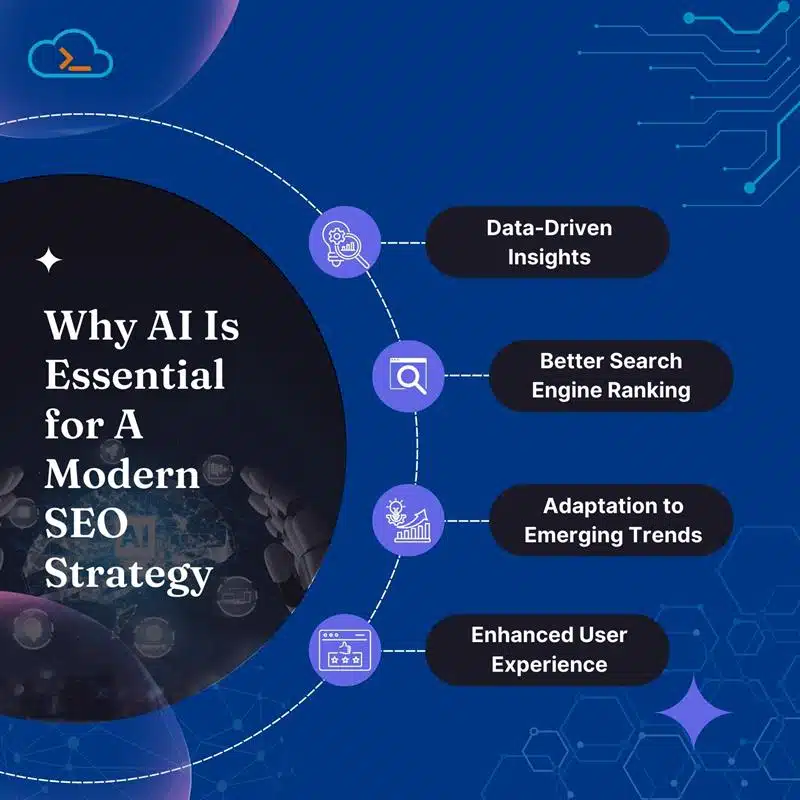
Why AI Is Essential for A Modern SEO Strategy

AI is no longer optional for achieving success in SEO; it’s a necessity. It offers unparalleled benefits in crafting effective digital marketing campaigns, enhancing client satisfaction, and staying compliant with data protection regulations. Here’s why integrating AI into your SEO strategy is vital:

  • Data-Driven Insights: AI enables comprehensive analysis of user data, uncovering patterns and preferences that guide digital marketers in crafting personalized content and refining their marketing efforts.
  • Better Search Engine Rankings: AI ensures higher and better search visibility by aligning content with evolving search engine mechanisms.
  • Adaptation to Emerging Trends: As audio search and image search gain traction, AI tools help businesses adapt by optimizing content for these formats.
  • Enhanced User Experience: AI improves customer satisfaction by delivering highly relevant and engaging content tailored to meet the unique needs of the audience.

Our Content Marketing Services are adapted to help organizations craft compelling content that resonates with audiences and drives measurable results.

Why AI Is Essential for A Modern SEO Strategy

AI and Content SEO Strategies in 2024

The year 2024 will witness further integration of AI into content SEO approaches, with an emphasis on creating value-driven, relevant, and engaging content. Key trends to watch include:

  • Voice Search Optimization: As smart assistants expand, optimizing for voice search queries will be pivotal. Marketers should focus on conversational content and address specific user questions.
  • Visual and Video Content Optimization: AI tools will enhance the ability to index visual content, ensuring that images and videos are accessible and optimized for search engines.
  • Hyper-Personalization: AI will refine personalized content delivery, ensuring that users receive tailored experiences that align with their preferences and past interactions. This could include serving content based on a user’s previous search history or recommending products based on their past purchases.
  • Smarter Predictive Analytics: Data forecasting, an AI, will play a central role in anticipating search request queries and trends, enabling marketers to stay proactive in their strategies.
  • SEO for Emerging Platforms: AI will help optimize content for non-traditional platforms like augmented reality (AR) and virtual reality (VR), expanding the scope of SEO.

Network with the Best Digital Marketing Agency in India to elevate your brand’s online presence and drive measurable results across various platforms.

Key Takeaways

  • AI automates routine SEO tasks like keyword analysis, content optimization, and competitor tracking, allowing marketers to focus on strategy and creativity.
  • AI enables personalized content, optimized for voice and visual searches, ensuring relevance and improving user experience for better search rankings.
  • AI-driven predictive analytics and trend forecasting help businesses adapt to emerging search formats and platforms, staying competitive in the evolving digital landscape.

Conclusion

AI is redefining what it means to succeed in SEO, making it an indispensable part of any digital marketing strategy. By embracing AI-driven tools and strategies, marketers can achieve better search engine rankings, deliver tailored experiences, and remain flexible in a rapidly evolving digital environment. As the SEO landscape continues to change, businesses that leverage AI will be well-positioned to thrive in the competitive online marketplace.

Frequently Asked Questions

1. How is AI revolutionizing SEO?

AI is revolutionizing SEO by automating processes, improving keyword targeting, enhancing content relevance, and adapting to user intent to achieve higher search visibility and better online visibility.

2. What are the main profits of using AI in SEO?

The main profits of using AI in SEO is its ability to analyze data, streamline tasks, and optimize strategies to enhance search rankings and deliver highly relevant content to users.

3. How can businesses integrate AI into their SEO strategies?

Businesses can integrate AI into their SEO strategies by using AI-powered tools for keyword analysis, content optimization, and trend prediction while focusing on enhancing user experience and aligning with search engine requirements.

Social Media Performance: Key Metrics You Can’t Ignore

Social Media Performance: Key Metrics You Can’t Ignore

Rashmita Patro

In today’s digital marketing world, the strategic evaluation of social media metrics is essential for developing an effective online platform that engages your target audience and achieves business objectives. Key social media metrics, such as click-through rate (CTR), engagement rate, and customer satisfaction score, offer strategic importance to how well your content is performing. Tracking important customer service metrics like website traffic using Google Analytics, follower growth, and conversion metrics helps businesses understand their audience’s behavior and preferences.

Tools for social media reporting enable marketers to assess both actionable metrics and awareness indicators, distinguishing between data that informs strategy and vanity metrics like follower count, which may not necessarily drive meaningful results. Social media KPIs, including net promoter score (NPS), cost per click (CPC), and exit rate, are essential for measuring ad account performance and optimizing content. As social media algorithms continue to evolve, digital marketers must stay informed about audience demographics, competitive analysis, and customer sentiment to ensure content remains relevant across various social platforms, ultimately fostering long-term growth and loyalty.

The Role of Social Media Performance Metrics

Social Media Metrics: Social media performance metrics are specific data points that help measure various aspects of a brand’s media performance. They tell us how well our social media posts are performing, which strategies are effective, and where adjustments might be needed. They can track everything from unique user reach and engagement to more specific measures like customer satisfaction scores and conversions. Some of the most common metrics include engagement rate, CTR, conversion rate, and NPS, among others.

Tracking Metrics: Tracking social media metrics helps businesses gain insight into what their audience finds most engaging, allowing them to fine-tune their content and maximize impact. Metrics show which types of social media content resonate best, reveal areas for improvement and highlight where resources should be focused to meet broader business leaders’ objectives. By analyzing this data, brands can make informed decisions that align with strategic goals, ultimately leading to better outcomes.

As the Best social media marketing agency in India, we specialize in crafting personalized strategies that maximize engagement and grow your brand’s digital presence.

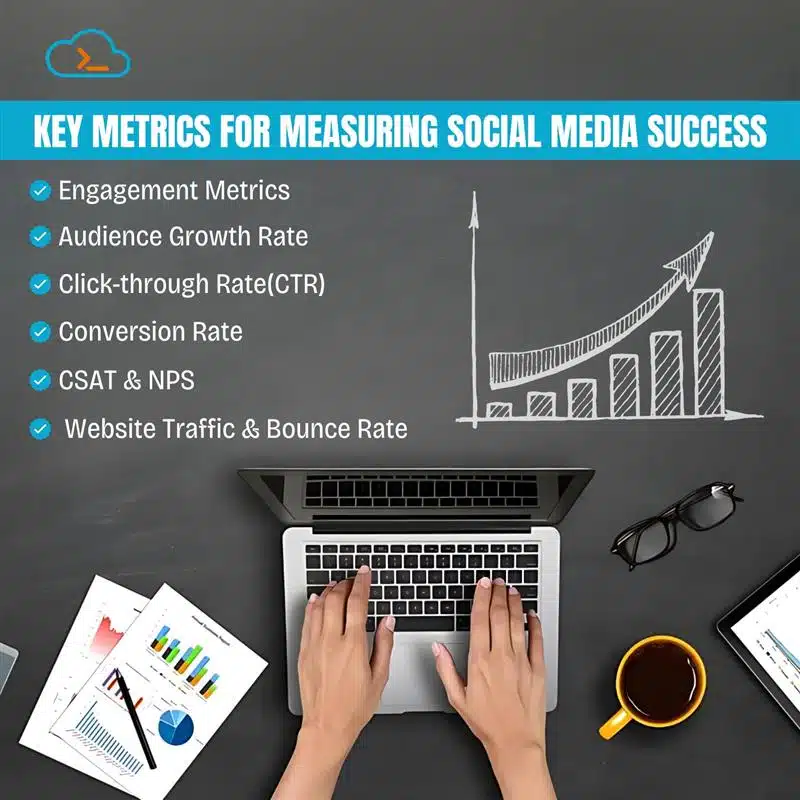
Key Metrics for Measuring Social Media Success

To effectively measure social media performance, it’s essential to focus on a combination of metrics that provide a comprehensive overview of your efforts. Here are some of the most critical metrics to consider:

  • Engagement Metrics:  These metrics, such as likes, comments, shares, and overall engagement rate, reveal how well the content is resonating with your audience. High engagement indicates that followers are not just seeing your content but interacting with it, suggesting it’s meaningful to them.
  • Audience Growth Rate: Tracking the rate at which your audience grows over time gives insight into whether your reach and influence are expanding. This metric helps estimate the efficiency of the social media plan in attracting new followers and keeping current ones engaged.
  • Click-through Rate(CTR): The CTR measures how often users tap on a link in a social media post, which is a key indicator of how compelling your calls to action are. A high CTR shows that the posts are effectively driving traffic to your landing page, making this an important metric for campaigns focused on conversions.
  • Conversion Rate: Conversion rate is the percentage of unique users who take a desired action, like making a purchase or signing up for a bulletin, after clicking on your post. This metric helps to measure how well the social channels effort aligns with broader business goals, such as lead generation or sales.
  • CSAT & NPS: Metrics like Customer Satisfaction Score (CSAT) and Net Promoter Score(NPS) reflect customer satisfaction and loyalty, providing insight into the quality of interactions your audience has with the brand. These scores are particularly valuable for businesses focused on building long-term relationships with customers.
  • Website Traffic & Bounce Rate: Google Analytics reveals how social media posts drive traffic to your site. The percentile of users who leave after viewing only one page helps gauge the relevance and appeal of your content. A low bounce rate shows engaging content, while a high exit rate suggests areas for improvement.

Our Content Marketing Services are developed to create engaging and valuable content that attracts foot traffic, boosts brand awareness, and enhances customer honesty.

Key Metrics for Measuring Social Media Success

Limitations of Social Media KPIs

While social media metrics provide valuable insights, it’s equally important to be aware of their limitations. This awareness will keep you aware and equipped for any challenges that may arise. While social media metrics provide valuable insights, it’s important to be aware of their limitations:

  • Vanity Metric: Some metrics, such as follower count and likes, may not directly correlate with business outcomes.
  • Platform-Specific Differences: Metrics may vary across different social network media platforms, making it challenging to compare performance.
  • Algorithm Changes: Social platform algorithms can significantly impact the visibility of your content, affecting the accuracy of metrics.
  • Data Quality: Incomplete data can lead to misleading insights.

Leveraging Social Media Analytics Tools

To effectively measure and analyze social media engagement, you can utilize various analytics tools:

  • Platform-Native Analytics: Most social media platforms offer built-in analytics tools.
  • Third-Party Analytics Tools:
  1. Google Analytics: Track web traffic and user behavior.
  2. Hootsuite: Monitor brand mentions, analyze engagement and schedule posts.
  3. Sprout Social: Manage social media, track analytics, and engage with the audience.
  4. Buffer: Schedule posts, analyze performance, and collaborate with team members.

KloudPortal is recognized as the Best Digital Marketing Agency in India. We offer client-specific solutions to enhance your brand’s visibility and drive online success.

Key Takeaways

  • Focus on metrics like engagement rate, CTR, and conversion rate to assess your social media strategy and meet business goals. 
  • Differentiate between actionable metrics (e.g., website traffic, NPS) that drive meaningful results and vanity metrics (e.g., likes, follower count) that may not reflect real value.
  • Leverage tools like Google Analytics, Hootsuite, or Sprout Social for tracking, insights, and strategy refinement.

Conclusion

Understanding these metrics and their limitations can help you effectively assess and improve your social media effectiveness. Consistently tracking and evaluating your data can also help you make data-driven decisions that drive business development and success. By integrating these insights with a strong focus on audience understanding, brand messaging, and market positioning, companies can shape a social media strategy that not only achieves immediate goals but also fosters long-term success and deeper audience connections.

Frequently Asked Questions

1. What are the most critical social media metrics for new businesses?

New businesses should focus on awareness metrics, engagement rate, and follower growth to build a strong brand presence.

2. Can metrics measure customer loyalty effectively?

Metrics like NPS and CSAT are useful indicators of loyalty, while consistent engagement and repeat interactions are also valuable indicators.

3. Why are some metrics considered “vanity metrics”?

Vanity metrics, like follower count, offer a surface view of reach but don’t necessarily reflect audience engagement or content effectiveness.

AI In Website Design: Pros And Cons

AI In Website Design: Pros And Cons

Aparna Sushumna

Artificial intelligence in website design and development integrates machine learning techniques and advanced algorithms that streamline and enhance the entire design process. By leveraging AI, designers can automate repetitive tasks, gain insightful data-driven recommendations, and create more personalized user experiences. This technology not only speeds up the workflow but also improves the overall quality and functionality of websites, making them more intuitive and engaging for users. AI-powered tools and platforms can analyze user behavior, generate design elements, and optimize user interfaces. AI in web development can improve efficiency, reduce costs, and enhance user experience.

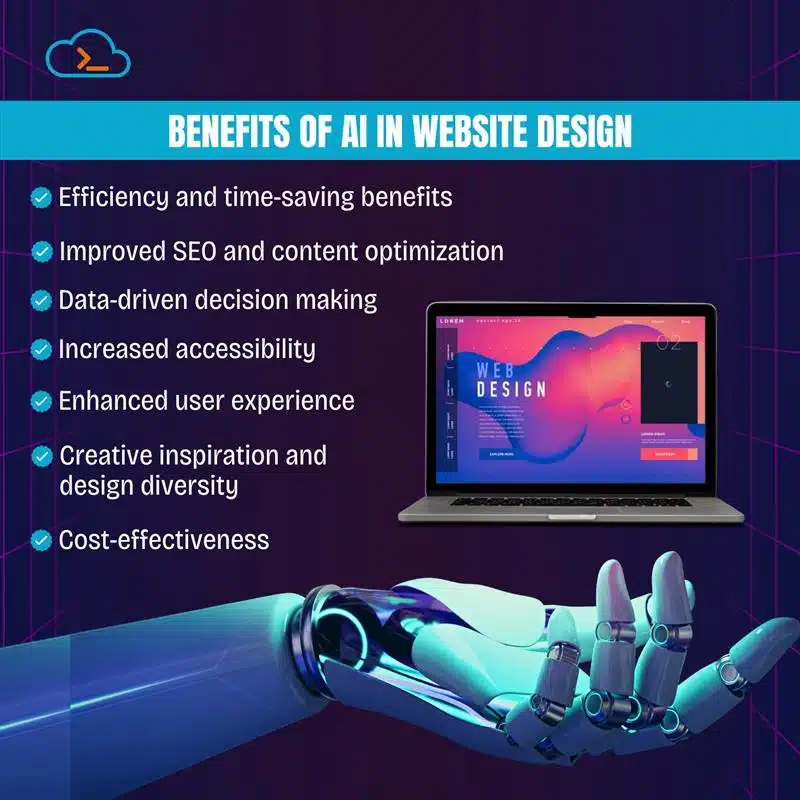
Benefits Of AI in Website Design

AI is transforming website building and design by bringing efficiency, creativity, and personalization to the forefront. Here are some key benefits:

1. Efficiency and time-saving benefits

AI enhances web design by automating repetitive tasks like layout creation, code generation, and content population, allowing designers to focus on high-level creative work. AI-powered tools streamline processes, improve efficiency, and reduce manual effort, resulting in quicker project turnarounds. Additionally, AI-driven platforms accelerate prototype creation, enabling faster testing and iterative cycles.

2. Improved SEO and content optimization

AI can assist with generating content ideas, layouts, and keyword suggestions that boost SEO, making sites more discoverable and engaging. AI can automatically tag multimedia elements and create blog posts with relevant keywords, ensuring they’re accessible and optimized for search engines. Content marketing services integrate AI-based solutions with content creation that help brands promote their product.

3. Data-driven decision making

AI can process vast amounts of user interaction data, providing valuable insights into which design elements work best. This helps designers make informed decisions based on real-world usage rather than guesswork. Some AI tools can autonomously test design variations and refine layouts to maximize user engagement.

4. Increased accessibility

AI can create responsive designs and adaptive interfaces that adapt to individual users’ needs, including those with disabilities. For instance, it can suggest design elements optimized for screen readers or users with color blindness. AI enables more inclusive designs by supporting voice commands, gestures, and other non-traditional inputs.

5. Enhanced User Experience

AI analyzes user patterns, behavior, and preferences to provide personalized recommendations and content. AI-powered tools can optimize user interfaces and enhance user engagement. AI can improve search engine optimization, website usability, data privacy, and accessibility and enables hyper-personalization and context-aware experiences.

6. Creative inspiration and design diversity

AI tools can suggest color schemes, layouts, or design elements based on a brand’s style and user preferences, giving designers fresh ideas and accelerating creativity. AI can analyze brand guidelines and ensure that all elements of content creation on a site maintain a cohesive look and feel across all pages.

7. Cost-effectiveness

AI in web design reduces the need for large design teams by automating routine tasks, making it a cost-effective solution for businesses of all sizes. With AI managing repetitive work, design and development teams can work more efficiently, optimizing time and resources without compromising quality. Ultimately, AI empowers designers to work smarter, combining speed, creativity, and data-driven insights to enhance the design process.

Benefits of AI in Website Design

Challenges of AI in Website Design

Though generative AI creates an edge in web design, this transformation has its drawbacks.

a. Technical Limitations

AI algorithms may struggle with complex design requirements and technical limitations. AI-powered tools may require significant upfront investment and resources. AI may have practical limitations in terms of customization and personalization of user queries. AI and the latest tools may require continuous learning and adaptation to stay relevant.

b. Creative Limitations

AI-generated designs and concepts may lack the creativity and originality of human designers. AI may struggle to understand human emotions and nuances. AI may not be able to replicate the human touch and intuition. AI may require some human input and oversight to ensure design integrity.

c. Dependence on Data Quality

AI algorithms rely heavily on high-quality data for accurate and fair design recommendations. If the data is poor—meaning it has mistakes, is incomplete, or is biased—it can lead to unreliable or unfair design recommendations. To ensure optimal outcomes, continuous refinement, updates, and quality data are essential, enabling AI to adapt to changing trends and user behavior effectively.

Future of AI in Website Design

The Role of Human Designers in AI-Powered Design

Human designers play a crucial role in AI-powered design, providing creative direction, data analysis, and oversight of machine learning algorithms. They can also work alongside AI tools to enhance and refine design recommendations. Human designers can ensure that AI-generated designs meet brand identity and user experience requirements and provide emotional depth and resonance to AI-generated designs.

Evolving role of AI in web design

AI is estimated to take central control in web development, automating repetitive tasks and enhancing personalization. AI will optimize user experiences and improve efficiency in web design. AI will create more innovative and creative designs for expert web developers. AI will revolutionize the web design industry.

Strategies to integrate AI along with human creativity

Designers should view AI as a tool to augment their human creativity. AI should inform creative decisions, not replace human intuition. Human oversight is essential to ensure design integrity and user-centricity. The integration of humans and machines is key to further effective AI integration.

Best Practices for Implementing AI in Website Design

Start with clear goals and objectives for AI integration. With the assistance of the best digital marketing agency in India in India, choose the right AI tools and platforms for your needs. Ensure high-quality data for accurate design recommendations. Provide human oversight and creative direction. Continuously refine and update AI algorithms to adapt to changing trends and user preferences.

Key Takeaways

  • Several AI platforms are emerging to automate web design and improve the quality and performance of websites in general.
  • AI in web development can improve efficiency, reduce costs, and enhance user experience.
  • AI platform offers users a variety of prebuilt templates and an extensive set of automated features.

Conclusion

AI in website design offers benefits such as efficiency, time savings, and enhanced user experience. However, AI in website performance also presents challenges such as technical limitations, ethical concerns, creative limitations, and dependence on data quality. Human and AI collaboration is essential for effective AI integration. The future of AI in website design is promising, with predictions of increased automation, personalization, and innovation. Best practices for implementing AI in website design include starting with clear goals, choosing the right tools, ensuring high-quality data, providing human oversight, and continuously refining and updating AI algorithms.

Frequently Asked Questions

Is AI good for websites?

Yes, AI is beneficial for websites. Though implementing an effective AI strategy requires careful planning, creativity and expertise, the rewards are substantial.

How will AI affect web design?

AI will transform web design by enhancing tools that shape a website’s look, layout, and user experience, making it a powerful force in redefining industry standards.

We use cookies to ensure that we give you the best experience on our website. If you continue to use this site we will assume that you are happy with it.

Cookies settings
Accept
Privacy & Cookie policy
Privacy & Cookies policy
Cookie name Active

Privacy Policy

What information do we collect?

We collect information from you when you register on our site or place an order. When ordering or registering on our site, as appropriate, you may be asked to enter your: name, e-mail address or mailing address.

What do we use your information for?

Any of the information we collect from you may be used in one of the following ways: To personalize your experience (your information helps us to better respond to your individual needs) To improve our website (we continually strive to improve our website offerings based on the information and feedback we receive from you) To improve customer service (your information helps us to more effectively respond to your customer service requests and support needs) To process transactions Your information, whether public or private, will not be sold, exchanged, transferred, or given to any other company for any reason whatsoever, without your consent, other than for the express purpose of delivering the purchased product or service requested. To administer a contest, promotion, survey or other site feature To send periodic emails The email address you provide for order processing, will only be used to send you information and updates pertaining to your order.

How do we protect your information?

We implement a variety of security measures to maintain the safety of your personal information when you place an order or enter, submit, or access your personal information. We offer the use of a secure server. All supplied sensitive/credit information is transmitted via Secure Socket Layer (SSL) technology and then encrypted into our Payment gateway providers database only to be accessible by those authorized with special access rights to such systems, and are required to?keep the information confidential. After a transaction, your private information (credit cards, social security numbers, financials, etc.) will not be kept on file for more than 60 days.

Do we use cookies?

Yes (Cookies are small files that a site or its service provider transfers to your computers hard drive through your Web browser (if you allow) that enables the sites or service providers systems to recognize your browser and capture and remember certain information We use cookies to help us remember and process the items in your shopping cart, understand and save your preferences for future visits, keep track of advertisements and compile aggregate data about site traffic and site interaction so that we can offer better site experiences and tools in the future. We may contract with third-party service providers to assist us in better understanding our site visitors. These service providers are not permitted to use the information collected on our behalf except to help us conduct and improve our business. If you prefer, you can choose to have your computer warn you each time a cookie is being sent, or you can choose to turn off all cookies via your browser settings. Like most websites, if you turn your cookies off, some of our services may not function properly. However, you can still place orders by contacting customer service. Google Analytics We use Google Analytics on our sites for anonymous reporting of site usage and for advertising on the site. If you would like to opt-out of Google Analytics monitoring your behaviour on our sites please use this link (https://tools.google.com/dlpage/gaoptout/)

Do we disclose any information to outside parties?

We do not sell, trade, or otherwise transfer to outside parties your personally identifiable information. This does not include trusted third parties who assist us in operating our website, conducting our business, or servicing you, so long as those parties agree to keep this information confidential. We may also release your information when we believe release is appropriate to comply with the law, enforce our site policies, or protect ours or others rights, property, or safety. However, non-personally identifiable visitor information may be provided to other parties for marketing, advertising, or other uses.

Registration

The minimum information we need to register you is your name, email address and a password. We will ask you more questions for different services, including sales promotions. Unless we say otherwise, you have to answer all the registration questions. We may also ask some other, voluntary questions during registration for certain services (for example, professional networks) so we can gain a clearer understanding of who you are. This also allows us to personalise services for you. To assist us in our marketing, in addition to the data that you provide to us if you register, we may also obtain data from trusted third parties to help us understand what you might be interested in. This ‘profiling’ information is produced from a variety of sources, including publicly available data (such as the electoral roll) or from sources such as surveys and polls where you have given your permission for your data to be shared. You can choose not to have such data shared with the Guardian from these sources by logging into your account and changing the settings in the privacy section. After you have registered, and with your permission, we may send you emails we think may interest you. Newsletters may be personalised based on what you have been reading on theguardian.com. At any time you can decide not to receive these emails and will be able to ‘unsubscribe’. Logging in using social networking credentials If you log-in to our sites using a Facebook log-in, you are granting permission to Facebook to share your user details with us. This will include your name, email address, date of birth and location which will then be used to form a Guardian identity. You can also use your picture from Facebook as part of your profile. This will also allow us and Facebook to share your, networks, user ID and any other information you choose to share according to your Facebook account settings. If you remove the Guardian app from your Facebook settings, we will no longer have access to this information. If you log-in to our sites using a Google log-in, you grant permission to Google to share your user details with us. This will include your name, email address, date of birth, sex and location which we will then use to form a Guardian identity. You may use your picture from Google as part of your profile. This also allows us to share your networks, user ID and any other information you choose to share according to your Google account settings. If you remove the Guardian from your Google settings, we will no longer have access to this information. If you log-in to our sites using a twitter log-in, we receive your avatar (the small picture that appears next to your tweets) and twitter username.

Children’s Online Privacy Protection Act Compliance

We are in compliance with the requirements of COPPA (Childrens Online Privacy Protection Act), we do not collect any information from anyone under 13 years of age. Our website, products and services are all directed to people who are at least 13 years old or older.

Updating your personal information

We offer a ‘My details’ page (also known as Dashboard), where you can update your personal information at any time, and change your marketing preferences. You can get to this page from most pages on the site – simply click on the ‘My details’ link at the top of the screen when you are signed in.

Online Privacy Policy Only

This online privacy policy applies only to information collected through our website and not to information collected offline.

Your Consent

By using our site, you consent to our privacy policy.

Changes to our Privacy Policy

If we decide to change our privacy policy, we will post those changes on this page.
Save settings
Cookies settings